







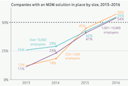
Within two years, more than 50 percent of organizations will have a machine-to-machine (M2M) project in the field, according to a latest annual report from Vodafone, which in cooperation with Machina Research and Circle Research studied global uptake of the technology.
Across all regions and industries, 22 percent of organizations have adopted M2M—an 80 percent increase from last year, the study found. The key trends between last year’s report and this one were a shift from internally focused projects to external ones, growing concerns around security, and a clearer picture of the type of organizations that are more prone to succeed with M2M.
“Some companies are starting with internal-based projects, to get comfortable keeping security concerns in check,” Andrew Morawski, Vodafone’s head of M2M in the Americas, told eWEEK. “As they feel comfortable, they move to bigger, external deployments. And that’s where it really gets interesting.”
Beginning with internal deployments also reduces the risk of disruption to mission-critical processes, plus it’s easier to measure ROI, said the report, adding that Vodafone refers to such deployments as “first-generation M2M.”
Within three years, 75 percent of organizations with internal deployments will transition to external-facing ones, the report also stated, explaining the two can also blur. For instance, a company may use a fleet-management technology for internal insights into its vehicles and efficiency, but the same solution could be used to offer customers a real-time view of when a delivery driver, or field service worker, will arrive at their homes.
While the first wave of M2M solutions focused on business efficiencies, the second wave will be more about implementing business strategies.
“This will require a more considered approach from the buyers, hence the relatively lower prevalence of externally focused M2M initiatives today,” said the report. “However, it will have a much more significant impact on how the company does business in the future.”
Among the industries with the highest M2M adoption rates are automotive, consumer electronics, energy and utilities, and health care.
In the automotive industry, connected car services are being sold as packages—for “remote maintenance to infotainment and safety services,” said the report—though regulations are also driving M2M-based safety and security applications, such as the eCall program in Europe, which calls for emergency help following a crash.
The consumer electronics industry has one of the highest adoption rates of external-facing strategies (71 percent). A portion of this includes tracking devices in shipping containers, but 20 percent of the companies surveyed said they’re also selling connected devices directly to consumers.
In the utilities sector, 21 percent of companies surveyed said they’re looking at asset-tracking solutions, while 20 percent have adopted smart grid and smart metering solutions (in some instances nudged by regulatory demands) and 17 percent have adopted smart home and office solutions, which include heating and cooling and security systems.
Among health care organizations, 14 percent said they have internal remote monitoring solutions while around 10 said they’re already adopting patient-facing solutions—an area expected to grow as home management of chronic conditions becomes more popular.
“Anywhere in the Americas, where there’s an aging population, that’s where we’re seeing tremendous amounts of growth,” said Morawski, highlighting Brazil in particular.
Vodafone found adoption in Africa (27 percent now have a solution in place, compared with 12 percent last year), the Middle East and the Asia-Pacific (21 percent, versus 11 percent in 2013) to be outpacing adoption in the Americas (17 percent, versus 13 percent). But in the Americas, Brazil is, again, an overall growth market.
“In Brazil, a lot of the interest is around insurance—asset tracking, automotive tracking, anything tied to security is going to be very big,” said Morawski.
Further, in all markets, businesses of all sizes stand to gain from M2M, Vodafone found.
“It works both ways,” Morawski explained. “Smaller companies are using M2M to be more innovative and compete with large companies, and large companies are using it to lower their cost base and compete with smaller, more nimble players.”
He added, “The thing I was most pleased to see in the report is that 98 percent of respondents said they’re seeing a return on investment. I come from a fixed-line background, and that’s not what you see there.”