







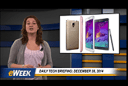
Samsung announced on Dec. 28 what it called its fastest-ever smartphone, the new Galaxy Note 4 phablet with built-in 4G LTE Advanced capabilities.
The device allows users to get download speeds up to 300MBps, which is four times the speed potential of existing LTE smartphones.
The latest Note 4 gets its higher speed capabilities through Tri-Band Carrier Aggregation, which allows the phone to receive three different signal frequencies over different bandwidths and then combine them together, giving users the combined speed potential for their needs, according to Samsung.
The Chinese smartphone company Xiaomi just brought in another $1.1 billion in funding, according to a Dec. 29 story by Forbes, as it continues to expand to take on the heavyweights in the worldwide smartphone marketplace. The 5-year-old company is now being valued at some $45 billion.
Yuri Milner, the Russian billionaire investor who controls the DST Global investment company, told Bloomberg that he believes that Xiaomi’s valuation could even hit $100 billion in the future, based on its successes so far and on its new funding.
The WordPress blogging and content management system has now taken a large step forward to help reduce the risk of security breaches through out-of-date and unpatched software by providing automatic updates for plug-ins.
With Jetpack 3.3, site administrators can now choose to enable automatic updates for any plug-in that runs on a WordPress site, or even across a group of WordPress sites. The inclusion of automatic plug-in updates for WordPress follows Automattic’s acquisition of security technology vendor BruteProtect in August.
Microsoft’s Xbox Live service and Sony’s PlayStation Network were effectively knocked offline on Dec. 25 after a distributed denial-of-service attack rendered them unreachable.
Groups that stage DDoS attacks typically marshal the resources a multitude of computers operating in botnets, to flood online services with traffic to overwhelm their servers. DDoS attacks are a constant worry for online companies today. Lizard Squad, a hacking group suspected of having a role in recently disconnecting North Korea from the Internet, claimed responsibility for the attacks.