







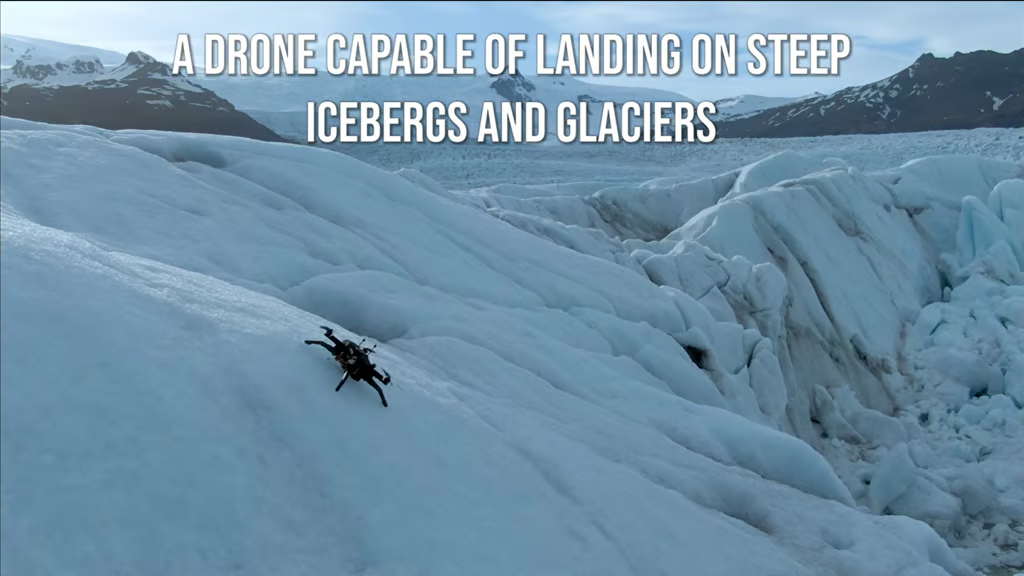
A drone designed to land where ordinary quadcopters cannot has successfully perched on steep glaciers and icebergs in Iceland, using retractable spiny feet, shock-absorbing landing gear, and reverse thrust to stay attached to the ice.
Called Ice Dart, the quadcopter was developed by researchers at Université de Sherbrooke. Field tests described by the team included landings on ice slopes of up to 60 degrees, taking the system beyond controlled experiments and onto real glaciers and icebergs.
IEEE Spectrum reported on the Ice Dart project, which is detailed in a January 2026 paper in IEEE Transactions on Field Robotics by Isaac Tunney, John Bass, and Alexis Lussier Desbiens. The researchers describe a landing strategy built around spiny feet, friction-damping landing gear, specialized controls, and reverse-thrust stabilization.
How Ice Dart grips steep ice
Ice Dart’s four legs pivot as the aircraft touches down, while friction shock absorbers dissipate some of the landing force before the spines fully engage. The spines extend as the suspension compresses, giving them a chance to grip the ice after the initial impact has been absorbed.
The approach resembles wall-climbing robots built to operate on surfaces that conventional wheels or feet cannot handle. Reaching the surface is only useful if the machine can stay attached once it gets there.
Reverse thrust adds another layer of stability. Rather than relying only on gravity and the landing gear to settle the aircraft, the motors can help press Ice Dart against the slope while its feet establish a hold.
The researchers say the completed system was validated in controlled experiments and a real-world Iceland expedition, where it landed successfully on ice slopes of up to 60 degrees. Other drone designs have focused on staying useful in fog, rain, and darkness; Ice Dart tackles a different problem by making the landing surface itself part of the engineering challenge.
Landing works, but long-term monitoring is still ahead
Perching could let a drone remain with the same iceberg instead of repeatedly flying over it. That could support longer observations while using less energy than continuous flight, particularly in the Arctic, where researchers want repeated measurements from difficult-to-reach moving targets.
The landing system alone does not establish how long Ice Dart can remain operational on an iceberg or what a full scientific monitoring mission would look like. The published work focuses on reaching and holding steep ice rather than demonstrating extended monitoring in the field.
IEEE Spectrum said the team planned a Canadian Arctic mission for August to land on icebergs, collect data, and help validate ship-based iceberg-detection systems. As of August 20, no public follow-up confirming results from that mission was available.
Ice Dart has already demonstrated the unusual part: a small drone can land and hold on steep natural ice. The next step is proving that foothold can support useful data collection in the field.
Also read: AI coding models helped turn a roughly $100 consumer drone into a facial-recognition tracker, adding person tracking to inexpensive off-the-shelf hardware.