







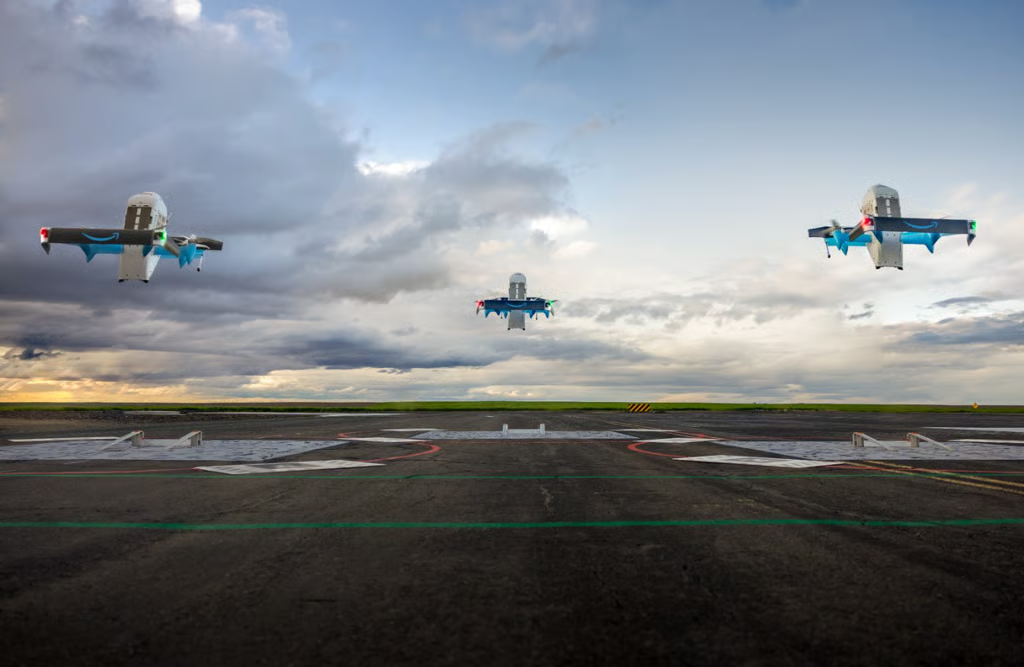
Amazon is preparing its biggest Prime Air expansion yet. The company plans to bring drone delivery to nearly 500 US cities and towns by the end of 2026, roughly six times its current reach.
Chicago, Atlanta, Cleveland, Syracuse and Boise are among the next markets Amazon has announced. But the nearly 500-community target is not a list of locations already cleared for commercial drone service, and individual sites remain subject to federal and local requirements.
The Associated Press reported that Amazon says Prime Air has already delivered hundreds of thousands of packages in 2026. Wider deployment will depend on how quickly its proposed sites move through regulatory review and into operation.
FAA clearances are moving site by site
FAA records distinguish projects that have completed environmental review from those still being evaluated. A Finding of No Significant Impact/Record of Decision, or FONSI/ROD, completes the agency's environmental review for a proposed action but does not represent every authorization required to begin service.
The FAA has completed environmental reviews covering 22 proposed Prime Air centers in Texas, six in Florida, four in the Detroit area and two in the Kansas City area. Chicago remains under review after the public-comment period for three proposed centers closed Aug. 14, 2026.
Additional centers proposed for Baton Rouge and Omaha also remain under review, although Prime Air already operates in those metro areas. Amazon's filings contemplate up to 1,000 MK30 delivery flights per center per day in Chicago, Baton Rouge and Omaha. That figure is a proposed maximum, not an expected daily volume.
The MK30 can carry packages weighing up to 5 pounds and has a maximum operating range of 7.5 miles, creating a potential service area of about 174 square miles around each center. Amazon also received FAA permission in 2024 to operate beyond a remote pilot's visual line of sight using onboard detect-and-avoid technology.
Scaling brings operational pressure
Richardson, Texas, offers an early view of higher-volume operations. Amazon said the site completed more than 13,000 deliveries in its first three months, while Inside Climate News reported that resident complaints prompted changes to flight paths and minimum altitudes.
A Prime Air drone also struck a Richardson apartment building in February 2026. No injuries were reported, but expansion will expose Amazon to more scrutiny over noise, safety and acceptable flight volumes as drones become more common over residential areas.
Amazon's expansion is part of a wider push to automate logistics from warehouses to the last mile. Developers are testing robots handling thousands of packages autonomously, while JD.com is exploring how robots could take on more deliveries. Longer-running systems are also targeting warehouse and logistics work where uptime can determine whether automation makes economic sense.
Amazon's next test is whether markets such as Chicago can move from proposal to operation quickly enough to support its year-end target. Reaching nearly 500 communities would expand commercial drone delivery substantially, but regulatory approvals, operating economics and local acceptance will determine how much of the planned network becomes permanent.
Read more: That economics question extends inside fulfillment centers, where new warehouse robots are targeting 20-hour workdays to squeeze more productive time from each machine.