








- Enterprise Data Mobility Initiatives: 10 Tips for a Successful Rollout
- Decide which Business Processes to Mobilize
- Prioritize Back-end Connectivity
- Identify the Mobile Platforms You Need to Support
- Select the Mobile Architecture That Will Work Best for Each App
- Choose Development Approaches, Tools That Match Your Objectives
- Make the User Interface Design a Group Decision
- Establish Required Security Levels and Policies
- Determine How You Will Deploy, Monitor and Guarantee the Service Level of the App
- Finalize Your Implementation Strategy
- Get Started Immediately
Enterprise Data Mobility Initiatives: 10 Tips for a Successful Rollout

by Chris Preimesberger
Decide which Business Processes to Mobilize
The first thing you need to do is focus on the business value, not the technology, user interface, or development tools. Prioritize apps that can provide the quickest ROI. Decide if you want first to mobilize existing processes or create new processes for mobility.
Prioritize Back-end Connectivity
To add value, a mobile app needs to interact with business data and processes. Therefore, correct integration with your enterprise systems is of critical importance. IT must determine the best way to connect to back-end systems that will provide the security, scalability, speed and performance expected of business apps.
Identify the Mobile Platforms You Need to Support
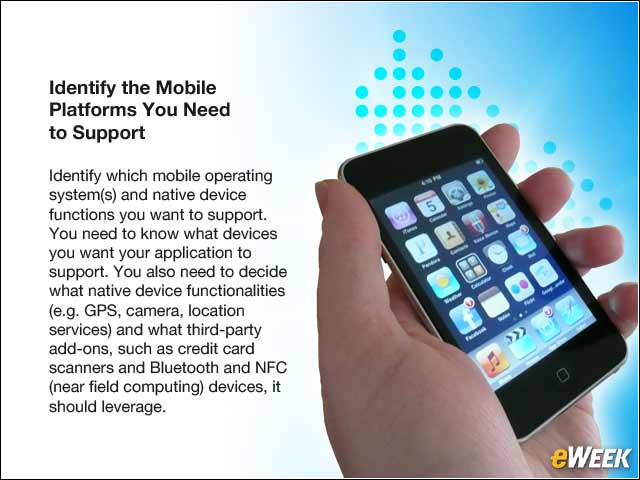
Identify which mobile operating system(s) and native device functions you want to support. You need to know what devices you want your application to support. You also need to decide what native device functionalities (e.g. GPS, camera, location services) and what third-party add-ons, such as credit card scanners and Bluetooth and NFC (near field computing) devices, it should leverage.
Select the Mobile Architecture That Will Work Best for Each App
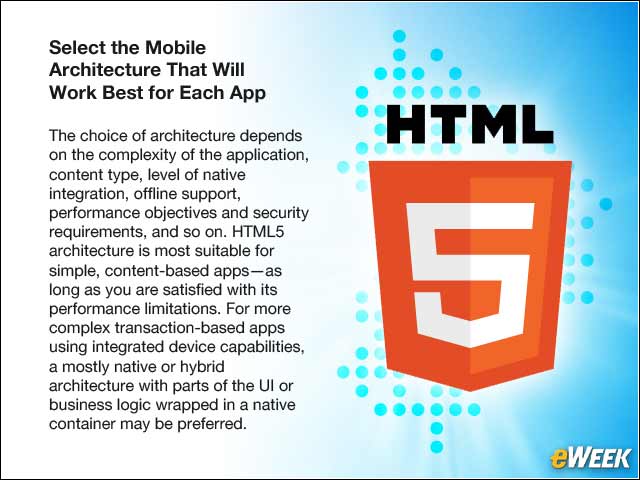
The choice of architecture depends on the complexity of the application, content type, level of native integration, offline support, performance objectives and security requirements, and so on. HTML5 architecture is most suitable for simple, content-based apps—as long as you are satisfied with its performance limitations. For more complex transaction-based apps using integrated device capabilities, a mostly native or hybrid architecture with parts of the UI or business logic wrapped in a native container may be preferred.
Choose Development Approaches, Tools That Match Your Objectives
You can develop for each specific OS or use a cross-channel development platform. Choosing the right approach is important in term of agility, reusability and functionalities. In the majority of cases, multi-channel, code-free development platforms with off-the-shelf and certified adapters to multiple back-end systems (such as Oracle JDE, SAP, Salesforce, Microsoft SharePoint, IBM, legacy, Google, Facebook, and more) offer the greatest value by enabling you to quickly and cost-effectively develop and deploy a wide variety of business apps.
Make the User Interface Design a Group Decision
While mobile enterprises apps do not need the same type of UI as games or other business-to-consumer applications, they still need to be attractive, natural to use and provide an efficient, business-oriented user experience. Many times the developer is also responsible for UI design, which is usually a mistake. Every mobile app project must have a designer that knows user experience, mobile usability and OS capabilities.
Establish Required Security Levels and Policies
Security needs to be considered at the device, application and user levels. Secure communication between mobile device and back-end enterprise systems are just one important factor. So are authentication and access right management, policy management, provisioning, sandboxing, and more. Make sure you have the tools in place.
Determine How You Will Deploy, Monitor and Guarantee the Service Level of the App
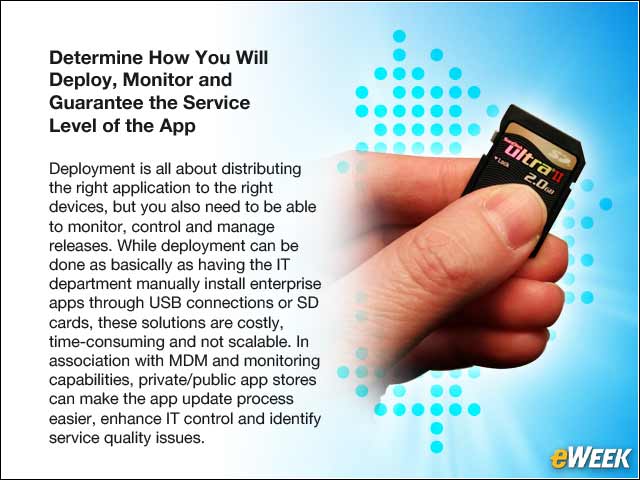
Deployment is all about distributing the right application to the right devices, but you also need to be able to monitor, control and manage releases. While deployment can be done as basically as having the IT department manually install enterprise apps through USB connections or SD cards, these solutions are costly, time-consuming and not scalable. In association with MDM and monitoring capabilities, private/public app stores can make the app update process easier, enhance IT control and identify service quality issues.
Finalize Your Implementation Strategy
Now that you have worked out the approaches and tools you want to use, you need to decide on the implementation methods. Do you want this to be an in-house job or outsourced? Are you starting from scratch or reusing existing assets? In short, what’s the budget and who is going to do the actual implementation?
Get Started Immediately
Enterprise mobility is evolving rapidly. It’s better to get started, even if you have to make changes down the road, than to put it off and risk falling behind. The fact that you’ve looked at the whole picture in advance will help you minimize risk and put you on the most effective and cost-efficient path to enterprise mobility.