







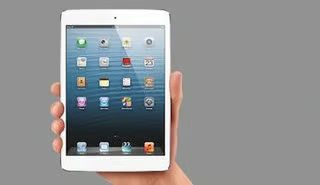
If the small tablet market has had any issues building sales, the reason may well be that no major player has proven it to be a large, sustainable market. With the introduction of the iPad Mini, that’s all changed. The nearly 8-inch tablet shows this is a real market, if only because Apple is now a player.
As was the case with 10-inch tablets, it was the iPad that created the market. While other companies, notably Samsung, have also made their mark, Apple was the standard. Things are a little different over in 7-inch land. There, Samsung is a major player, but Amazon, which launched the hot-selling Kindle Fire for less than $200, is the big seller. Now it’s selling the Kindle HD at that price, complete with a real HD-quality screen. The original Kindle Fire now sells for $159.
So a major question will be whether Apple can charge twice as much for an iPad Mini as Amazon does for a Kindle Fire. This is especially true now that Amazon’s Kindle Fire HD includes that high-definition display. To be better than that, Apple would have to include its Retina display, but that’s not happening. What is happening is that Apple is shipping what is basically a shrunken iPad 2.
But no doubt when the iPad Mini hits the market on Nov. 2, it will sell like hotcakes. Rumors abound that Apple has ordered as many as ten million of the smaller devices from its suppliers, indicating that Apple plans to have huge sales to go along with the hot sales of the iPhone 5.
But what about the rest of the small tablet market? If anything, the iPad will make the 7-inch tablet market stronger. Because the iPad Mini is significantly more expensive than the competition, what it will do is provide a reason for buyers to consider smaller tablets. But many of those buyers, when they see what they can get for a lot less money from Amazon and Samsung (and a lot of other companies) for $250 and less, will decide to save money.
Amazon in particular stands to benefit. Its Kindle Fire HD is designed to be a device for consuming content from Amazon, including movies and video as well as magazines and books. You can do the same thing on the iPad with the already-available Kindle software. In other words, Amazon wins when people decide to go with the Kindle Fire HD because of its beautiful screen and much lower price, thus tying themselves to Amazon’s ecosystem.
iPad Mini Validates 7-Inch Tablet Market Despite Apple’s High Prices
But Amazon also wins when people use Amazon’s Kindle app to buy Amazon content, which a lot of people will do, if only because the Kindle software is more flexible, and because users can share the same content across a wide variety of devices from smartphones to desktop computers. You can share Apple’s iBooks content with other iOS devices. But there’s no iBooks app for Android, BlackBerry, Windows Phone and probably not for the new Surface tablet, which Microsoft will ship before the iPad Mini.
For its part, Apple has also announced a new version of iBooks that’s designed to siphon some readers from Amazon. But iBooks still just runs on iOS, so despite the fact that it looks like a nice app, it’s also at a competitive disadvantage. However, Apple is also going full tilt at the education market and as a result will offer a lot of textbooks as part of the iBooks library. The iPad Mini will probably appeal to the education market if only because it’s a lot cheaper than the fourth-generation iPad.
That fourth-generation iPad is an upgrade to the third generation iPad that was announced in March 2012. It has a faster processor, a better screen, faster WiFi and expanded LTE capabilities. It will replace the third-generation iPad in the lineup, and it will cost the same. The iPad 2 will continue to be available.
So what will consumers do? The iPad Mini looks hard to beat. Despite its high price, the Mini offers a lot and while it’s a better tablet than the iPad 2, it’s not a fourth-generation iPad in a smaller version. Apple has created a new version of the form factor with an aluminum case that allows very thin bezels, resulting in a larger screen than other tablets in the 7-inch market. The device itself is also a lot thinner than most and it’s light. The case allows Apple to deliver a tablet weighing 0.68 pounds that’s 7.9 millimeters thick. But it still has that 1024 x 768 resolution from the iPad 2, although with a smaller screen it looks better.
On the other hand, the Kindle Fire HD has a better screen, Amazon has a full application and content ecosystem similar to (but not as large as) Apple’s. And it costs $140 less. It’s going to be tough to choose. But in the meantime, Apple’s entry into this part of the market has added a level of legitimacy that it needed. Apple, as a result, may be the rising tide that lifts all boats.