








- J.D. Power Finds Consumers Relying on Smartphones for Mobile Purchases
- Wireless Customers More Satisfied Buying Things on Smartphones
- Customers Report Purchases Are Faster on Smartphones too
- But Wireless Costs Are Rising
- T-Mobile’s the Top Performer in Wireless Purchasing
- AT&T Came in Second
- Verizon Falls Behind the Industry Average
- Sprint Trails Far Behind
- The Top Non-Contract Full-Service Carrier
- The Top Non-Contract Value Carrier
- Other Non-Contract Takeaways
J.D. Power Finds Consumers Relying on Smartphones for Mobile Purchases
In a study of the U.S. wireless purchase experience, researcher J.D. Power discovered that during the last six months of 2017, the typical customer purchasing experience varied considerably among users who bought mobile devices through wireless services providers compared to similar purchases made on tablets or personals computers. “The wireless market is rapidly evolving into a self-contained ecosystem in which all aspects of the ownership experience, from buying the device to engaging with customer support, is done entirely on a mobile device,” Peter Cunningham, Technology, Media, and Telecommunications Practice Lead at J.D. Power stated in releasing the study results. This slide show will cover the details of the J.D. Power findings, which are derived from survey responses from more than 13,000 people who purchased something from a wireless carrier at the end of 2017.
Wireless Customers More Satisfied Buying Things on Smartphones

According to the data collected by J.D. Power, consumers are generally more satisfied with wireless purchases when they make them on smartphones instead of desktops or tablets. Overall customer satisfaction on smartphone purchases had a rating of 857 out of a possible 1,000 in the study, topping the 823 points awarded to Web-based purchases on a desktop or tablet.
Customers Report Purchases Are Faster on Smartphones too
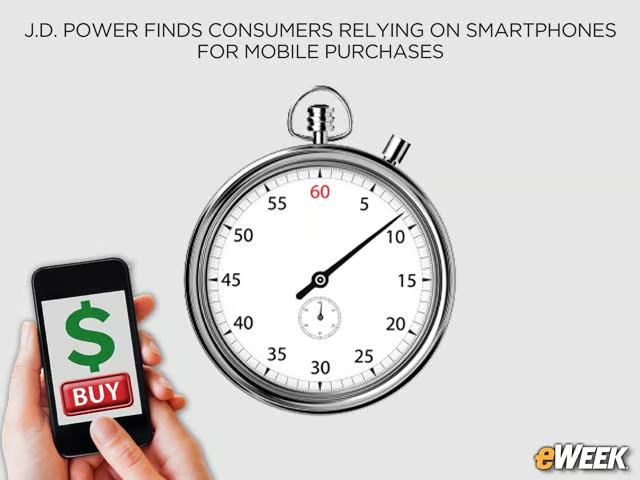
Wireless customers reported that it takes an average of 10.6 minutes to complete purchases on a new smartphone or tablet through their wireless carries compared to 13.7 minutes when they make the same purchases on a desktop or other type of computers. Consumers found that buying products on mobile devices provided easier navigation with better “website attributes,” according to J.D. Power.
But Wireless Costs Are Rising
Although customers seem generally pleased with the wireless purchase experience, they’re also finding that their costs are rising. The average American wireless customer now pays $364 for a smartphone, up from $308 in early 2017, according to J.D. Power. The average monthly service bill is now $157, up from $149.
T-Mobile’s the Top Performer in Wireless Purchasing
T-Mobile reigns supreme in J.D. Power’s study of the best full-service carrier wireless purchasing experiences. T-Mobile earned a rating of 855 out of a possible 1,000 in the study. It earned five “power circles” from J.D. Power—all other full service carriers earned three power circles or fewer.
AT&T Came in Second
AT&T landed in the second spot in J.D. Power’s analysis of wireless purchasing experiences among full-service carriers with a score of 839 out of a possible 1,000. It barely topped the industry average of 838.
Verizon Falls Behind the Industry Average
Verizon placed in third in the J.D. Power study. The carrier nabbed a score of 833 out of a possible 1,000, earning it three power circles. It was also slightly behind the industry average of 838.
Sprint Trails Far Behind
Sprint was the worst-performing full-service carrier in the J.D. Power study. The carrier, which has faced its fair share of challenges competing against the other three, earned a score of 819 in the study. With that score, Sprint was behind every other non-contract carrier, as well.
The Top Non-Contract Full-Service Carrier
In J.D. Power’s analysis of non-contract full-service carriers that offer handsets and service, MetroPCS took the top spot with a score of 858 out of a possible 1,000. It topped Boost Mobile’s score of 853.
The Top Non-Contract Value Carrier

In its analysis of non-contract value carriers that offer low-cost wireless service, Consumer Cellular earned the highest wireless purchase experience score of 866. That was enough to place the small carrier above all others in the industry, including T-Mobile and MetroPCS.
Other Non-Contract Takeaways
Overall, non-contract carriers appear to be providing a more appealing consumer purchase experience than traditional carriers. The average non-contract full-service carrier earned a score of 851—a higher score than AT&T, Verizon, and Sprint. The worst-performing non-contract full-service carrier, Virgin Mobile, scored 833 in the study. The worst performer in that category, Straight Talk, received a score of 826, which still beat Sprint.