







Microsoft is taking an unconventional approach to wearable tech compared to its rivals.
Google has Google Glass, the company’s app-enabled smart glasses technology. Samsung offers the Galaxy Gear 2 smartwatch, which links with the company’s smartphones. Apple, meanwhile, is rumored to be gearing up to for the release of a fitness and health monitoring “iWatch,” possibly as soon as this fall.
Rather than launch a new wearable tracker or smartphone companion, Microsoft is taking its cues from the world of fashion and teaming up with a clothing designer to produce pants that can wirelessly charge smartphones. As it turns out, it’s not the company’s first brush with the stylish industry.
“We have a proud history of working within fashion, having previously collaborated with Bruce Weber and David Bailey, as well as recent partnerships at New York and London Fashion Week,” Adam Johnson, marketing director for Microsoft Mobile in the U.K. and Ireland, said in a statement.
The company collaborated with British designer A. Sauvage for the world’s first pair of wireless charging trousers, according Microsoft. The garment features inductive charging technology from the Nokia DC-50, a device that tops off compatible Lumia smartphones using the Qi wireless charging standard. Microsoft acquired Nokia’s hardware unit for $7 billion in a deal that closed nearly eight months after it was first announced on Sept. 2, 2013.
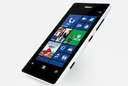
No need to fumble with wires and plug a Nokia Lumia 930 Windows Phone into a power outlet, for example. A user can charge the device by simply placing it on the DC-50. A built-in 2,400mAh battery provides power while on the go.
The same technology, incorporated into the new A. Sauvage pants, makes it possible to slip a smartphone into a pocket and keep it charged as the wearer goes on about the day.
Early images of the pants show a slim-fitting, relatively unornamented design. “As well as having the vision to co-create these amazing wireless charging trousers, [A. Sauvage’s] style complements the cutting-edge design of the new Lumia 930 smartphone perfectly,” said Johnson.
Amazon.com will carry the pants, which will soon be made available for preorder, said Microsoft.
Wireless charging is slowly, but surely gaining market acceptance. Some vehicles, like the new Jeep Cherokee, offer wireless charging pad as an option. This week, Starbucks announced that it had signed on with Duracell Powermat to install wireless charging equipment at the coffee chain’s locations.
Chief Digital Officer Adam Brotman, citing his Starbucks’ early support of in-store WiFi and mobile payments tech, said in a statement that his company “always tried to anticipate our customers’ needs early in the adoption curve and provide a world-class solution.”
Soon, customers will be able to “seamlessly charge their device while enjoying their favorite food or beverage offering right in our stores” instead of hunting for unoccupied power outlets, he added.