








- Elastic Application Platforms Emerge
- Platform as a Service Crosses the Chasm
- Data Services, Virtualization Reach Critical Mass
- Holistic Integration Enables Agile Enterprises
- Social IT Becomes Enterprise Plumbing
- Improved Virtualization Sets Stage for Private Cloud
- Always On, Always Available Is the New Expectation
- Network Architecture Evolves to Meet Cloud Demands
- Personal Device Momentum Changes Mobile-Platform Strategy
- App Internet Ushers in the Next Generation of Computing
Elastic Application Platforms Emerge

This signifies the rise of elastic applications, which represent a fundamentally new architecture to accommodate variable scale. The platform for this class of applications saves money and reduces time-to-market by automatically scaling processor and storage resources up or down, depending on workload.
Platform as a Service Crosses the Chasm

Cloud computing offers instant access to resources for development and testing, enables application deployment in minutes and supports better scaling options. However, if enterprises are to get all these benefits, they need more than just cloud infrastructure. Platform as a service (PaaS) provides application-development tools abstracted from the underlying cloud infrastructure, freeing developers from many of the tedious details with which they would otherwise have to cope.
Data Services, Virtualization Reach Critical Mass

More and more enterprises will incorporate data virtualization technology into their integration toolkits. Leading firms will go further and implement data services to extend their enterprise data warehouse or to operate in a multitechnology environment with a mix of physical and virtual data stores. These companies will realize additional benefits by ensuring that served data is mapped through canonical information models to provide consistency of meaning and form.
Holistic Integration Enables Agile Enterprises
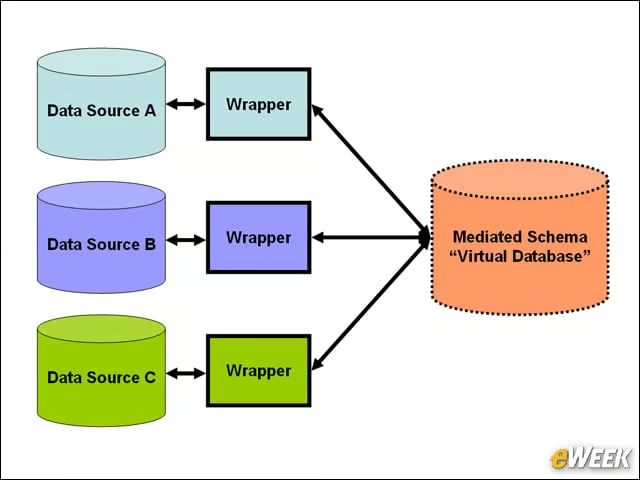
Application, process and data integration efforts evolved over the years into separate silos due to technology limitations. This factor made it difficult to support effective end-to-end integration that encompasses all three. However, this situation is beginning to change with the arrival of more comprehensive tools that address the full range of integration needs.
Social IT Becomes Enterprise Plumbing
Applications now treat social networking as a silo capability, integrating it in as an add-on or afterthought. Tomorrow, social interaction will become part of normal workflows, and applications must be architected from the inception to enable this. In 2011, Forrester found many vendors actively positioning their offerings as ready for social layer integration. Examples include Salesforce.com Chatter extending Core Salesforce CRM processes, Socialtext actively being used in integrated solutions, Yammer integrating with Salesforce CRM and NetSuite, and Tibco tibbr winning acceptance in the market.
Improved Virtualization Sets Stage for Private Cloud

Over the next three years, Forrester expects to see more focus on virtualization maturity to raise utilization rates, standardization and automation, while only a small percentage of enterprises will truly succeed in deploying a real private cloud.
Always On, Always Available Is the New Expectation

In a recent study, Forrester found that many enterprise disaster-recovery and high-availability programs don’t adequately protect against outages and that the majority of companies aren’t prepared for a disaster. Forrester believes a lack of investment of time and money during the recent down economy is the root cause. Over the next three years, Forrester will see increasing attention on building highly available infrastructure that can deliver continuous services to end users by leveraging technology improvements such as cloud-based disaster-recovery services.
Network Architecture Evolves to Meet Cloud Demands
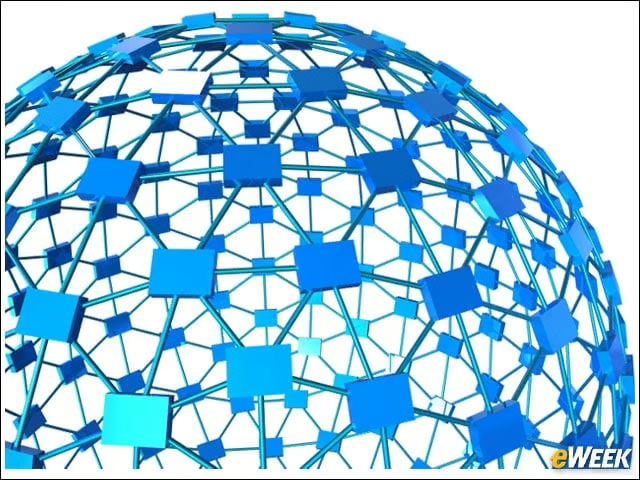
The rise of 10 Gigabit Ethernet in data centers has provided some very big data pipes, but has done little to reduce complexity and deliver more predictable performance. As a result, enterprises are finding that they need to build fundamentally different networks to accommodate advances in server and storage virtualization that pave the path to cloud computing. Today’s traditional multitiered network architectures are giving way to single-tier converged Ethernet fabrics.
Personal Device Momentum Changes Mobile-Platform Strategy

Within the next 12 to 18 months, most IT managers worldwide will significantly alter their client computing strategies, and this will have a profound impact on connected smart-device adoption and management. Necessitating this change is a significant generational shift toward information workers—who are an increasingly empowered group—dictating the technology used to solve business issues.
App Internet Ushers in the Next Generation of Computing
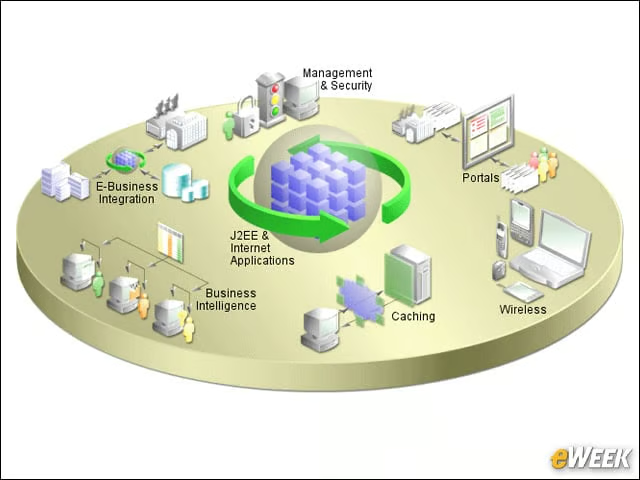
Over the next three years, Forrester expects to see dramatic improvements in the underlying mobile-platform technology to fully enable context-aware and secure application-based mobile computing. HTML5 will compete with platform-specific application development, but the latter will win unless the standards organizations overcome political obstacles quickly.