








How On-Demand Networks Change the Way We Live and Work

by Chris Preimesberger
Video

Whether you are at home using a streaming player like a Roku box or Apple TV, an iPad while commuting on a train, or a mobile phone on the go, people expect a high-quality, disruption-free experience. This could be streaming Netflix original content, user-generated content on YouTube or video calling family and friends on FaceTime or Skype. Most of us don’t have the time to waste waiting for content to load; on-demand networks provide us with the bandwidth when we need it.
Health Care
An advanced telehealth application, telesurgery enables doctors to leverage the latest HD and stereoscopic video technology, state-of-the-art robotics and high-capacity, low-latency networks to perform remote surgical procedures. The round-trip latency from the issuing of a robotic control signal to the resulting video displayed at the surgeon’s site—essentially determines the safety of telesurgery. On-demand service provides network performance to make telesurgery possible.
Marquee Events

Whether watching at home on your HD television or a mobile device, there is nothing more frustrating than to watch a premiere event like the World Cup, Olympics or top music artist performing and see video pixilation. To ensure a high quality of service, video broadcasting companies can set-up a temporary virtual, high-speed network to deliver low-latency HD video and other bandwidth-intensive files. This technology will become even more prudent as 4K Ultra HD TVs take off; they deliver four times as much detail as 1,080p full-HD TVs do, necessitating even more bandwidth.
Shopping
For the fourth consecutive year, Cyber Monday (Dec. 2, 2013) was the heaviest Web-spending day of the year, bringing in $1.4 billion in sales. As more and more people skip the long lines at the malls and shop from home or the office, retailers must prepare for additional online transactions without having to design and build a network that supports peak loads the entire calendar year. On-demand networks provide the resources only when you need it, saving capital and increasing efficiency.
Research
Collaborative learning on a global scale is making waves in the research and education community as a means to connect students and schools at all levels to unique, geographically isolated research content. To learn and share information properly, there must be sufficient lighting, detailed imaging and video data collection systems, which require large amounts of bandwidth versus the alternative: shipping hard drives, a long and arduous process. SDN and other advanced technologies like real-time analytics software applications enable researchers to run trials of new methodologies on a fully operational network, without having to build a unique infrastructure for every use case.
Education

Educators and their students no longer need to be located in the same room. The classroom has become virtual, such as allowing a set of students in Ohio to watch a lesson about marine biology in Massachusetts. An on-demand network makes it easy to use instantaneous video and share large files and to change the traditional classroom-teacher learning model.
Transportation
To alleviate dreaded traffic congestion, on-demand networks can allow cities to provide transportation operations centers with detailed, real-time data on traffic volume, speeds, transit schedule status, evolving weather conditions and other roadway conditions—large sums of data that an over-provisioned or manually reconfigured network could not handle. Transportation agencies can then use the information collected to understand traffic patterns and then reroute traffic to reduce congestion.
eGovernment

To cut costs and make government more efficient, many local jurisdictions are handling voter registration, the issuance of permits, and tax collection and other municipal services online, necessitating a costly network-capacity upgrade. With many preferring to avoid making trips to the town hall, having a network automatically scale to accommodate bandwidth demand, particularly around tax and voter registration deadlines, is key. This also supports the “smart city” concept as a means for cities to lure businesses, young professionals and high-profile events by showing they have an infrastructure that supports today’s bandwidth needs across government services.
Energy
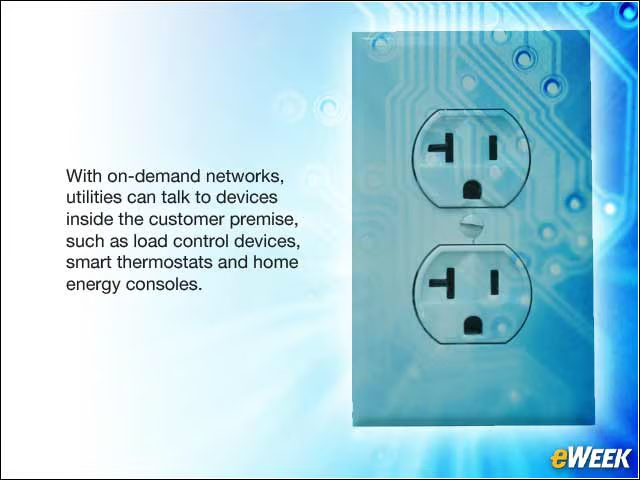
On-demand networks allow utilities to talk to devices inside the customer premise, such as load control devices, smart thermostats and home energy consoles, to reduce peak consumption and minimize costs. This becomes especially important because approximately 10 percent of all electricity generated is lost in the transmission and distribution system, costing consumers about $25 billion annually, according to data from the Environmental Defense Fund.
Public Safety
In some instances, emergency responders have to bring their own smartphones to work to access applications, search databases and share videos. All of this requires a large amount of bandwidth that can overburden public safety networks that don’t have the capacity to support these smartphones. During a major disaster, such as a widespread fire or major hurricane, on-demand networks help facilitate the use of these devices designed to meet public safety requirements and provide a rich set of applications and services that enhance their ability to do their jobs, making all of us safer in the process.