






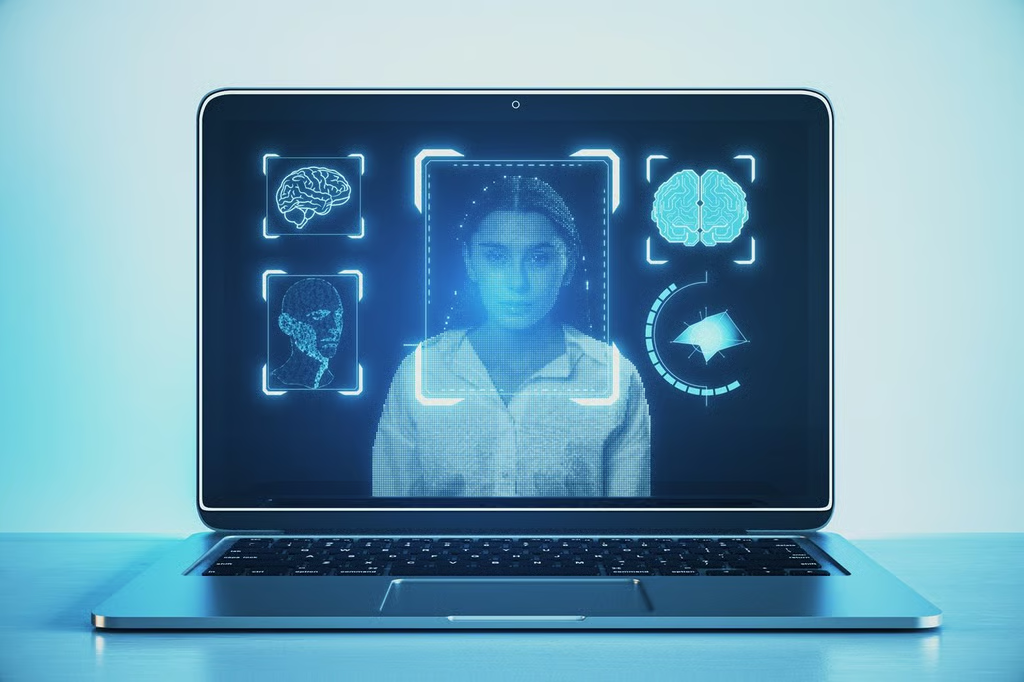


Artificial intelligence has crossed a chilling new threshold, creating death threats so realistic they are fooling law enforcement and terrorizing victims like never before.
Florida Judge Jennifer Johnson received what looked like a Grand Theft Auto-style video game clip. Then she realized it depicted her own murder in graphic detail.
The violent AI-generated video showed an animated attacker following a woman on the street, then killing her with a hatchet and gun while a voiceover stated, “Judge Johnson, let’s bury the hatchet,” according to The New York Times on October 31.
Human nature being what it is, it’s perhaps unsurprising that tech built to make life easier now makes threats sound truer and feel closer. From AI-generated news videos used for blackmail to deepfake assassination simulations targeting judges, criminals are weaponizing everything from voice cloning to fake news broadcasts, creating a new strain of digital terror that is tough to spot and tougher to dismiss.
Fell on black days
Johnson’s case shows how polished these attacks have become. The video did not stop at animated violence, it listed deeply personal details, mentioning “my divorce, my remarriage, my name change, my children, where I live and where I work,” she revealed.
Law enforcement initially dismissed the threat, but it took five months before authorities took it seriously. The perpetrator was eventually convicted and received the maximum 15-year prison sentence.
But Johnson’s experience is only the start. Three weeks ago, a security analysis found that extremist groups are increasingly using AI tools, including chatbots, deepfake imagery and generative content, to automate and amplify disinformation while spurring self-radicalization of lone actors, according to CBS News.
The bulletin warns that as “AI-generated content begins to create increasingly higher-quality images, the line between real and fake blurs,” making false threatening material appear more credible.
Earlier this year, when a Tesla Cybertruck exploded outside Trump International Hotel in Las Vegas, investigators discovered that the attacker allegedly used ChatGPT to gather information about explosives and plan the attack.
Las Vegas sheriff Kevin McMahill stated this was “the first incident that I’m aware of on US soil where ChatGPT is utilized to help an individual build a particular device,” calling it “a concerning moment.”
The years of living dangerously
The tech behind these threats is evolving at breakneck speed. In May, the FBI documented a coordinated campaign involving AI-enhanced smishing and vishing techniques targeting government officials since April.
These attacks use AI-generated voices that are difficult to distinguish between real and fake calls or voicemails, making them particularly effective at building trust before extracting sensitive information.
In March, research from the UK’s Turing Institute revealed “widespread evidence emerging of a substantial acceleration in AI-enabled crime.” Criminal organizations benefit from AI’s capacity to “automate and rapidly scale the volume of criminal activity,” while the technology’s deceptive capabilities align perfectly with human psychological vulnerabilities. The study found this threat “could accelerate at an even faster rate in the next five years” if countermeasures are not “rapidly adopted.”
The scariest part is scale. Criminals now use AI voice cloning to create convincing audio messages, deepfake video technology to simulate realistic footage, and automated tools to gather personal information for more targeted harassment. Research from last year shows that only 61% of participants could distinguish between AI-generated people and real ones, according to the University of Waterloo.
Public profiles, potent perils
The implications extend far beyond high-profile targets. Eight months ago, analysis showed that over 2,200 direct threats against CEOs were identified in just five weeks following a high-profile corporate murder, with executives now facing rising risks from AI-driven disinformation, deepfake attacks, and online harassment, research from Nisos reveals.
Since the beginning of this year, incidents of doxxing and swatting have increased significantly. The growing accessibility of AI tools and automated data scraping technologies has intensified the scale, precision, and anonymity with which these attacks are carried out, investigators found. Automated data scraping tools allow bad actors to assemble personal profiles with minimal effort, while synthetic media including voice cloning and image manipulation enable more convincing false reports.
Law enforcement agencies are struggling to keep pace. UK authorities concluded that “law enforcement is not adequately equipped to prevent, disrupt or investigate AI-enabled crime,” leading to recommendations for a new AI Crime Taskforce. Most concerning, public warnings by the FBI and major media outlets noted the rising use of AI-generated voices in fraudulent emergency calls throughout this year.
The rise of AI-generated death threats represents more than just a technological advancement in criminal methodology, it is a fundamental shift that is making the digital world more dangerous for anyone with a public presence.
Unless response systems catch up, it will get worse before it gets better.
In August, an AI deepfake scam featuring a soap opera star conned a woman out of $431,000.