







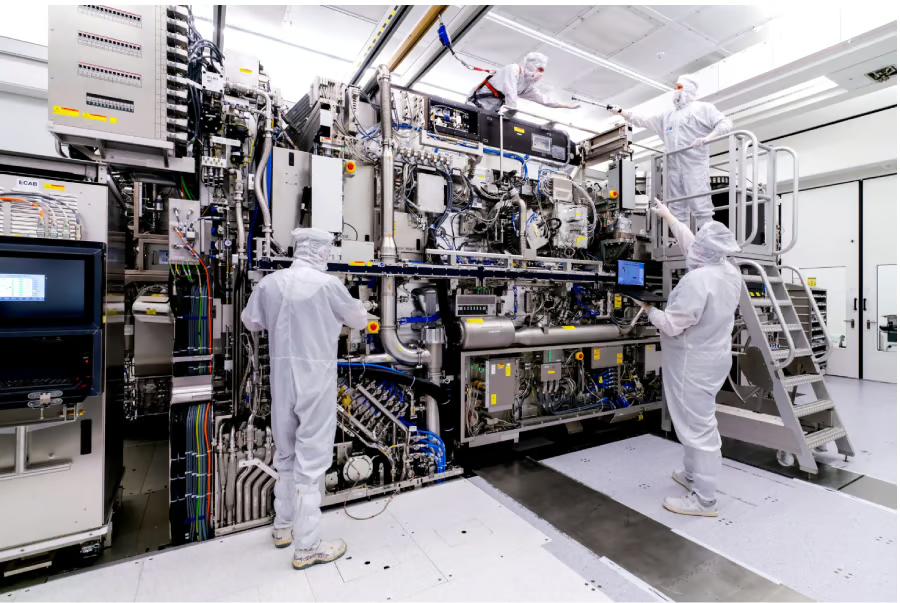
China has started manufacturing domestically developed immersion deep ultraviolet (DUV) lithography machines, marking an important step in its yearslong effort to reduce dependence on foreign semiconductor equipment.
According to a report from The Information cited by Reuters, the first systems are expected to reach major Chinese chipmakers later this year, including Semiconductor Manufacturing International Corp. (SMIC), Hua Hong Semiconductor and ChangXin Memory Technologies (CXMT).
Reuters identified the manufacturer as Shanghai Aishengna Electronic Technology Group, a little-known Chinese state-owned company that is leading the production effort after absorbing teams from top domestic lithography startups, including Yuliangsheng and Shanghai Micro Electronics Equipment (SMEE).
The development comes as the United States and its allies continue tightening restrictions on China's access to advanced chipmaking technology.
A breakthrough, but not yet a replacement
Immersion DUV lithography machines are used to print circuit patterns onto silicon wafers and are currently the most advanced lithography systems available to Chinese chipmakers after export controls blocked access to extreme ultraviolet (EUV) machines.
The Information, cited by Reuters, said the new Chinese-built systems still trail ASML's machines in performance and reliability. The equipment also requires additional testing before it is ready for large-scale production, meaning the Dutch company maintains its technological lead for now.
Production is expected to remain modest, with roughly five machines planned this year and about 20 in 2027. China is also developing a domestic EUV lithography machine, although that project remains at the prototype stage.
Markets react to the report
The report weighed on shares across the semiconductor equipment industry. ASML shares fell more than 7% on Monday after the news, while other companies tied to the global chip equipment supply chain also declined. Reuters reported that BE Semiconductor Industries dropped about 8.5%, Soitec lost 5%, and Infineon Technologies fell nearly 3%.
The market reaction reflects investor concerns that China could gradually replace some imported chipmaking equipment with domestic alternatives if the technology continues to improve.
What this means for the chip industry
The timing is significant because Washington is considering additional restrictions on exporting and servicing foreign lithography equipment in China.
A domestic source of DUV machines could help Chinese chipmakers reduce one of their biggest supply chain risks if access to overseas equipment becomes even more limited. However, limited production capacity and lower performance mean Chinese manufacturers are unlikely to replace imported systems on a broad scale anytime soon.
Nonetheless, China's latest milestone shows that export controls can reshape global competition in unexpected ways. Restrictions may slow access to cutting-edge technology, but they can also accelerate domestic investment in alternatives.
With production expected to remain limited and the technology still undergoing validation, ASML's lead in advanced lithography remains intact. But if China steadily improves these tools over the coming years, the balance of the global semiconductor equipment market could gradually change.
Also read: Huawei says its next smartphone chip could increase transistor density by 55% without moving to a newer manufacturing process.