







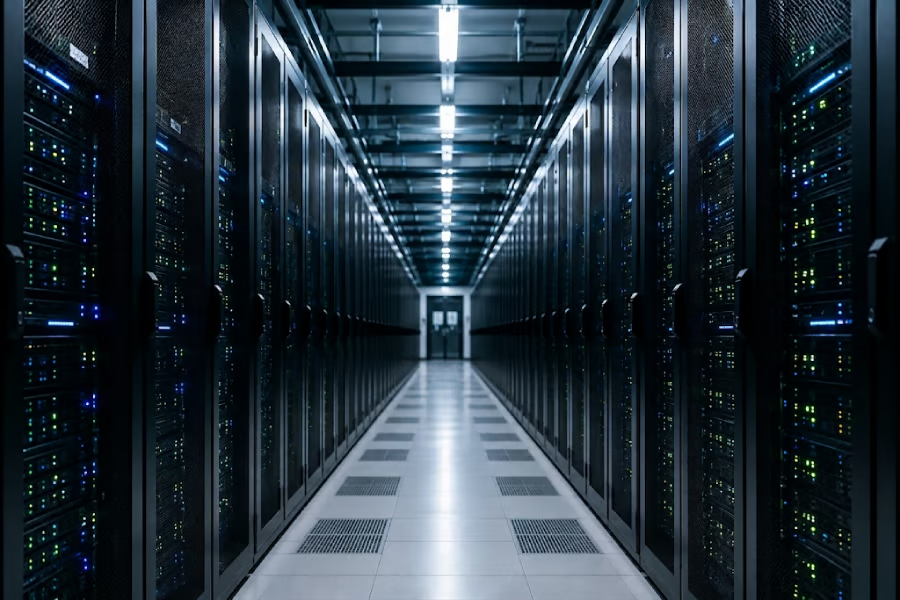
Singapore’s AI ambitions are running into a physical reality: advanced models need somewhere to live.
The city-state has provisionally allocated 200 megawatts of new data center capacity to Digital Realty, Equinix, Keppel Data Centres, and ST Telemedia Global Data Centres, according to an Aug. 21 announcement from the Economic Development Board. Each company received a provisional allocation of 50MW under Singapore’s second Data Centre – Call for Application, or DC-CFA2.
The expansion could give Singapore more room for cloud and high-performance computing infrastructure, which increasingly supports enterprise AI as new capacity is developed. It also highlights how the AI race is spreading beyond models and chips into another increasingly strategic resource: access to power, cooling, connectivity, and data center space.
What eWeek found:
A closer look at Singapore’s data center plans shows the 200MW allocation is part of a much larger infrastructure strategy:
- Singapore already has scale. The country hosts more than 70 data centers totaling roughly 1.4GW of capacity, meaning the newly allocated 200MW is equivalent to about 14% of its current capacity.
- There is room for much more. Singapore has reserved about 20 hectares on Jurong Island for a low-carbon data center park that could eventually support up to 700MW.
- AI is shaping the buildout. Singapore says it is expanding data center infrastructure to meet growing demand from cloud computing, AI, and digital services.
- AI power density is climbing fast. ST Telemedia Global Data Centres is testing an HVDC system at Nanyang Technological University designed to support ultra-high-density server racks exceeding 1MW, illustrating the scale of the power challenge posed by future AI infrastructure.
Taken together, those numbers suggest Singapore is doing more than adding server capacity. It is trying to build an AI-ready infrastructure layer while maintaining tight controls over energy use and sustainability.
The 200MW expansion is only part of the plan
Singapore’s Economic Development Board and Infocomm Media Development Authority selected Digital Realty, Equinix, Keppel Data Centres, and ST Telemedia Global Data Centres for the new capacity.
Each operator received a provisional allocation of 50MW.
Singapore says it is expanding data center infrastructure to meet growing demand from cloud computing, AI, and digital services.
That fits a larger push to make Singapore a regional hub for deploying the technology. Earlier this year, OpenAI committed more than S$300 million to establish its first Applied AI Lab outside the US, in Singapore, focusing on helping businesses and government organizations deploy existing AI systems.
Those applications ultimately depend on infrastructure underneath them. Training models, running inference, managing enterprise data, and operating AI agents at scale all place new demands on computing capacity.
A recent Google Cloud survey highlighted just how quickly those requirements are changing, with 83% of organizations saying their infrastructure needs upgrades to support production-grade agentic AI.
Singapore is putting limits around the AI data center boom
Singapore is not simply opening the floodgates for more server farms.
Singapore has taken a selective approach to new data center capacity since lifting a three-year moratorium in 2022, while balancing rising compute demand with land, energy, and sustainability constraints.
Its Green Data Centre Roadmap aims to provide at least 300MW of additional capacity in the near term, with potentially another 200MW or more unlocked through green-energy deployments. The roadmap also calls for greater energy efficiency across data center hardware and software and increased use of green-energy sources.
Cooling and power delivery are becoming particularly important as racks become denser with GPUs and other AI accelerators.
One example is STT GDC’s FutureGrid Accelerator, an HVDC AI infrastructure testbed at Nanyang Technological University. The project is designed to support ultra-high-density racks exceeding 1MW with higher reliability and lower costs, while STT GDC says HVDC can deliver energy savings of up to 30% compared with alternating-current systems.
Much of Singapore’s future data center expansion is also converging on Jurong Island. The country has reserved roughly 20 hectares there for its largest low-carbon data center park, which could eventually support up to 700MW. Operators can leverage shared energy storage infrastructure and utilities, as well as emerging low-carbon energy sources, on the island.
The four projects selected under DC-CFA2 will also be located on Jurong Island. The Aug. 21 allocation is provisional, meaning the 200MW represents future capacity allocated to the four operators rather than 200MW of data center infrastructure that is already operational.
The approach reflects a dilemma facing governments around the world. AI infrastructure can bring investment, jobs, cloud capacity, and access to advanced computing, but the physical infrastructure supporting it also demands substantial power and increasingly sophisticated cooling and electrical systems.
That buildout is already creating a new labor market. In the US, data center growth is fueling demand for engineers, technicians, electricians, and other infrastructure workers, including roles with six-figure median salaries.
Why 200MW matters for Singapore’s enterprise AI ambitions
Singapore already hosts more than 70 data centers with roughly 1.4GW of capacity, according to the EDB. Adding another 200MW therefore represents roughly 14% of that existing capacity, although the new capacity will not come online all at once.
More importantly, Singapore’s policies increasingly connect future data center growth with AI demand, energy efficiency, and access to lower-carbon power. Under DC-CFA2, proposals were assessed partly on their ability to strengthen Singapore as a trusted hub for AI and data center investment, contribute through areas such as innovation and talent development, and accelerate green-energy adoption.
The four selected projects have also made commitments around green energy and energy-efficient infrastructure as part of the DC-CFA2 process. The government is effectively deciding not only how much infrastructure gets built, but how that infrastructure fits within the country's land and energy constraints.
That could become an increasingly important model as enterprise AI expands. The AI race is no longer only about who can build the most capable model or secure the newest chips. Countries also need enough electricity, cooling, networks, and physical space to run those systems at scale.
Singapore’s next steps will therefore be worth watching. The government has already laid the groundwork for a substantially larger data center footprint on Jurong Island while the country's technology sector tests infrastructure designed for increasingly demanding AI workloads.
For enterprises betting heavily on AI across Asia, the bigger question is how much of that potential capacity Singapore ultimately brings online, and whether its attempt to pair AI-scale computing with tighter energy constraints can become a model for other technology hubs.
Also read: Microsoft’s AI power bottleneck shows how electricity and data-center capacity are becoming critical constraints on AI growth.