







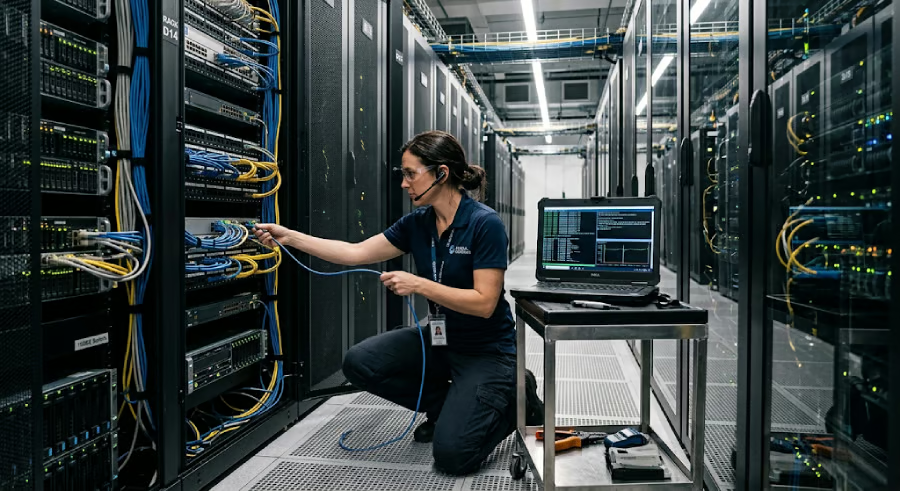
AI may threaten some desk jobs. It is also creating a scramble for people who can wire, cool, build, connect, and keep enormous GPU warehouses alive.
Data center job postings in the US have more than doubled in two years, even as overall job postings declined, according to a recent Indeed Hiring Lab analysis. About six of every 1,000 US job postings are now connected to data centers, up from roughly two per 1,000 in 2023.
The hiring wave spans construction, installation, maintenance, engineering, and IT infrastructure roles. Several of the occupations supporting that build-out already have national median salaries above $100,000, while some skilled-trade jobs command meaningful pay premiums when the work is tied specifically to data centers.
That makes the AI boom a very different kind of labor story than the last tech boom.
- AI's hiring boom is moving outside the office
- Construction managers: $106,980 median pay
- Electrical engineers: $111,910 median pay
- Mechanical engineers: $102,320 median pay
- Computer network architects: $130,390 median pay
- Facilities managers: $104,690 median pay
- Electricians can break six figures, and data centers are paying a premium
- What the AI infrastructure boom could mean for your career
AI's hiring boom is moving outside the office
The AI economy needs far more than algorithms.
Every new cluster of GPUs needs electrical infrastructure. Servers need cooling. Buildings have to be constructed. Fiber has to be connected. Backup systems must be installed and tested. Once a facility comes online, someone has to keep all of it running around the clock.
That infrastructure layer is getting very big, very quickly.
JLL estimates the data center sector could add roughly 97 gigawatts of capacity between 2025 and 2030, reaching about 200 gigawatts globally by the end of the decade. The firm's 2026 Global Data Center Outlook says supporting that expansion could require as much as $3 trillion in infrastructure investment.
AI workloads are expected to account for a substantial share of that growth. That means AI's labor story increasingly includes people who might never train a model or write a line of Python.
Indeed found that installation and maintenance workers account for about one-quarter of data center openings. IT infrastructure and operations, along with installation and maintenance, collectively make up roughly half of data center postings.
The 10 largest tech companies by market capitalization account for 71% of data center-related postings so far in 2026, according to Indeed. That hiring is also spreading beyond traditional technology centers, with Big Tech's share of postings climbing sharply in places including Columbus, Ohio; Jackson, Mississippi; and Reno, Nevada.
It is a very different version of the tech hiring boom.
Construction managers: $106,980 median pay
Before an AI model can consume megawatts of electricity, somebody has to build the place where it lives.
Construction managers coordinate budgets, contractors, schedules, safety requirements, and technical work across large construction projects. The US Bureau of Labor Statistics reports a median construction manager pay of $106,980, based on May 2024 wage data. Employment is projected to grow 9% between 2024 and 2034, much faster than the average for all occupations.
Data centers raise the stakes considerably. These are highly specialized industrial projects involving enormous electrical loads, cooling systems, generators, networking, security, and strict uptime requirements.
As the number and size of AI campuses grow, so does the demand for people capable of coordinating increasingly complex construction.
Electrical engineers: $111,910 median pay
Electricity is becoming one of AI's biggest constraints.
Electrical engineers design and work on the power systems that bring electricity into facilities and distribute it safely through buildings packed with high-density computing equipment.
The BLS reports a median annual wage of $111,910 for electrical engineers. The broader category of electrical and electronics engineers had a median wage of $118,780. Their importance is becoming harder to miss as data center developers compete not just for chips, but also for available power.
As eWeek previously covered, AI data center demand is already testing the US power grid. US data centers consumed around 4.4% of national electricity in 2023, with government-backed estimates suggesting their share could climb significantly by 2028.
Someone has to engineer that transition from utility-scale power to rack-scale computing.
Mechanical engineers: $102,320 median pay
AI servers turn electricity into computation and a remarkable amount of heat.
Keeping thousands of accelerators within safe operating temperatures requires sophisticated cooling equipment, pumps, chillers, heat exchangers, airflow systems, and increasingly liquid cooling.
That puts mechanical engineering squarely in the middle of the AI infrastructure race. Mechanical engineers earned a median annual wage of $102,320 in May 2024, according to the BLS Occupational Outlook Handbook. Employment is projected to grow 9% through 2034.
As rack densities increase, cooling is becoming more than a building-services problem. It is part of the fundamental architecture of AI computing.
The hotter the chips get, the more valuable the people who know how to keep them cool.
Computer network architects: $130,390 median pay
A room full of GPUs is not particularly useful if those GPUs cannot communicate quickly enough.
Computer network architects design the networks that connect servers, storage, cloud systems, and other computing infrastructure. AI clusters have made that work especially important because training and inference systems can depend on enormous amounts of data moving between machines.
The BLS lists median annual pay for computer network architects at $130,390.
The agency projects employment in the field to grow 12% from 2024 to 2034 and specifically points to artificial intelligence and cloud computing as factors driving demand for upgraded IT networks. This is perhaps the most recognizable "tech job" on the list, but its growth illustrates the same shift: AI's infrastructure requirements create work well beyond model development itself.
Facilities managers: $104,690 median pay
Building a data center is only the first act. Then it has to run.
Facilities managers oversee the physical environments businesses depend on, including equipment, maintenance, safety, building systems, and emergency response. The BLS reports median pay of $104,690 for facilities managers. The highest-paid workers in the occupation earn considerably more.
Data centers make that role unusually consequential. A cooling failure, electrical problem, generator issue, or maintenance error can affect millions of dollars' worth of hardware and potentially disrupt services used by customers worldwide.
AI infrastructure may be digital at the workload level, but keeping it online remains a profoundly physical job.
Electricians can break six figures, and data centers are paying a premium
Electricians are where the data gets especially interesting.
The national median annual wage for electricians is $62,350, so it would be misleading to describe electrical work broadly as a six-figure job. However, the highest-paid 10% earn more than $106,030, according to BLS data on electrician wages.
Data center work can further improve the pay equation.
Indeed found that hourly installation and maintenance positions tied to data centers advertise pay roughly $10 an hour higher than comparable jobs outside data centers. That represents a 42% premium in median advertised hourly compensation. Annual salary postings for these roles also showed a 12% premium.
The demand is arriving at the same time the US already faces a shortage of skilled tradespeople. JLL estimates that 2.1 million skilled-trade positions could go unfilled by 2030 across fields including electrical work, HVAC, plumbing, pipefitting, equipment operation, and maintenance.
That shortage could turn the people who physically build AI infrastructure into some of the industry's most fiercely contested talent.
It also echoes a prediction Nvidia CEO Jensen Huang made earlier this year. Speaking at the World Economic Forum in Davos, Huang argued that AI infrastructure spending would create opportunities for electricians, plumbers, construction workers, network technicians, architects, and other workers.
As eWeek reported at the time, Huang described AI as a stack beginning with energy and extending through chips, infrastructure, and cloud computing.
The newest hiring data suggest that stack is becoming a labor market, too.
What the AI infrastructure boom could mean for your career
For workers watching AI reshape the labor market, the opportunity may not be where the loudest AI headlines suggest.
You do not necessarily need to become a machine learning engineer to find work connected to the AI boom. Experience in networking, electrical systems, mechanical engineering, construction management, facilities operations, HVAC, and other infrastructure fields aligns closely with the types of roles appearing in the data center hiring surge.
For tech professionals, network architecture is one potential path into the infrastructure side of the AI boom. The BLS reports a median pay of $130,390 for computer network architects and specifically identifies AI and cloud computing as factors expected to drive demand for upgraded networks.
Workers already in network administration, infrastructure, cloud operations, or related IT fields may therefore find some of their existing skills relevant to data center employers. The exact path will depend on experience and the technical requirements of individual roles, particularly in mission-critical environments.
The same principle applies outside traditional IT. Electricians and other installation and maintenance workers may not have six-figure median salaries nationally, but Indeed's data suggests employers are already advertising higher pay when those skills are applied to data center work.
Location matters, too. Data center hiring is spreading beyond Silicon Valley and other traditional technology hubs. Indeed found Big Tech's share of data center postings rising in places including Columbus, Jackson, and Reno. That shift is bringing more Big Tech hiring activity into regions that have not traditionally been major technology hubs.
There are caveats. A national median salary does not guarantee what a particular data center employer will pay, and moving into the sector may require specialized experience, licenses, certifications, or knowledge of mission-critical infrastructure. Compensation can also vary substantially by location and seniority.
Indeed's figures should also be read as a measure of the broader hiring trend rather than a complete census of data center employment. Its analysis identifies job listings with data center-related postings that contain data center-related terms.
Still, the hiring numbers point to a useful lesson for anyone wondering where AI is creating opportunity: follow the infrastructure.
The models getting the attention may live in the cloud, but the jobs supporting them are decidedly earthbound. AI needs buildings, electricity, cooling, networks, maintenance, and people who know how to keep all of those systems running.
For workers with skills that match those needs, the AI boom is opening another route into the technology economy, and it may not require becoming an AI engineer first.
Related reading: For more on the AI infrastructure boom, see how orbital data centers could take AI computing beyond Earth.