







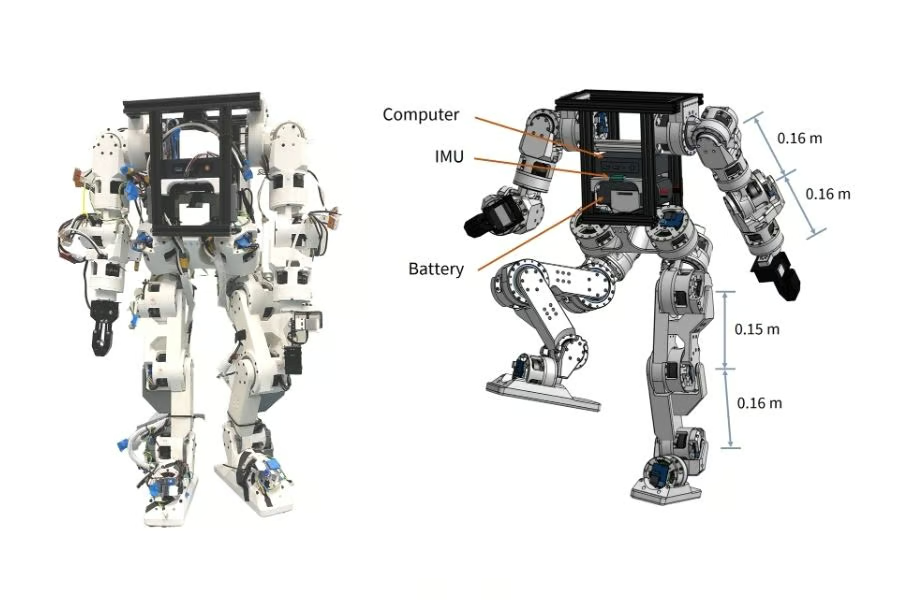
A humanoid robot you can build with a desktop 3D printer is lowering the barrier to experimenting with machines that usually cost far more.
Researchers at the University of California, Berkeley, have developed the Berkeley Humanoid Lite, an open-source humanoid robot designed to give students, hobbyists and researchers a cheaper way to experiment with robotics.
The roughly 1-meter robot weighs about 16 kilograms and costs less than $5,000 in hardware, according to UC Berkeley Engineering. That is still a serious expense, but far below the cost of many commercially built humanoid platforms. More importantly, Berkeley is not selling it as a finished robot. The project is meant to be a starting point that people can build, modify, and learn from.
The robot uses a modular actuator built around a brushless DC motor, magnetic encoder and 3D-printed cycloidal gearbox. The largest printed components fit within a standard 200-by-200-by-200-millimeter desktop 3D printer, while the rest can be sourced from common online suppliers.
The hardware is only half the story
The Berkeley team has also released the robot's hardware design, embedded code, training and deployment frameworks as open source.
That makes the project potentially useful beyond humanoid robotics. The modular actuators can be used individually and adapted to different configurations, including bipedal and quadruped designs, according to Interesting Engineering.
The researchers tested the actuators for efficiency and durability. Interesting Engineering reports that the gearbox reached about 90% mechanical efficiency under most conditions, while a 60-hour endurance test showed gradually increasing backlash as the printed components wore.
The robot has also demonstrated basic walking and object manipulation. Researchers used reinforcement learning for locomotion and a VR-based teleoperation system for tasks including moving objects and solving a Rubik's Cube.
The Berkeley team, however, acknowledges that its walking remains imperfect, while the long-term effects of heat and wear on the 3D-printed structure require more study.
What eWeek found: The real opportunity is the actuator
The most interesting part of Berkeley Humanoid Lite may not be the humanoid at all. Its modular actuator could become the project's most useful research and educational building block because developers can experiment with a single robotic joint before committing to an entire machine. That lowers both the financial and technical risk of getting started.
The open-source design removes another barrier, but hardware ecosystems do not grow from design files alone. Berkeley still needs a community that builds the robot, documents failures, improves components, and makes those changes useful to the next person.
If that happens, Berkeley Humanoid Lite could become more valuable as a platform than as a single robot. Its biggest contribution may ultimately be creating a repeatable way for students and smaller robotics teams to learn how humanoids are built from the joint up.
Other News: eWeek compared six leading AI video generators for 2026, examining how platforms such as Synthesia, HeyGen and VEED stack up for business use cases including training, marketing, localization and video editing.