







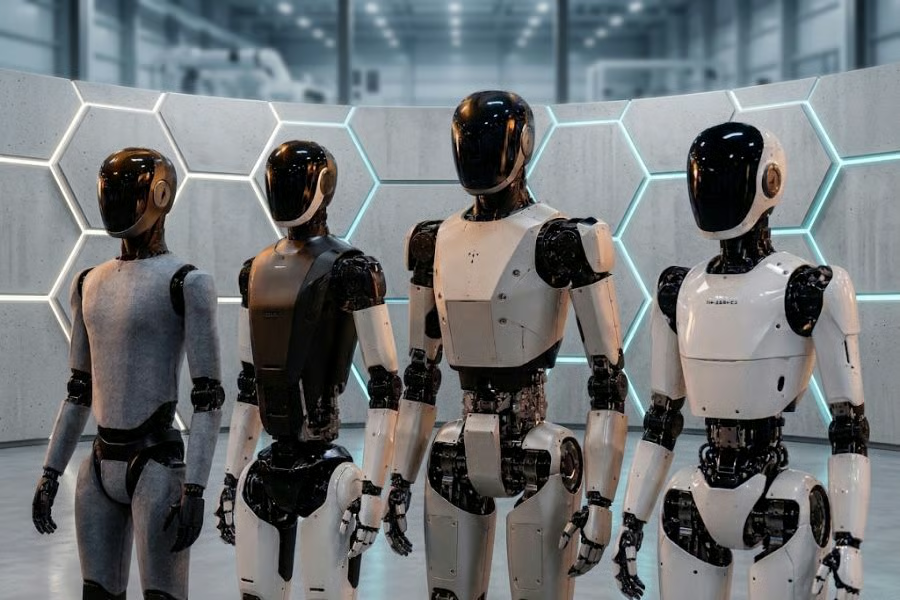
Humanoid robots are beginning to look less like science fiction. Their price tags, however, are still all over the map.
Among full-body humanoid robots with publicly displayed prices, current listings range from about $4,900 to $100,000. Unitree also offers its developer-oriented R1-D dual-arm humanoid platform from $4,290, but that system is not directly comparable to walking humanoids such as the R1, G1, H2, NEO, or Figure 03.
Many of the most advanced industrial humanoids still have no public price.
For businesses, that makes the sticker price only the beginning. The better question is not simply how much a humanoid robot costs, but how much useful work it can perform for that money.
- How much do humanoid robots cost today?
- Why can humanoid robots be so expensive?
- Manufacturing cost is not the same as purchase price
- The sticker price is only part of the cost
- Buying may not be the only option
- When does a humanoid robot become worth the money?
- Real-world productivity matters more than purchase price
- Will humanoid robots eventually get cheaper?
- What humanoid robot pricing really tells us
How much do humanoid robots cost today?
Unlike laptops or industrial robot arms, humanoid robots do not yet have a standardized price range. Some manufacturers openly advertise prices. Others sell through commercial partnerships, pilots, or negotiated deployment agreements without publicly disclosing the cost per robot.
As of August 2026, some of the most notable publicly displayed prices include:
- Unitree R1-D: From $4,290. Unitree describes the R1-D as a dual-arm humanoid robot designed for development and deployment in fixed-base or mobile-base configurations. Because it is not a conventional full-body walking humanoid, its price should not be treated as directly comparable to models such as the R1, G1, H2, NEO, or Figure 03. Unitree's R1-D product page provides specifications and purchasing information.
- Unitree R1: From $4,900. Unitree's full-body R1 family starts with the R1 Air at $4,900, while the standard R1 costs $5,900. Unitree says those prices exclude tax and shipping. Unitree's R1 page outlines the configurations and current pricing.
- Unitree G1: $13,500. Unitree currently displays the G1 at $13,500, putting a more sophisticated walking humanoid well below the six-figure territory often associated with advanced robotics. Unitree's humanoid robot collection lists the current price.
- 1X NEO: $20,000 or $499 per month. 1X offers its home humanoid through a $20,000 Early Access ownership option or a $499 monthly subscription. The company also requires a refundable $200 deposit and says U.S. deliveries begin in 2026. 1X's NEO ordering page details the current purchasing options.
- Unitree H2: $29,900. Unitree currently displays its larger H2 humanoid at $29,900. Unitree's humanoid robot collection lists the current price.
- Unitree H2 Plus: $100,000. The H2 Plus represents the high end of Unitree's current publicly displayed humanoid pricing, although customers must contact the company's sales team to purchase it. The price does not include customs duties. Unitree's H2 Plus listing provides the current purchasing details.
Unitree also displays its H1 at $90,000 in its online store, but the listing simultaneously instructs prospective buyers to contact the company for the "real price." For that reason, $90,000 is better treated as a reference figure than a firm purchase price.
Those numbers demonstrate why comparing humanoids based on price alone can be misleading. A $4,290 developer-oriented dual-arm platform is not necessarily competing with a sophisticated industrial humanoid expected to walk through a factory and perform useful physical work for hours at a time.
eWeek's ranking of the top humanoid robots from Tesla, Unitree, Agility Robotics, Apptronik, and others similarly shows a market divided between development platforms, industrial machines, and ambitious general-purpose robots.
In other words, asking how much a humanoid robot costs is a little like asking how much a vehicle costs. A scooter, delivery van, and excavator all move things, but the price tells you very little until you know the job.
Why can humanoid robots be so expensive?
A humanoid robot squeezes an unusual amount of hardware into a machine expected to walk, balance, perceive its surroundings, manipulate objects, and make decisions in real time.
That hardware adds up quickly.
Actuators and joints
Humanoid robots need motors and actuators to move their hips, knees, ankles, shoulders, elbows, hands, and other joints. More sophisticated machines may have dozens of independently controlled degrees of freedom.
Those components have to be powerful enough to move the robot while remaining precise, compact, and efficient. They also need to withstand thousands or millions of repeated movements.
Hands are particularly difficult. Carrying a box requires much less mechanical complexity than manipulating small parts, using tools, or handling objects of different shapes without dropping or crushing them.
Sensors and cameras
A robot also needs to understand what is around it.
That can require depth cameras, traditional cameras, LiDAR, force sensors, inertial measurement units, tactile sensors, microphones, and other hardware. These systems effectively act as the robot's eyes, ears, sense of balance, and touch.
The more unpredictable the environment, the more important perception becomes. A factory robot working inside a fenced-off cell can repeat the same movement thousands of times. A humanoid walking among people has to continuously detect obstacles, judge distances, adapt its movements, and react when something changes.
Computing and AI
Then there is the brain.
Modern humanoids increasingly rely on artificial intelligence for computer vision, navigation, manipulation, language understanding, and task planning. That requires onboard computing hardware, software development, model training, simulation, and potentially cloud infrastructure.
This is one reason the cost of building a robot and the price of buying one are not necessarily the same thing.
Buyers are paying for more than metal, motors, cameras, and batteries. Behind the machine sits an increasingly expensive software, AI, training, manufacturing, and support ecosystem.
Manufacturing cost is not the same as purchase price
One of the easiest ways to get humanoid robot pricing wrong is to mix up manufacturing cost with selling price.
Goldman Sachs Research estimated in 2024 that the manufacturing cost of humanoid robots had fallen from roughly $50,000 to $250,000 per unit to about $30,000 to $150,000 per unit, depending on the sophistication of the machine.
Those figures are manufacturing-cost estimates, not retail prices. They also date to 2024 and should not be treated as an estimate of the cost to manufacture a humanoid robot in 2026. Still, the decline identified by Goldman pointed to an important trajectory: cheaper components, improved manufacturing, and greater production scale could eventually drive down robot prices.
There is now evidence that some manufacturers are beginning to achieve greater scale.
Figure said in April 2026 that its BotQ manufacturing facility had delivered more than 350 Figure 03 robots. The company also said it increased its production rate from one Figure 03 per day to a demonstrated cycle time of one robot per hour, a 24-fold throughput improvement achieved in less than 120 days. Figure's April production update details the manufacturing ramp.
Figure also reported that its battery line had achieved a 99.3% first-pass yield and shipped more than 500 battery packs. The company's end-of-line first-pass yield for completed robots had climbed above 80% and was continuing to improve, according to Figure. Those numbers matter because manufacturing scale and yield are two of the biggest levers robot companies can pull to reduce costs.
Figure 03 itself was redesigned with mass production in mind, replacing many CNC-machined components with manufacturing processes such as die-casting, injection molding, and stamping. The company says each Figure 03 costs substantially less to build than its predecessor, although it has not disclosed the robot's actual manufacturing cost or selling price. Figure's introduction to Figure 03 explains how the robot was redesigned for high-volume production.
Figure has also said BotQ's first-generation manufacturing line is capable of producing up to 12,000 humanoid robots per year. That figure represents stated production capacity, not the number of robots Figure has actually produced or sold.
If manufacturers can turn that theoretical capacity into sustained production while improving yields, humanoid robots could follow a familiar technology curve: expensive prototypes gradually giving way to increasingly standardized and less costly products.
The sticker price is only part of the cost
For enterprises, buying the robot could prove to be the easiest number to calculate. Deploying one introduces a much larger group of expenses that may not appear in a product announcement.
These can include:
- Software: AI systems, fleet-management platforms, monitoring tools, and software subscriptions.
- Integration: Connecting robots to manufacturing, warehouse, inventory, or other business systems.
- Training: Teaching the robot specific tasks and training employees to work safely around it.
- Maintenance: Repairing motors, joints, sensors, batteries, hands, and other components.
- Charging infrastructure: Creating charging stations or managing swappable batteries.
- Human supervision: Remote operators or technicians may still be required when a robot encounters a situation it cannot handle.
- Safety: Facilities may need new procedures, physical changes, risk assessments, or monitoring systems.
- Downtime: A robot that frequently stops, fails, or requires intervention can become expensive regardless of its purchase price.
This is why eWeek's guide to what companies should know before hiring humanoid robots emphasizes operational questions such as safety, integration, autonomy, data, maintenance, and fleet management.
A $20,000 robot that requires constant human rescue may ultimately cost more than a much more expensive machine that reliably completes an entire shift.
Buying may not be the only option
Humanoid robots may also increasingly be sold more like software or cloud infrastructure than traditional industrial machinery.
Instead of purchasing a robot outright, companies and consumers could pay through subscriptions or Robots-as-a-Service (RaaS) arrangements. The vendor can retain ownership of the hardware while the customer pays a recurring fee to use it.
1X's NEO offers a concrete example of how humanoid pricing can move beyond outright ownership. The company currently advertises:
- Early Access ownership: $20,000
- Standard subscription: $499 per month
- Deposit: $200, fully refundable
- US deliveries: Beginning in 2026
According to 1X, the ownership option includes a three-year warranty, premium support, and priority delivery. The company also says early NEO robots arrive with basic autonomy and can receive scheduled remote supervision from a 1X expert for complex tasks they do not yet know how to perform.
That last detail is important when comparing costs. A robot's monthly subscription price does not necessarily tell buyers how independently it can perform useful work.
For enterprises, service models could nevertheless make expensive robots easier to adopt because companies would not necessarily need a large upfront capital investment. They could also shift some of the maintenance, support, and technology upgrade risk back to the manufacturer.
That matters in a field developing this quickly. A company buying an expensive robot today has to consider the possibility that a substantially better generation could appear only a few years later.
When does a humanoid robot become worth the money?
This is where robot economics becomes much more interesting than robot prices.
A business does not necessarily need a humanoid to become cheaper than an employee. It needs the robot to become cheaper or more effective than the best alternative for a particular workflow.
That could mean comparing a humanoid against:
- Human labor
- An industrial robot arm
- An autonomous mobile robot
- A conveyor system
- A forklift
- A purpose-built machine
- Redesigning the workflow entirely
For many tasks, traditional automation will still win.
A fixed robot arm can perform the same movement rapidly and reliably without needing legs, advanced vision, or general-purpose AI. There is little reason to pay for a human-shaped robot when the environment can be engineered around a simpler machine. Humanoids become more interesting when companies want automation to operate inside environments already designed for humans.
Doors, stairs, shelves, tools, carts, workstations, and assembly lines all reflect human proportions. A sufficiently capable humanoid could potentially move between tasks without forcing a company to rebuild the workplace around it. That flexibility is the bet behind many of the humanoid robots now being developed for factory work.
But flexibility only has economic value if the robot works reliably.
Real-world productivity matters more than purchase price
The emerging humanoid race is therefore shifting toward a less glamorous metric: hours of productive work.
Figure AI offers one useful example. The company previously reported that Figure 02 accumulated more than 1,250 hours of runtime and loaded more than 90,000 parts during an 11-month deployment at BMW's Spartanburg plant, eventually working 10-hour weekday shifts.
Figure has since moved on to Figure 03 as its latest-generation robot. On June 30, 2026, the company announced that Figure 03 had arrived at BMW's Spartanburg plant for a more complex logistics workflow involving selecting parts, manipulating carts, stepping, and repositioning its body while working. Figure said its earlier Figure 02 deployment contributed to the assembly of 30,000 BMW vehicles. Figure's latest BMW deployment update details the new sequencing workflow.
Those figures are company-reported results rather than independently audited productivity measurements, but they illustrate the kinds of numbers businesses will ultimately need to evaluate.
Figure does not publish a simple retail price for Figure 03. Without one, the economics of the deployment cannot be calculated from public information alone.
For any humanoid robot, buyers will eventually need answers to questions such as:
- How many hours can the robot work?
- How many useful tasks does it complete per hour?
- How often does it need a person to intervene?
- How expensive is maintenance?
- How long does it take to learn a new task?
- How many different jobs can one machine perform?
Those figures determine whether a $20,000, $60,000, or $100,000 robot represents a bargain or an expensive experiment.
Will humanoid robots eventually get cheaper?
Probably, if manufacturers can turn today's production experiments into sustained manufacturing scale. How quickly that happens is much harder to predict.
Robot makers are chasing the same virtuous cycle that transformed computers, smartphones, electric vehicles, and other advanced hardware: higher production volumes can lead to cheaper components and better manufacturing processes, which can lower prices and expand the market further.
Figure's 2026 production ramp provides an early example of what that transition could look like. Delivering more than 350 Figure 03 units is still tiny compared with mature consumer electronics or automotive manufacturing, but Figure's demonstrated move from one robot per day to a one-per-hour production cycle suggests that at least some humanoid manufacturing is beginning to move beyond hand-built prototypes.
Humanoid manufacturers may have another advantage. Many companies are solving similar hardware problems simultaneously, creating demand for components such as motors, actuators, batteries, sensors, cameras, processors, and robotic hands. But the body is only half the equation.
A cheap robot that cannot reliably understand its surroundings or perform useful work is simply an affordable machine standing around. AI, training data, dexterity, battery life, reliability, and autonomy will ultimately determine whether falling hardware prices translate into useful robotic labor.
What humanoid robot pricing really tells us
Among full-body humanoids with publicly displayed pricing, current advertised figures range from roughly $4,900 to $100,000. Unitree occupies several points across that spectrum, while 1X's NEO adds another pricing model: $20,000 for Early Access ownership or $499 per month through a subscription.
Unitree also offers its developer-oriented R1-D dual-arm humanoid platform starting at $4,290, but that system is not directly comparable to a full-body walking humanoid.
The $100,000 figure should not be treated as a universal ceiling. Many sophisticated industrial systems from companies such as Figure, Agility Robotics, and Apptronik still do not carry simple public retail prices. That makes any single "average humanoid robot price" misleading.
Buyers need to distinguish among the publicly displayed price, the estimated manufacturing cost, and the total deployment cost. A robot advertised for $20,000 is not automatically cheaper to operate than one sold through a negotiated commercial agreement.
For businesses, purchase price may ultimately become the least interesting number.
The humanoid robot race will be decided by cost per useful hour of work. A robot that can reliably move between tasks, require little supervision, and operate for years could justify a surprisingly high price. One that spends its day waiting for an engineer to intervene could be overpriced at almost any price.
As humanoid robots move from demonstrations to homes and factory floors, that distinction will separate inexpensive hardware from productive machines.
Also read: For another glimpse at where humanoid performance is heading, see how Unitree’s new “Superman” robot topped Usain Bolt’s peak speed and what faster robots could mean for real-world work.