







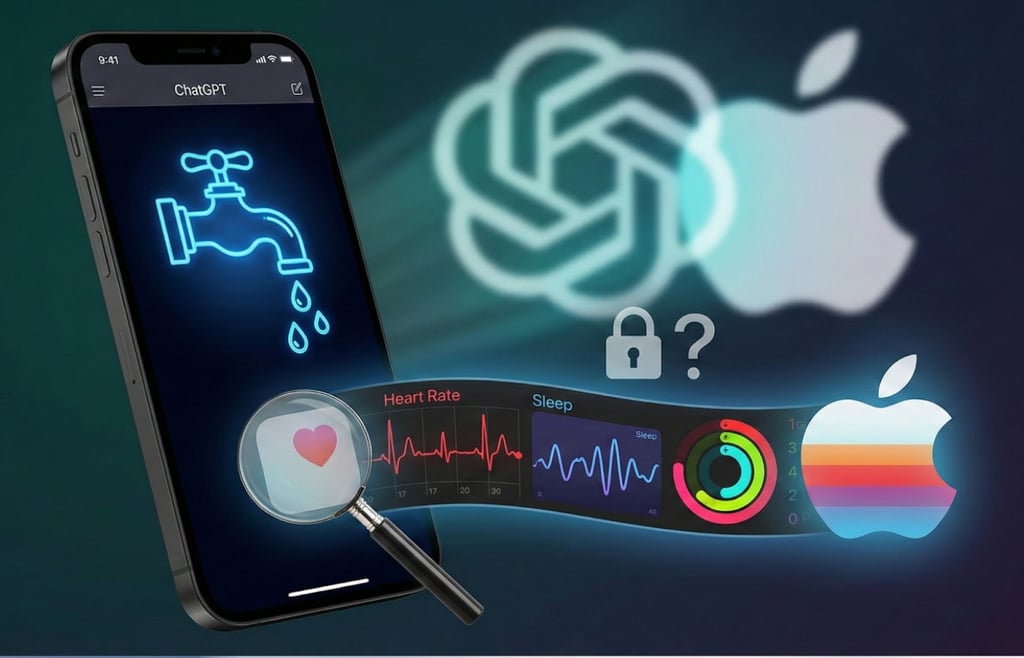
OpenAI is proving to be a leaky faucet with another rumored integration surfacing this week, triggered by a hidden icon in the ChatGPT iPhone app that points to potential Apple Health access.
The discovery was made by developer and researcher Aaron Perris, who revealed that the latest build of the iOS ChatGPT app includes a hidden image of the Apple Health icon, suggesting a potential option to link Apple Health data to ChatGPT. Such integration could allow ChatGPT to access users’ exercise, sleep, diet, and breathing data.
While neither OpenAI nor Apple has officially confirmed the feature, it is likely that the presence of the icon suggests integration is undergoing internal testing.
OpenAI’s big experiments
Rumors of this latest big-deal integration come on the heels of OpenAI’s suspected implementation of ads within ChatGPT’s search function.
The near overlap implies the company is in a period of accelerated feature rollout, where even internal tests are now escaping into the open. Against that backdrop, the discovery of an Apple Health asset inside the iOS build reads like part of a broader push toward deeper system-level integrations.
Right now, ChatGPT offers some integrations via its “Apps & Connectors” menu, but the health-related options are sparse. Peloton stands out as one of the few exceptions, but its data connection is narrow. Connecting to Apple Health brings a different level of access by offering users tailored responses underpinned by their actual data and real habits.
If such an integration comes to fruition, it would signal that OpenAI sees health as a high-value use case where personalization could shape how users rely on ChatGPT in their daily routines. It would also reinforce a broader trend in consumer AI, where real utility increasingly comes from models that understand individual patterns instead of offering generic advice.
Data privacy questions
As with any technology tapping into personal data, a marriage between ChatGPT and Apple Health immediately raises concerns about data handling.
The two platforms use different data storage methods — on-device for Apple Health and cloud-based for ChatGPT. Any link between the two systems would need clear rules about how data is shared, where it goes, and whether OpenAI can access only what users explicitly approve.
Apple’s own notoriously strict security and privacy policies would also shape the limits of the integration. HealthKit data is governed by strict permission requirements that define how developers can use it and prohibit secondary uses, such as advertising or broad profiling. If ChatGPT were to tap into that ecosystem, it would have to operate within a narrow scope of what that integration could actually deliver.
There is also the question of generative AI’s accuracy and its tendency to hallucinate. Once an AI model references real health metrics, expectations around truth and validity rise. Misinterpretations carry real consequences in a healthcare context, and even casual suggestions risk being viewed as guidance. That places pressure on OpenAI to ensure reliability at a level that the company has not yet addressed.
For now, the buried Apple Health icon is only an indication of experimentation. Still, its presence shows how quickly AI assistants are moving into areas that carry stronger privacy risks for users.
Apple’s latest AI leadership shake-up offers a preview of how the company may steer Siri and on-device intelligence in the coming years.