








China wants AI to move out of the chatbot window and into daily life.
A new “AI plus consumption” plan from China’s Ministry of Commerce and seven other government departments calls for wider AI adoption across consumer electronics, home appliances, retail, logistics, tourism, eldercare, education, and public-facing services. The push is designed to turn AI into a larger driver of consumer demand while giving companies a clearer policy signal around smart devices, robotics, service automation, and AI-enabled commerce.
For companies and IT leaders, the plan shows how AI could deepen its presence across devices, retail operations, supply chains, and public services.
China outlines ‘AI plus consumption’ plan
China’s Ministry of Commerce and seven other government departments released the implementation guideline to speed up the development of “AI plus consumption,” according to Xinhua. The plan includes 17 measures across five areas: smart product consumption, services consumption, new consumption scenarios, retail and logistics, and support policies.
The Ministry of Commerce said the plan is intended to create new drivers of consumption growth and improve the quality and capacity of consumer spending, according to a statement cited by the South China Morning Post (SCMP).
SCMP also noted that the government said it wants AI to enter “millions of households and millions of shops.”
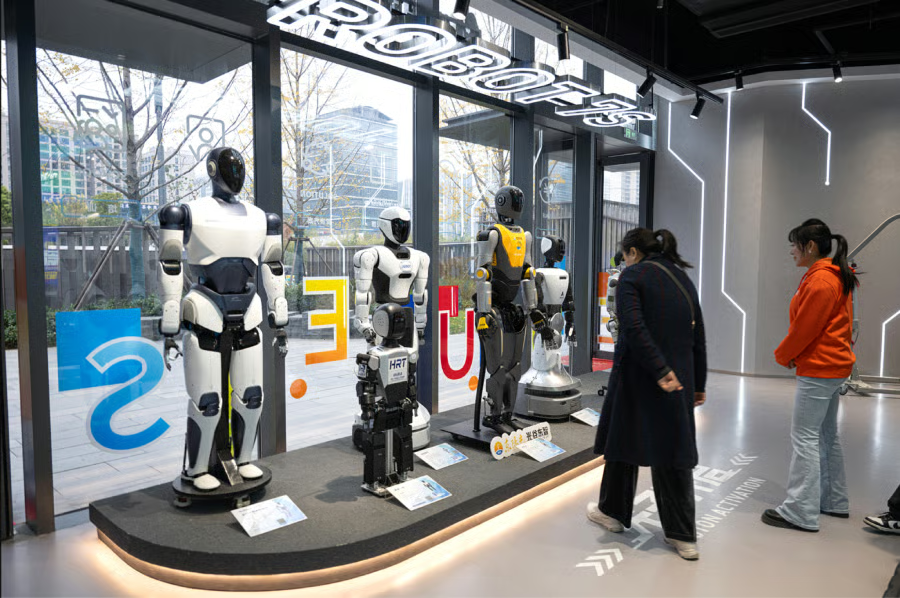
In practical terms, that means more AI-enabled consumer electronics, smart home products, connected cars, wearables, AI glasses, and household appliances. The measures also encourage the development of humanoid robots and other AI-powered machines for elderly care, companionship, mobility assistance, and daily household tasks.
For companies, China’s consumer AI strategy reaches well beyond gadgets. It touches devices, retail systems, logistics networks, and public-facing services.
Services and retail are part of the plan
China’s plan also targets service industries, including home services, elderly care, tourism, accommodation, catering, and education. Xinhua reported that the measures encouraged smart eldercare facilities, AI-enabled tourism services, and smart canteens in offices, schools, and hospitals.
Reuters reported that the Ministry of Commerce aims to promote AI applications across both products and services. For goods consumption, the measures aim to move consumer electronics “from functional to intelligent” and grow a market for humanoid robots, citing state broadcaster CCTV.
Lin Jian, deputy director of the International Trade Cooperation Institute under the ministry, said AI could help address service-sector constraints.
“The introduction of AI is expected to break through the bottleneck in service consumption constrained by high labour costs and low standardization,” Lin said, according to Reuters.
The retail and logistics pieces could matter beyond China’s consumer market. According to Xinhua, the guidelines called for smarter retail, deeper integration of AI with e-commerce, improved logistics networks at the county, township, and village levels, and wider delivery coverage in remote areas.
Those goals suggest more demand for AI infrastructure, data systems, edge devices, robotics platforms, and operational governance. Companies selling into China, competing with Chinese manufacturers, or sourcing from AI-enabled supply chains may need to watch how quickly these policies turn into procurement, subsidies, and standards.
Subsidies and standards could shape adoption
China also plans to build “AI plus consumption” clusters and AI experience centers, according to Xinhua. The guidelines encouraged rental, sharing, and trial use of AI products in public venues.
Local governments were also encouraged to create subsidy policies for next-generation smart terminals and other AI-related consumer products under China’s consumer goods trade-in framework.
Those support measures could be important because consumer AI adoption may depend on more than product availability. Pricing, local incentives, standards, distribution networks, and public demonstration sites could all affect how quickly AI devices and services move from pilot programs into everyday use.
As AI moves into consumer goods and public services, familiar enterprise concerns follow: data privacy, device security, vendor risk, uptime, and integration across fragmented systems.
China’s plan shows how national policy can accelerate AI adoption by tying it to consumer demand, public services, and commerce infrastructure.
For global technology companies, it also raises the competitive stakes around AI hardware, robotics, and platform ecosystems.
Read more: China is testing household humanoid robots that can cook, clean, and do laundry.