







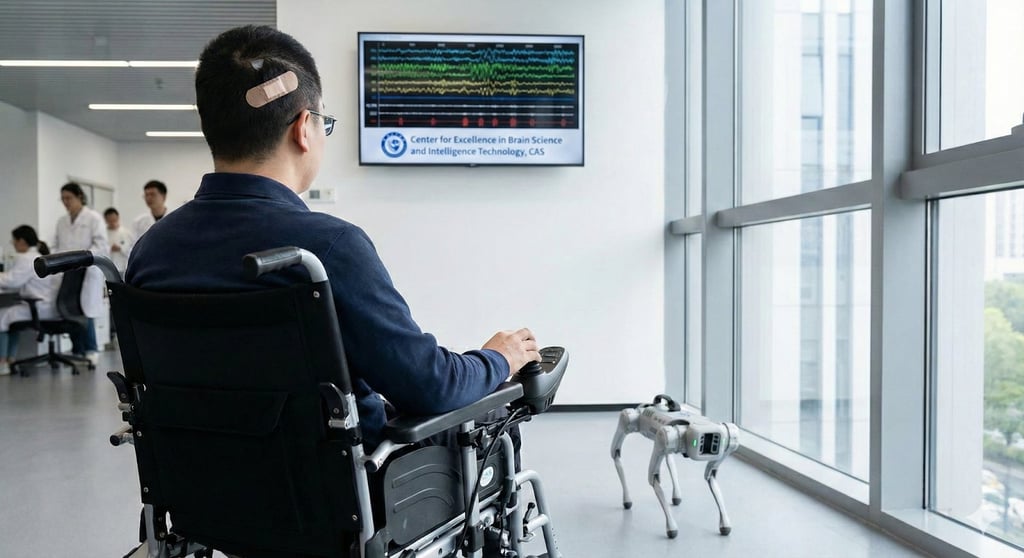
Chinese scientists have shown that people with severe paralysis can now control machines using only their thoughts.
The breakthrough was announced this week by the Center for Excellence in Brain Science and Intelligence Technology of the Chinese Academy of Sciences (CAS) at a media briefing in Shanghai. In recent trials, two patients in their 30s received tiny implanted brain-machine interface (BMI) systems in June and October, respectively.
After short training periods, they were able to interact with the physical world in ways previously impossible.
They used implanted BMI systems to steer power wheelchairs, command robotic dogs to collect deliveries, and operate a robotic arm to pick up a cup and drink water. Researchers say this is the first time globally that both a wheelchair and a robotic dog have been controlled purely through thought.
How the technology works
The system relies on invasive BCI technology, where ultra-thin electrodes are implanted into the brain through a very small opening, about 5 millimetres wide. The implant used is reported to be one of the smallest in the world, about half the size of Neuralink’s device, according to China Daily.
To make mind control feel natural, researchers focused heavily on speed and stability. They reduced the delay between a thought and a machine’s response to under 100 milliseconds, faster than the body’s own nerve signals. China Daily reports that one patient has already returned to work. He is now employed as an intern product sorter, using a brain-controlled cursor to help verify AI systems used in vending machines.
“Our research is advancing BMI technology toward practical clinical applications,” said Zhao Zhengtuo, a leading scientist on the project, at the Shanghai media briefing reported by China Daily. “With an open mindset, we are collaborating with various smart devices and application platforms to jointly promote cutting-edge BMI innovation in our country.”
China Daily notes that a patient controlling a wheelchair described the experience as feeling natural, comparing it to guiding a video game character without thinking about a joystick.
How it compares globally
The breakthrough has drawn comparisons to Elon Musk’s Neuralink, which aims to let users control devices with their minds under a concept Musk calls “Telepathy.” While Neuralink has shown patients playing video games or using robotic arms, Chinese researchers say they have already moved into stable, real-world use.
According to SCMP, China’s advantage lies in its tightly integrated ecosystem, combining neurotechnology, wireless communication, artificial intelligence, and robotics. This integration allows brain signals to translate into physical actions with minimal delay.
Pu Muming, an academician with the Chinese Academy of Sciences, told Chinese state television that the trials have confirmed “the safety of electrodes in the brain, their long-term stability and the stability of signal recording and decoding,” calling these essential steps toward real medical use, according to SCMP.
Looking ahead, the team has ambitious timelines. They foresee applications for restoring movement and speech within three years, treating conditions like Parkinson’s disease within five, and minimally invasive systems for both medical and consumer use within a decade.
To learn more about how robotics is accelerating across industries, see 10 surprising humanoid robot milestones.