







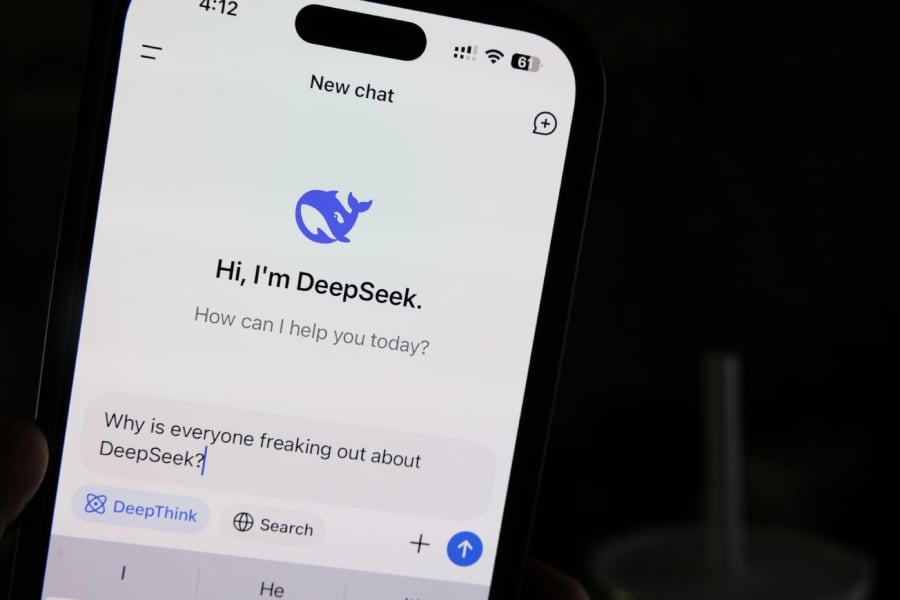
DeepSeek has unveiled a new AI system that promises to make long-context processing faster and leaner. Called DeepSeek-OCR, the model converts massive text inputs into compact visual tokens, shrinking data by up to tenfold.
In a blog post, the DeepSeek AI research team described the system as a “new paradigm for context compression,” using optical 2D mapping to let language models read text as images. DeepSeek says the approach slashes computational costs while maintaining up to 97% precision, setting the stage for more efficient large-scale AI applications.
Turning text into vision
At the heart of DeepSeek-OCR is a two-part engine built to rethink how machines process information.
The DeepEncoder handles the front end, compressing entire documents into compact “vision tokens” while keeping memory use low. Instead of parsing thousands of text tokens, the system converts them into an optical form that’s faster for AI to store and recall.
On the other side, a Mixture-of-Experts decoder reconstructs the text with near-perfect precision, distributing tasks across specialized modules that work in parallel. Together, they form a visual language loop that lets models read layouts, tables, and multilingual pages almost as easily as they read plain text.
The result is an AI system that reads and sees. DeepSeek says the approach unlocks new possibilities for handling dense, irregular, or image-heavy documents that once overwhelmed traditional text-based models.
A compact model with industrial reach
DeepSeek-OCR is built to run at scale. Tests show the system outperforms leading OCR models like GOT-OCR2.0 and MinerU2.0 while using a fraction of the vision tokens. On the OmniDocBench benchmark, it achieved state-of-the-art accuracy with as few as 100 tokens per page, compared to thousands in rival systems.
That efficiency translates directly into power and speed. According to DeepSeek, a single A100 GPU can process more than 200,000 pages per day, while a 20-node cluster handles 33 million pages daily. That’s enough to train or fine-tune massive AI systems on a global scale.
The company has also released DeepSeek-OCR as open source, inviting researchers and developers to test, adapt, and expand its architecture.
DeepSeek takes aim at AI’s costliest problem
Every major language model faces the same obstacle: context. The longer an AI has to remember, the more expensive it becomes to run.
In its blog, the AI company called the method a rethinking of how “vision and language modalities can work together” to make machines more efficient. By treating text as imagery, DeepSeek-OCR cuts down token counts, trims GPU load, and allows longer, richer context windows without ballooning costs.
Cost efficiency could be DeepSeek’s edge. Cheaper computation means faster experiments, more frequent updates, and less reliance on massive infrastructure budgets — a clear advantage against bigger, slower-moving rivals. The company’s open-source model also broadens access, inviting smaller players and researchers into its ecosystem. In a race increasingly defined by economics as much as intelligence, DeepSeek’s bet on efficiency may prove to be its most strategic move yet.
Where DeepSeek goes next
DeepSeek isn’t stopping at OCR. The company says the same optical principles could power hybrid systems that blend digital text and visual memory, allowing models to store, compress, and retrieve information the way humans recall images.
Future versions may move beyond document parsing toward long-term memory compression, where older context is visually summarized instead of deleted. Researchers also hint at “agentic” AI systems capable of managing their own visual archives, deciding what to remember and what to let fade.
For now, DeepSeek-OCR stands as proof that efficiency can be engineered, not just scaled. Should DeepSeek’s bet pay off, it may usher in AI that perceives rather than interprets.
Healthcare is emerging as one of the fastest adopters of AI, with new spending surging past every other industry this year.