






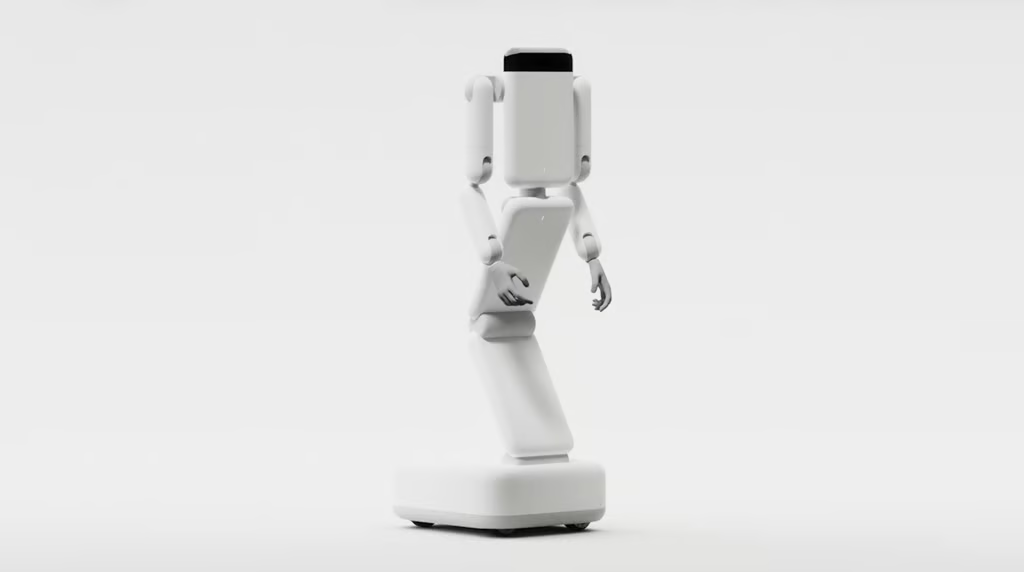


Genesis AI’s Eno robot looks partly humanoid from the waist up, but it moves on wheels.
Unveiled on June 16, 2026, the wheeled robot is aimed at enterprise environments where grasping, moving, and handling objects may matter more than walking. For logistics, manufacturing, and lab operators, Genesis’ pitch is that practical automation does not need to fully resemble a person to be commercially useful.
In its official launch announcement, Genesis described Eno as its first general-purpose robot, with a wheeled base, foldable tower, dexterous hands, and the company’s GENE robotics foundation model. Production and targeted customer deployments are planned by the end of 2026, starting with manufacturing, logistics, and labs.
Eno is testing whether enterprise robots need legs at all.
Why Eno skips the legs
Eno’s design follows a simple premise: many commercial robotics jobs depend more on manipulation than locomotion.
The robot has no head, uses wheels instead of legs, and is built around two arms and dexterous hands. Those hands are meant to work with tools, equipment, and objects already built for people. In warehouses, factories, and labs, the work often depends less on climbing stairs than on grasping, sorting, moving, assembling, or handling varied objects.
The wheeled base is also a practical trade-off. Wheels are simpler to stabilize and power than bipedal legs. Eno cannot climb stairs, but Genesis’ first target environments are mostly flat, structured commercial spaces where that limitation may matter less than uptime, reliability, and total cost of ownership.
That focus lines up with a broader shift toward AI factories and robotics systems built for simulation, digital twins, and industrial deployment. Recent real-world humanoid robot tests have also emphasized stability, adaptability, and long-running tasks — the same proof points Genesis will need beyond demos.
Genesis has funding to test the thesis. The company emerged from stealth in 2025 with $105 million in seed funding co-led by Eclipse and Khosla Ventures, with backers including Bpifrance, HSG, Eric Schmidt, and Xavier Niel.
Genesis’ Paris-and-California footprint puts it outside the usual US-China frame around humanoid robotics, while its $105 million seed round gives it room to test a more constrained enterprise robot design.
Where Genesis still has to prove itself
Genesis says Eno runs on GENE, its generalist robotics foundation model, which the company describes in its official launch announcement as the system behind Eno’s planning, perception, and dexterous manipulation. The company introduced GENE-26.5 on May 7, 2026, showing robotic hands completing tasks including cooking, wire harness assembly, Rubik’s Cube solving, and piano playing.
Genesis also says it built sensor gloves to collect human manipulation data more cheaply than conventional teleoperation systems, a detail that could affect how quickly customers train robots for site-specific tasks.
Cheaper data collection could help Genesis train robots faster and customize them for enterprise tasks. The public evidence is still limited. Business Insider reported that some Genesis demos were trained rather than zero-shot. Most cooking steps reached 90% to 95% success, while one-handed egg cracking and transferring chopped tomato with a knife were closer to 50% to 60% during filming.
Enterprise buyers need proof that Eno can work through a full shift, handle edge cases, meet safety requirements, and deliver a credible return on investment. Recent questions around AI liability and human oversight show why deployment evidence matters as much as model capability.
The next proof points are named customers, unit pricing, payload capacity, safety validation, and full-shift uptime. Until Genesis discloses those details, Eno remains a commercial robotics bet rather than a proven enterprise platform.
The broader enterprise AI shift now spans robotics, agents, governance, and infrastructure, as this Artificial Intelligence Cheat Sheet explains.