







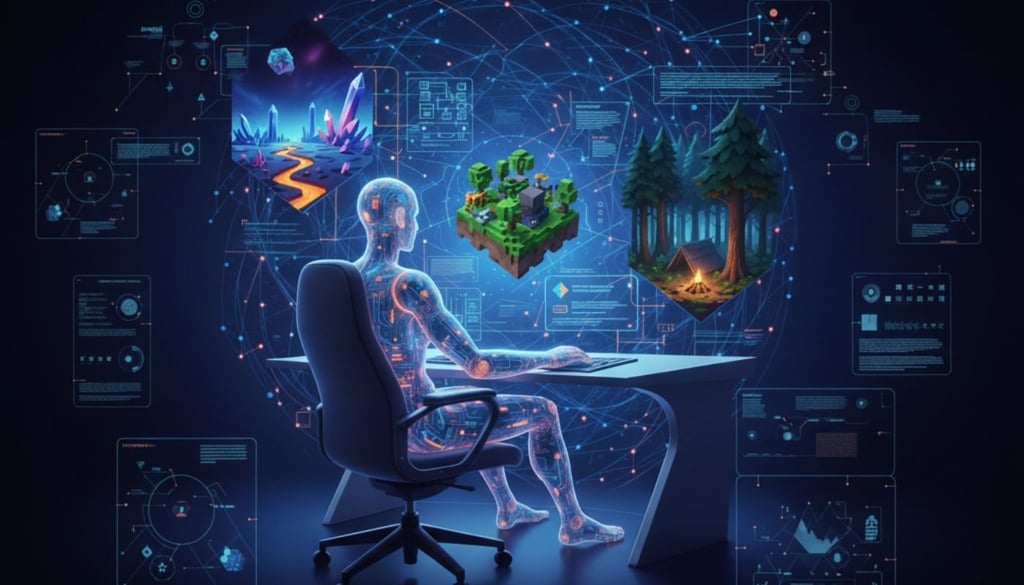
Forget scripted NPCs. Google DeepMind’s upgraded agent SIMA 2 is built to understand what you want, move through 3D worlds on its own, and keep getting better as it plays.
In an announcement from Google DeepMind, the tech giant said SIMA 2 now pairs Gemini’s reasoning engine with the ability to act inside complex virtual environments, turning the experimental system into something closer to a capable in-game teammate.
What SIMA 2 can actually do now
SIMA 2 arrives with a wider skill set than the original model, expanding how the agent understands instructions, moves through virtual spaces, and adapts to new situations. Here’s what DeepMind says the enhanced system can do today.
Reasoning
SIMA 2 is wired with Gemini’s logic engine, giving the agent the ability to break down goals, plan its next move, and explain what it intends to do. Instead of waiting for step-by-step input, it can interpret high-level instructions and execute them inside fast-moving virtual environments.
Generalization
The new model handles tougher instructions and performs reliably in games it was never trained on, including ASKA and MineDojo. It can follow sketches, multilingual prompts, and even emojis, then apply concepts learned in one game to totally different environments. Paired with Genie 3, it can even travel intelligently through freshly generated 3D worlds on the fly.
Self-improvement
SIMA 2 can practice on its own. Once seeded with human demonstrations, the agent creates new tasks, evaluates its attempts, and folds that experience back into training. DeepMind calls this a step toward agents that improve constantly, not through manual gameplay labels.
Next steps toward embodied intelligence
The behaviors SIMA 2 picks up, such as navigation, tool use, and multi-step reasoning, are the same high-level skills needed for real-world robotics. DeepMind says this line of research is helping lay the groundwork for systems that can eventually operate outside the screen.
Responsibility
Because SIMA 2 can self-train, DeepMind is keeping access tight. Google is releasing it as a limited research preview, with only select academics and developers invited to test the agent’s capabilities while safeguards mature.
The live tests that proved SIMA 2’s leap in intelligence
DeepMind researchers backed their claims with on-screen evidence, walking reporters through a series of controlled tests that put SIMA 2’s reasoning on display.
SIMA 2, Google’s new game agent, shows how it plays, reasons, and learns inside 3D worlds.
In one closed-door run, SIMA 2 entered No Man’s Sky, surveyed a rocky terrain, spotted a distress beacon, and advanced toward it.
The team also showcased how SIMA 2 reasons through instructions. When asked to head toward “the house the color of a ripe tomato,” the agent spelled out its thinking — ripe tomatoes are red, therefore the house must be red — before traversing toward the correct building.
The researchers framed these behaviors as a genuine break from the first-generation model.
In another demo, SIMA 2 interpreted emoji-based commands, an axe and a tree symbol, and executed the implied action, chopping down a tree. It also explored photorealistic worlds generated by Genie, correctly recognizing objects like benches, trees, and even butterflies as it moved through the scene.
Early architecture for robots that reason
DeepMind is building the cognitive scaffolding it believes future machines will stand on. The team said the agent’s ability to interpret goals, map out steps, and carry those plans through in unpredictable environments shows the kind of decision-making layer real-world systems will eventually require — the part that understands what needs doing before anything moves.
Researchers emphasized that this work sits upstream of robotics hardware, focusing on judgment, context, and task comprehension rather than motors or mechanics. It’s the strategic side of the equation, not the physical one, and DeepMind is treating this line of research as the framework for machines that will need to operate in varied settings with a clear sense of purpose.
Google is also freshening up the holiday retail rush with new AI-driven shopping features.