






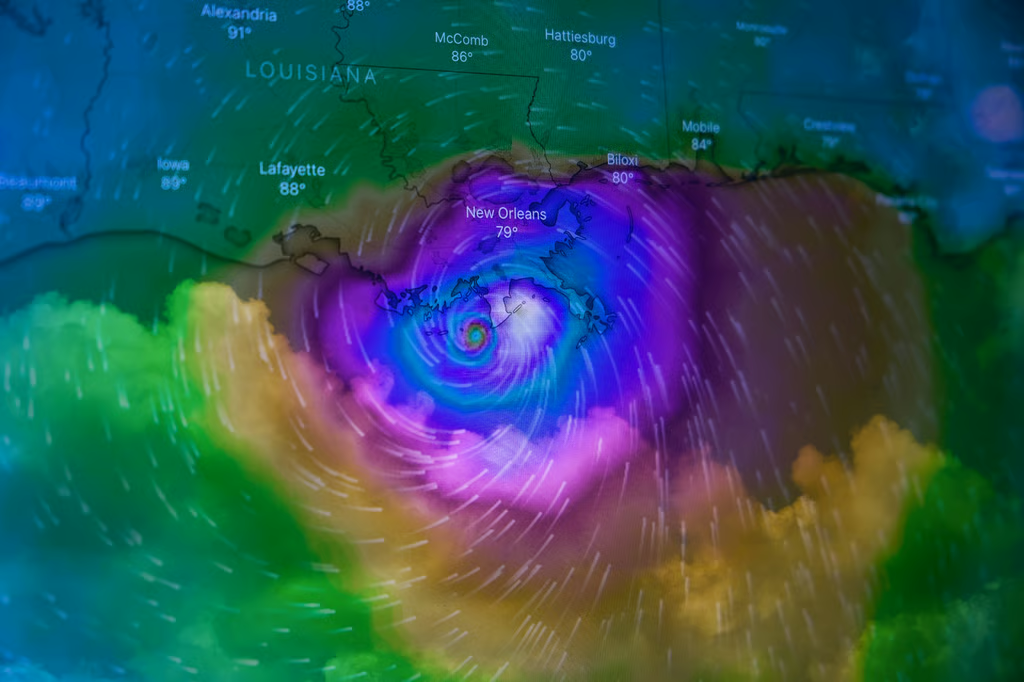


Google DeepMind says it has built an AI weather model that can predict a cyclone's path and strength with enough accuracy to give forecasters about an extra day of warning.
The company announced that its WeatherNext model achieved state-of-the-art accuracy in predicting a cyclone's track, intensity and wind structure, according to a paper published in Nature.
Google DeepMind said the model's three-day forecasts are roughly as accurate as older forecasting systems were at two days, giving meteorologists about 24 additional hours to prepare for dangerous storms.
The research was developed with Google Research and weather experts from organizations including the US National Hurricane Center (NHC), the Cooperative Institute for Research in the Atmosphere and the UK Met Office. Google said the model was trained on nearly 20 terabytes of atmospheric data and historical records from nearly 5,000 storms.
Lower-resolution data, stronger forecasts
One of the most surprising findings is that WeatherNext performs well even though it uses much lower-resolution weather data than traditional hurricane intensity models. The main version operates with data at about 28-by-28-kilometer resolution, which Google said is roughly 100 times coarser than the specialized high-resolution models usually used for intensity forecasting.
Researchers said they do not yet fully understand why the model performs so well with lower-resolution inputs. The system can also generate 1,000 possible storm scenarios, helping forecasters evaluate a range of outcomes, including rapid intensification events.
Hurricane Melissa helped validate the model
Google said the model can produce a 15-day forecast in less than a minute on a TPU, allowing forecasters to quickly evaluate many possible scenarios.
The model's biggest real-world test came with Hurricane Melissa in October 2025.
When Melissa was first identified as a weak tropical depression, WeatherNext predicted with 80% confidence that it would explode into a Category 5 and strike Jamaica five days before landfall.
The storm hit Jamaica as one of the most intense Atlantic hurricanes on record.
Where it falls short
The model isn't a crystal ball. Its skill at predicting rapid intensification remains limited even by Google's own metrics, with a standard accuracy measure improving from below 0.3 to 0.5.
Retired NHC branch chief James Franklin noted, according to Straight Arrow News, that even as WeatherNext gets folded into forecast consensus models, "you're not going to see NHC say, 'We're highly confident in DeepMind, we're taking the forecast to Miami.'"
Still a tool, not a replacement
Officials are careful to frame WeatherNext as one input among many. "There is a human, a very skilled forecaster here … using that expertise to deliver the most consistent, effective forecast, regardless of the inputs that go into it," Michael Brennan, NHC Director, told Straight Arrow News.
For now, the model's real value lies in buying time, the one thing forecasters can never generate on their own.
Alongside the research paper, Google DeepMind released the WeatherNext 2, WeatherNext Cyclones and WeatherNext 2-mini models as open-source software, making the code and model weights available to researchers, weather agencies and nonprofits.
Also read: Google’s Gemini AI can now control humanoid robots from head to toe, although Google’s reported task success rates still ranged from 32% to 92%.