







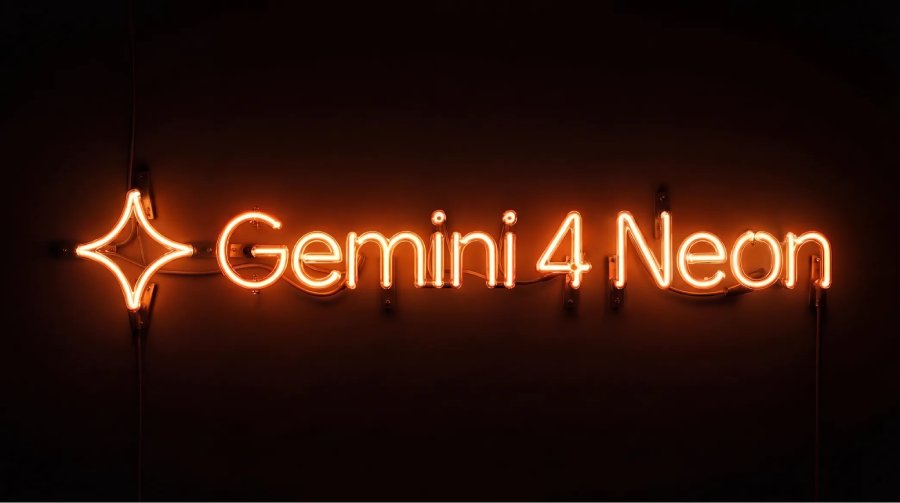
Google’s newest Gemini model makes a case for moving some complex work off its flagship.
The new model is making a bold play for the AI crown, combining high-end reasoning capabilities with a claimed 3x speed advantage over Google's Gemini 4 Carbon, from which it was forked. It also ranks third on Artificial Analysis' Intelligence Index, putting it among the strongest AI models currently available.
But Google's bigger bet isn't simply building another model that can top benchmarks. By making advanced AI cheaper and faster to run, the company wants to bring more demanding workloads, from software engineering and cybersecurity to complex business analysis, within practical reach of enterprises.
Where Neon fits in the Gemini 4 lineup
Gemini 4 Neon is hardly arriving alone. Since introducing Gemini 4 Argon, Google has steadily expanded the model family, unveiling Carbon in October, making it generally available in November, and following up with Hydrogen, before introducing Neon days later.
Neon has a one-million-token context window for inputs such as source code, spreadsheets, and PDFs. It also offers four reasoning levels, from low to extra-high, so developers can adjust how much processing effort the model spends on an assignment. blog.google
What eWeek found: Gemini 4 Neon isn't Google's best at everything
A closer look at Google's published model cards reveals that Gemini 4 Neon isn't designed to replace every model in the Gemini 4 family. Instead, Google is building a lineup that balances reasoning depth, coding capabilities, execution speed, and operating costs.
The distinction becomes clearer when comparing the four models using Google's own descriptions and Artificial Analysis Intelligence Index results.
| Comparison | Hydrogen | Argon | Neon | Carbon |
|---|---|---|---|---|
| Primary focus | Fast, everyday execution | Frontier-level reasoning | Advanced reasoning with greater efficiency | Most demanding, long-running tasks |
| Coding | Everyday coding and agentic workflows | Complex software engineering | Complex coding, debugging and repository modifications | Advanced engineering and multi-agent coding |
| Reasoning | Fast execution with configurable thinking | Deep, multi-step reasoning | Advanced analytical reasoning | Extended reasoning and verification |
| Cybersecurity | No specific defensive focus established in its model card | Cybersecurity defence | Vulnerability discovery, validation and patching | Advanced cybersecurity research and defense |
| Artificial Analysis Intelligence Index (High) | 51 | 50 | 61 | 60 |
Neon’s third-place result in Artificial Analysis’s launch write-up came at extra-high reasoning, where it scored 61. On the dashboard, raising Neon from high to extra-high increased the benchmark cost from $3.74 to $6.44 per task. That’s about 72% more for a one-point gain on the rounded overall index.
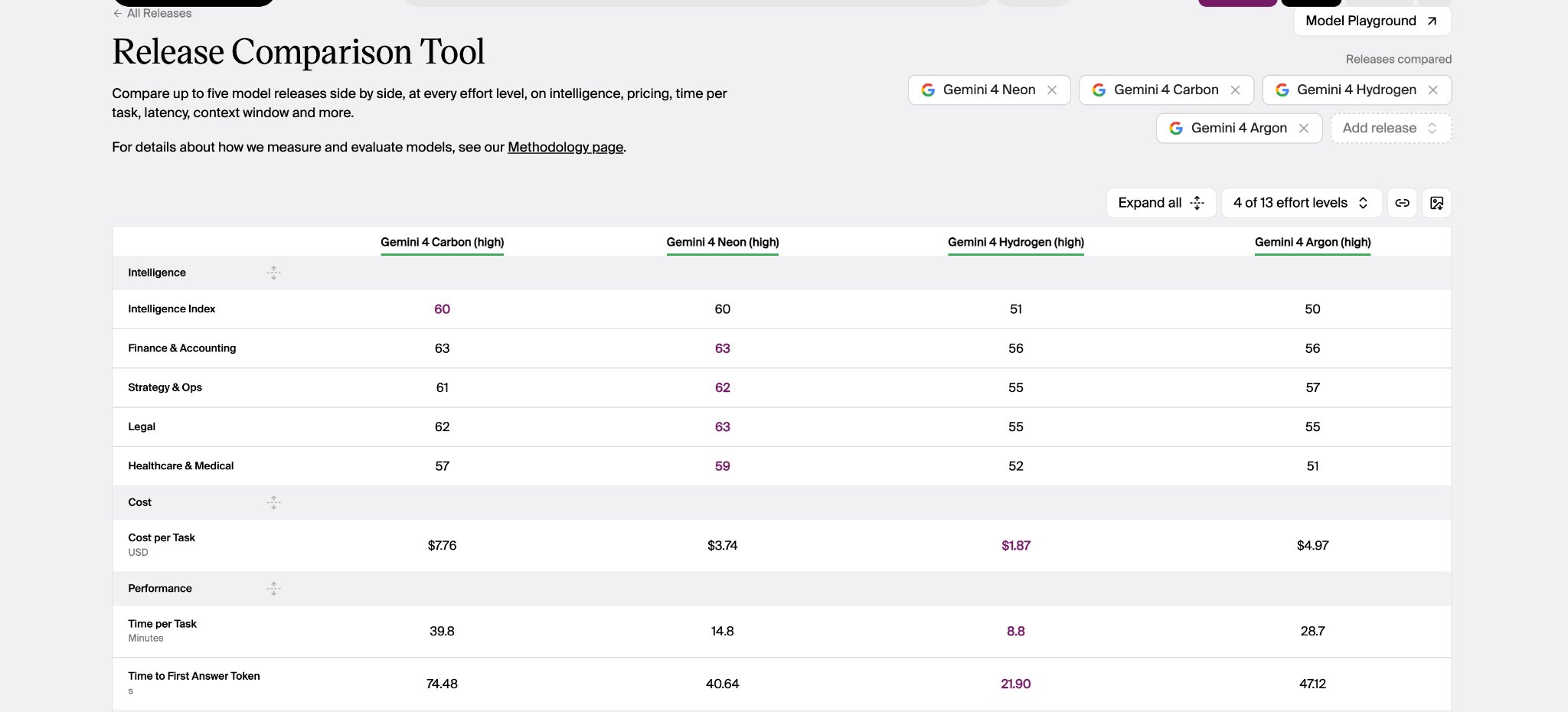
Argon, the first of the four, seems a bit outdated on paper, but that does not necessarily reflect how it may perform in practice, given its frontier-level nature.
Neon’s standard Gemini API rates are $3 per million input tokens and $15 per million output tokens. Carbon’s introductory rates are $2 and $10 through Nov. 30, rising to $4 and $20 on Dec. 1. Artificial Analysis used Carbon’s non-discounted rates in its launch cost comparison, so teams should use the rates they actually pay when estimating savings.
Where you can access Gemini 4 Neon
Google is rolling out Neon across its consumer, developer, and enterprise products, although access depends on the platform and subscription tier.
- Gemini app: Available to Google AI Pro and Ultra subscribers through the model selector.
- Google AI Studio: Developers can access Neon through the Gemini API paid tier. Google AI Pro and Ultra subscribers can also try it in AI Studio.
- Android Studio: Developers can use Neon through the Gemini API.
- Google Antigravity: Available to Google AI Pro and Ultra subscribers, with support for agentic coding workflows.
- Gemini for business: Available through the API and model selector for enterprise users.
- Cybersecurity defenders: Google is also extending access to eligible defenders through its Fairwind Program.
The rollout gives consumers and enterprises several access paths to accessing Neon's advanced reasoning capabilities.
Who stands to benefit from Gemini 4 Neon?
Gemini 4 Neon could be particularly useful for businesses and developers that need advanced AI capabilities but cannot justify the cost or waiting time associated with larger models. Its combination of complex reasoning, coding capabilities, multimodal processing, and lower claimed operating costs gives organizations more room to automate work without routing every assignment through their most expensive AI model.
Software engineering teams could use Neon to analyze large codebases, debug applications, and assist with complex development tasks. The model can also benefit cybersecurity teams through its vulnerability research and code-analysis capabilities.
Financial analysts, researchers, and other knowledge workers could also use its long-context processing to examine large document collections, compare information, and produce detailed reports.
However, enterprises should test Neon against their actual workloads before adopting it at scale. Google's benchmark results and cost claims are promising, but its benefits will depend on real-world performance, data-handling requirements, adherence to instructions, and security.
Neon's biggest selling point may not be that it is Google's newest AI model, but that it could make advanced AI reasoning more affordable to use regularly.
Thinking about putting AI agents to work on your team? Explore AI courses from The Neuron Academy to build the skills to evaluate where agents can help and where you still need a human in the loop.