





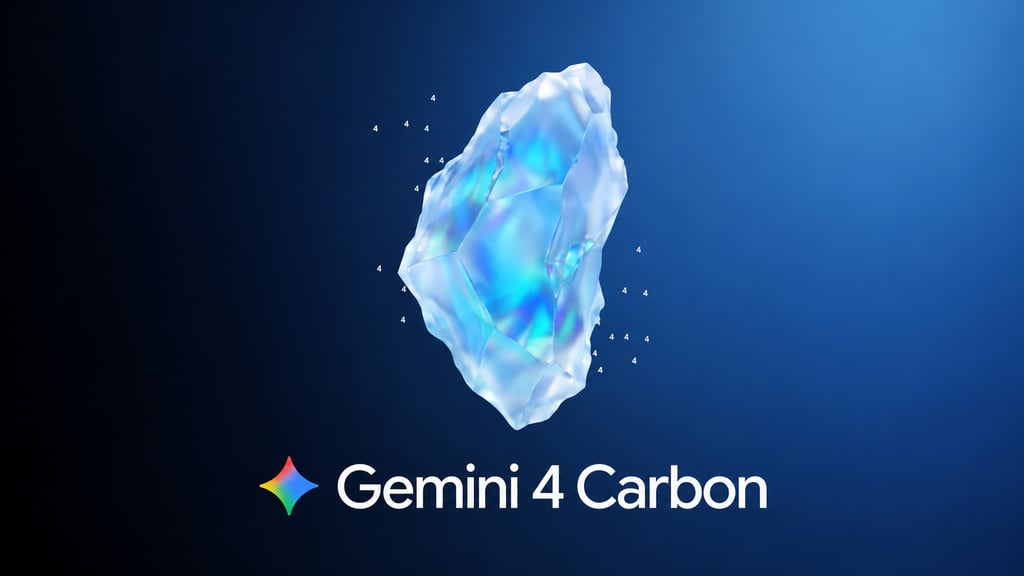
Google’s newest reasoning model is now available to businesses, but its advanced capabilities could come with higher operating costs — even though its per-token prices match Gemini 4 Argon.
On November 10, Google opened Gemini 4 Carbon to paying developers and enterprises, expanding beyond an October 28 rollout to selected cybersecurity defenders. Introductory API prices expire November 30, with standard input and output rates doubling December 1.
That leaves enterprise AI teams with a decision: Does Carbon's deeper reasoning justify the additional computing costs, or can Gemini 4 Argon handle the same workloads more economically?
Gemini 4 Carbon pricing and enterprise access
In its November 10 announcement, Google positioned Carbon for complex coding, scientific research, cybersecurity, and multistep AI workflows. The model is available through its paid developer API and enterprise products.
Google's published API rates show the following changes, priced per million tokens:
| Token type | Through Nov. 30 | From Dec. 1 |
|---|---|---|
| Standard input | $2 | $4 |
| Standard output | $10 | $20 |
| Cached input | $0.10 | $0.20 |
Carbon supports implicit caching but not explicit caching. Separate pricing applies to Batch, Flex, and Priority processing.
The higher rates also put API security in focus. As stolen enterprise AI credentials can generate substantial unauthorized charges, businesses testing Carbon need usage monitoring and access restrictions alongside cost controls.
Google's specialized Carbon for cyber remains restricted through its Fairwind Program. Separately, Palo Alto Networks reported significant gaps in vulnerability detection among models it evaluated, reinforcing the need for independent security testing. That research did not assess Carbon's performance.
Access also varies across enterprise platforms. Google Cloud's release notes confirm Carbon's availability in Gemini Enterprise's web and mobile apps, Workflow Builder, and AI developer tools.
Administrators must enable Carbon for web and mobile users. Licensed developer-tool users receive access under default model settings, while organizations using custom authorized-model lists must approve it separately.
Meanwhile, GitHub added Carbon to Copilot for eligible paid plans, including Business and Enterprise. Its gradual rollout includes administrator controls and separate usage-based billing.
What eWeek Found: Equal token rates can produce different AI costs
Carbon's December price increase is not unique. Gemini 4 Argon carries identical published API rates, including the upcoming increase documented in eWeek's October 15 coverage.
Google recommends Argon for most engineering and knowledge tasks, reserving Carbon for more demanding reasoning. Carbon can consume additional billable output tokens during extended processing, potentially making individual tasks more expensive despite identical rates.
An eWeek calculation illustrates the difference:
| Hypothetical workload | Through Nov. 30 | From Dec. 1 |
|---|---|---|
| 10M input + 1M output tokens | $30 | $60 |
| 10M input + 2M output tokens | $40 | $80 |
These calculations use standard, uncached API rates. They are not measured Carbon-versus-Argon results and exclude additional charges, retries, and other workload differences.
For businesses, completed-task cost is a more useful benchmark than token pricing alone. A model that consumes more tokens could still justify its expense if it produces better results with fewer retries or less human intervention, but that benefit must be demonstrated.
Before routing production workloads to Carbon, platform teams should test representative tasks at December rates, measure reasoning-token consumption, and verify administrator access controls. The introductory discount offers a testing opportunity, not evidence of long-term cost efficiency.
Want to learn more AI tips, tricks, and prompting techniques? Let us teach you How to Talk to AI for free! Try our six-minute course at The Neuron Academy, our practical learning platform designed to help professionals use AI more confidently at work.
Learn a few simple ways to write better prompts and get more useful results from AI, or browse our other AI course for free for seven days. eWeek readers get free 7-day access. Check out all the lessons here →