







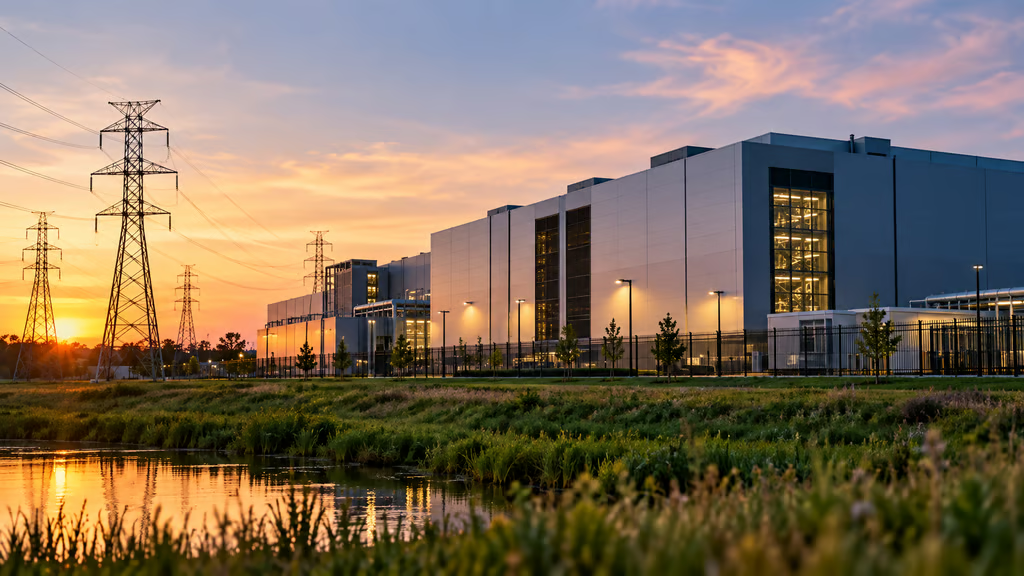
Google, Meta, Microsoft, and other members of the AI Infrastructure Coalition have agreed to cover the full energy costs created by their data centers instead of passing those costs to other utility customers.
The commitment is part of five Community Principles announced Sept. 30 as AI companies race to build the power-hungry infrastructure needed for larger models and services.
The AI Infrastructure Coalition says participating companies will build, bring, or pay for new generation and transmission needed by their facilities. Google, Meta, and Microsoft are among the coalition's members.
Data center companies make five commitments
Protecting ratepayers is the first principle. The coalition says large data center customers should work with utilities on rate structures that make them pay the costs created by their own electricity demand.
That has become a bigger issue as AI data center power demand puts pressure on grids that can take years to expand.
Microsoft has already described electricity and ready-to-use data center capacity as constraints on how quickly it can deploy more AI infrastructure. Its AI power bottleneck comes even as customer demand for Azure capacity continues to grow.
AIIC's other commitments cover four areas:
- Community investment: Support local priorities such as schools, roads, hospitals, and emergency services.
- Water and environmental impacts: Minimize water use, invest in water infrastructure where appropriate, and reduce construction and noise impacts.
- Local jobs: Prioritize local hiring and support technical education and workforce training.
- Community support: Engage residents and local leaders early and provide more transparency around proposed projects.
Those commitments extend beyond electricity. Data centers also carry water and land costs that can vary substantially depending on the location, cooling system, electricity source, and size of the facility.
What eWeek found: The pledge still has to work on paper
A Minnesota utility case filed one day after AIIC's announcement gives a useful look at what "paying the full cost" can involve once a data center reaches the contract stage.
The Minnesota Attorney General's Office is challenging parts of a proposed 15-year electricity agreement between Xcel Energy and Google for Google's planned Pine Island data center.
The office says Xcel has not yet demonstrated that Google would cover every cost attributable to the project or that other customers would be protected if Google reduces its electricity demand or leaves the system early. Xcel, meanwhile, projects the agreement would provide more than $1.1 billion in net benefits to other customers. The Attorney General's analysis says the result could instead be closer to $1 billion in net costs.
The Minnesota Public Utilities Commission has not ruled on either estimate, and the case is separate from AIIC's voluntary principles.
Reading the coalition's pledge alongside the Minnesota filing puts three practical questions in focus for large-load agreements:
- Who pays for new infrastructure? Contracts need to account for generation, transmission, and other investments required specifically to serve the data center.
- Who carries the risk if demand changes? Utilities may still have infrastructure costs if a customer uses less electricity than expected or ends an agreement early.
- Can regulators verify the numbers? Minnesota's Attorney General argues that extensive redactions in Xcel's filing make it harder to judge the potential impact on other ratepayers.
Minnesota law already requires costs attributable to very large customers to be assigned to those customers and includes protections against stranded costs.
AIIC's members are now making a similar commitment voluntarily. The Minnesota proceeding offers an early example of the details regulators may examine before deciding whether that promise is reflected in an actual utility agreement.
Also read: Europe is expanding its own AI infrastructure capacity as French supercomputer maker Bull doubles production to meet growing demand.