







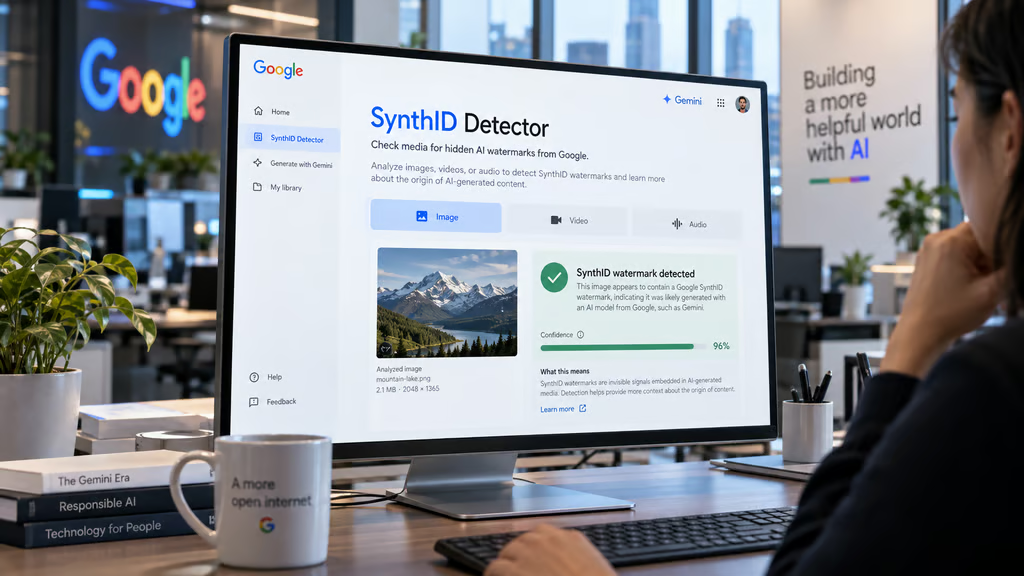
A convincing image can still carry an invisible clue that AI made it.
Google announced on Oct. 7 that its SynthID Detector website is available globally in English, allowing people to check images, videos, and audio for supported AI watermarks. Access previously began with journalists, media professionals, and researchers.
For businesses reviewing suspicious media or checking AI-generated marketing assets, the site offers another verification step. A watermark can indicate AI involvement, but cannot establish whether the content’s claims are true.
Inside SynthID's watermark checks
Visitors can upload a file to SynthID Detector, which scans for a digital watermark embedded when compatible AI software creates or alters content. According to Google DeepMind, the marks are invisible in images and videos and inaudible in recordings, so media can retain its original appearance or sound. Google’s 2025 Detector announcement described highlighting image regions and audio segments most likely to contain a watermark.
Google says image watermarks can survive common edits such as cropping and compression. Audio watermarks can also remain detectable after MP3 compression or changes in playback speed. Images created with Nano Banana 2 carry SynthID alongside other content provenance information.
Detection has proved helpful in real cases. In July, fact-checkers identified a fabricated hospital photo of Sen. Mitch McConnell after finding its embedded watermark. Still, a positive match cannot establish whether the claims depicted are true. An unsuccessful scan also cannot certify that a recording or image is authentic, since other AI systems may leave no compatible watermark.
More AI providers join the verification system
Google extends verification to compatible media from participating AI companies. OpenAI, Nvidia, and South Korea's Kakao are among the named partners, with Apple expected to join. A shared detector offers one place to check supported content from different providers, although compatibility does not extend to every product or output they generate.
Adoption has grown considerably since SynthID debuted in 2023. The tech company reports watermarking more than 180 billion images and videos, alongside audio equivalent to 240,000 years. Its technology appears in products ranging from Veo's video-generation tools to Lyria's AI music capabilities.
Verification was available through existing Google products before the standalone site opened publicly. Google says its verification features across Search, the Gemini app, and Chrome now regularly handle more than 1 million requests daily.
What eWeek found: Text verification can remain private
A comparison of Google’s public Detector announcement and its SynthID Text developer documentation shows an important distinction: the public rollout covers images, video, and audio, while organizations implementing SynthID Text separately can control access to their text detector.
Google offers three ways to control access to SynthID Text verification.
- Fully private detection. Organizations keep the detector internal, preventing outsiders from independently checking watermarks.
- Semi-private detection. Verification is available through an API, with access controlled by the organization.
- Public detection. Organizations release the detector for others to download and use independently.
SynthID Text checks for watermarks embedded during generation, unlike conventional AI writing detectors that analyze writing patterns. Google's original 2025 Detector announcement discussed text verification, but the new public website advertises checks only for images, video, and audio. Official documentation confirms private detection options for text but does not establish similar restrictions for other media formats.
A document can therefore carry a SynthID Text watermark without giving recipients access to a compatible detector. Even with access, detection is probabilistic, and extensive rewriting or translation can reduce confidence in the result. Consider a business using AI to prepare customer communications or regulated reports. If a customer or auditor later disputes a document's origin, they may have to rely on the business to provide verification.
Organizations adopting SynthID Text should decide in advance whether external parties can check their documents through an API or publicly available detector. Retaining original files and editing records can also help substantiate AI-use disclosures when questions arise later.
More AI news: Mistral’s latest flagship model targets larger workloads with a 1M-token context window and a more expensive API.