







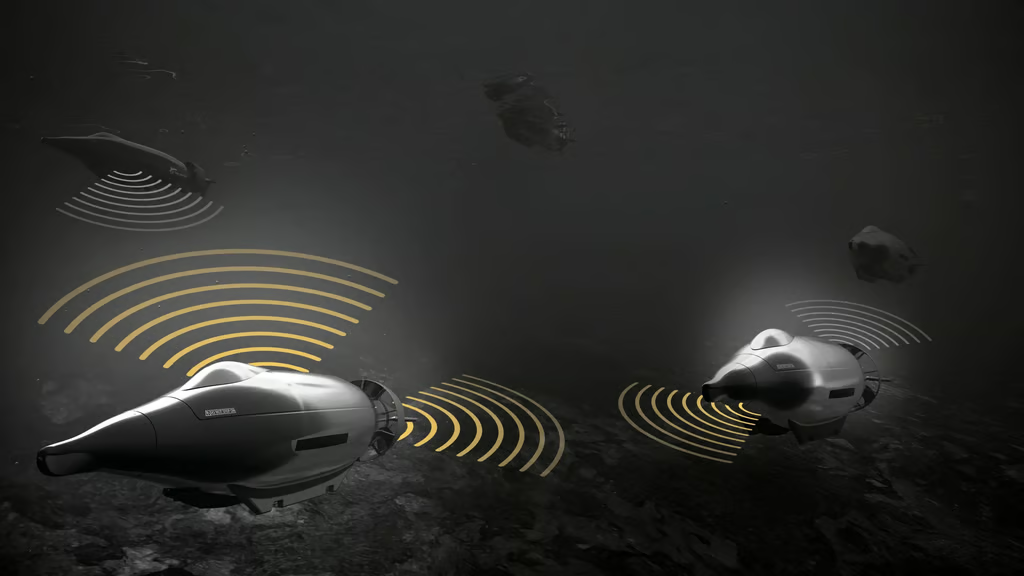
It swims like a predator. Looks like a shark. Hunts in packs. But this creature doesn’t eat fish… it guards the undersea cables that keep the modern world online.
A German defense-tech firm, Euroatlas, has rolled out a new underwater robot called Greyshark, a long-endurance autonomous underwater vehicle (AUV) designed to patrol and safeguard the world’s vast seabed infrastructure. The company says the system was built to operate with minimal human involvement and to address rising concerns about the security of subsea communication lines.
These cables, stretching roughly 800,000 miles, carry more than 95% of the world’s internet traffic and trillions of dollars in financial transfers each day. Recent incidents in the Baltic Sea and growing geopolitical tensions have forced governments to act faster.
According to Euroatlas, Greyshark’s design centers around stealth and independence. The robot’s low-noise electric motor, composite hull, and bio-inspired shape help it move stealthily underwater while staying hard to detect.
The company explained that multiple units can operate together as a coordinated group, sharing data in real time through secure underwater communication. The company also noted that the robot can “hold their position passively on the seabed and activate at critical events, such as the identification of a specific vessel,” per Interesting Engineering.
Using a stack of advanced sensors, including sonar, lidar, electromagnetic scanners, cameras, and laser imaging, Greyshark can map cable routes, spot anomalies, and detect objects such as mines or unauthorized vehicles near key underwater corridors.
NATO increases watch as cable attacks raise alarm
Greyshark’s introduction coincides with NATO’s expanded focus on subsea infrastructure monitoring. Following several cable disruptions in 2024, the alliance launched its Baltic Sentry surveillance initiative.
NATO Secretary-General Mark Rutte, quoted by Interesting Engineering, warned that “there is reason for grave concern,” noting that undersea cables are vital for communications and energy transmission. He added that NATO would do “what it takes” to ensure the network’s protection.
NATO members have been increasing patrol aircraft, warships, and unmanned systems. Euroatlas’s AUV is already of interest to several European nations, and its ability to detect underwater changes as small as two square centimeters was highlighted during demonstrations.
According to Reuters, Euroatlas has secured two contracts with European defense ministries worth “more than 100 million euros.”
CEO Eugen Ciemnyjewski told the outlet that the Greyshark systems were acquired for a “special military application,” though the drones “would not be weaponised.” Reuters also reported that interest is coming from countries across Europe and Asia, as navies worldwide seek unmanned systems capable of long underwater deployments.
A recent breakdown of AI-driven job cuts in 2025 examines how automation has pushed US layoffs past the one million mark.