






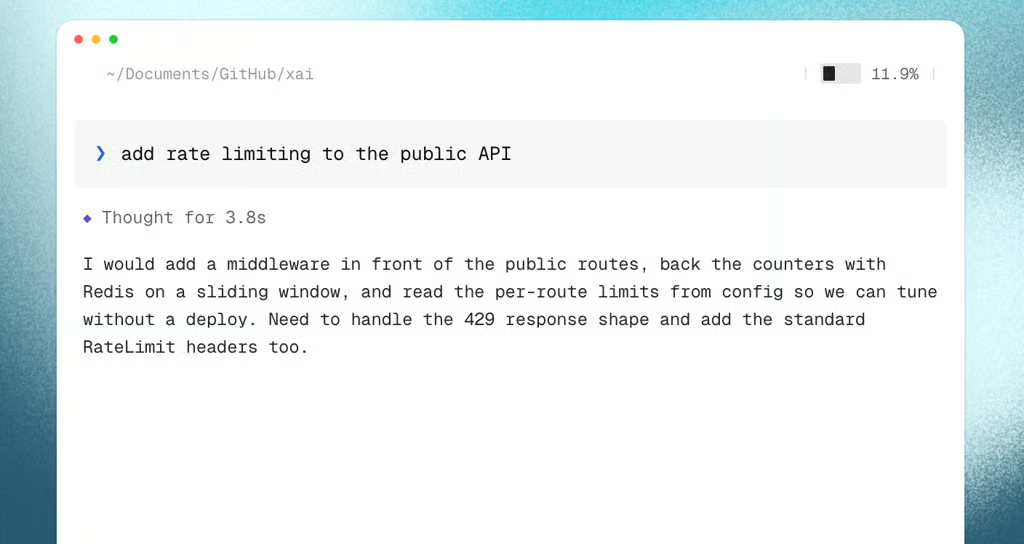


SpaceXAI released Grok Build 1.0.0 on Aug. 7, adding fuller command-approval prompts and changes to sandbox startup and remote session recovery. The release follows a rapid expansion of the coding agent’s automation capabilities, including workflows that can coordinate hundreds of parallel agents.
The version arrives less than a month after researchers found an earlier Grok Build release sending complete Git repositories to cloud storage before SpaceXAI disabled the behavior. As the tool takes on larger automated jobs, enterprises have more reason to scrutinize permissions, sandboxing, network access, and data-retention policies before giving agents access to proprietary code.
Version 1.0 exposes more before commands run
According to SpaceXAI’s Grok Build 1.0.0 changelog, permission prompts now display the complete script an agent intends to run, with long Bash commands expandable before approval. The release also fixes sandboxed startup on large directories and changes remote resume so conversations are restored by default while code is restored only when a user explicitly passes --restore-code.
Those changes sit alongside enterprise deployment controls that include team-level Zero Data Retention, centrally pinned configuration, authentication restrictions, sandbox profiles, allow-and-deny rules, and a setting that can prevent users from enabling always-approve mode.
The controls gained urgency after the July Grok Build repository-upload incident, when researcher Cereblab found version 0.2.93 packaging complete Git repositories, including commit history, and sending them to Google Cloud Storage. SpaceXAI stopped the whole-repository transfer and later said retained coding data had been deleted, although no publicly cited independent audit has verified historical deletion.
SpaceXAI later open-sourced the Grok Build harness, allowing developers to inspect how context, tools, commands, extensions, and subagents are handled. Its current documentation does not establish what happened to repositories transferred before the July fix.
Parallel agents make configuration more consequential
Workflows enabled by default on July 22 can divide large jobs among multiple agents. SpaceXAI says runs receive a default budget of 128 agents and can use as many as 1,024 for larger jobs, with separate agents able to investigate, review, verify, and combine results.
More parallel activity increases the consequences of an overly broad permission or network policy. Separate research showed how a clean-looking GitHub repository can manipulate AI coding agents that read project instructions and execute commands inside developer environments.
Organizations deploying Grok Build should determine which permission modes developers can use, what network destinations agents can reach, where credentials are exposed, and whether sandbox and retention policies remain enforced during headless and multi-agent runs. Those concerns are part of a broader enterprise AI governance gap as autonomous systems move from answering prompts to taking actions across business and development environments.
Grok Build 1.0.0 gives users more visibility before approving commands. Parallel agents, reusable workflows, and automated execution put more weight on centrally enforced controls that developers cannot accidentally or intentionally bypass.
Read more: Teams comparing SpaceXAI’s developer stack can also examine how Grok 4.5 targets enterprise coding workloads as model performance, agent autonomy, security, and cost converge in platform decisions.