







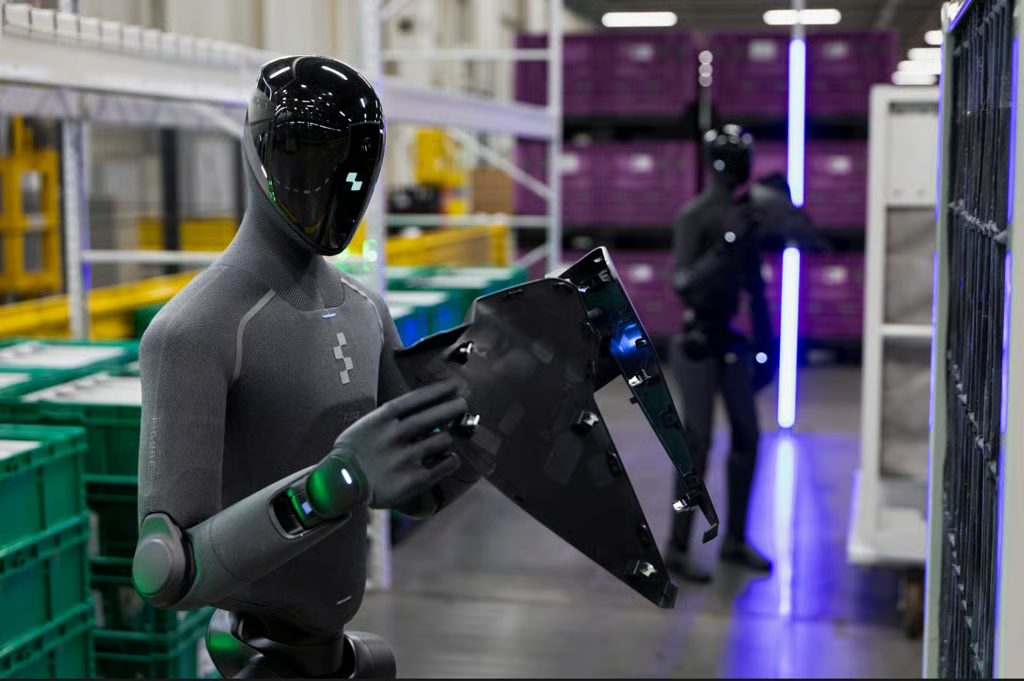
Humanoid robots are moving beyond flashy demonstrations and into real factories and warehouses. But which companies are actually delivering results?
On Oct. 26, GXO and Agility Robotics announced plans to expand their humanoid robot deployments to two additional US facilities in early 2027. Agility's Digit has already moved more than 100,000 totes at a Georgia warehouse, offering measurable evidence of real-world performance.
As Tesla, Figure AI, Boston Dynamics, Apptronik, and UBTech push toward broader commercialization, 2027 could reveal which humanoid robots are ready for everyday industrial work and which still have more to prove.
- Agility Robotics expands Digit deployments for 2027
- Which humanoid robot companies are closest to deployment?
- Figure AI: BMW moves from Figure 02 to Figure 03
- Apptronik: Apollo 2 trains for real-world industrial work
- Boston Dynamics: Atlas expands industrial training and customer plans
- Tesla: Optimus targets outside customers in late 2027
- UBTech: China reports growing humanoid robot deliveries
- What eWEEK found: Who's leading the humanoid robot race?
- What is preventing humanoid robots from scaling?
- What businesses should watch in 2027
Agility Robotics expands Digit deployments for 2027
According to GXO's Oct. 26 announcement, Digit robots will be introduced at company facilities in Statesville, North Carolina, and Lebanon, Tennessee. Both locations support e-commerce fulfillment, and the robots will perform repetitive material-handling tasks.
The deployments are expected to begin in early 2027 with Digit 4, then transition to Digit 5 when the newer model becomes commercially available. The agreement builds on a partnership that began with a proof-of-concept project in late 2023 and became a multiyear commercial agreement in June 2024.
At GXO's Flowery Branch, Georgia, warehouse, Digit performs repetitive material-handling work, including moving totes and placing them onto conveyors alongside existing automation equipment. The companies report that Digit has moved more than 100,000 totes at the facility, demonstrating that humanoid robots can perform useful tasks within an established logistics operation.
According to Agility, Digit robots have accumulated more than 65,000 hours of real-world operation across commercial deployments and customer programs. The figure is cumulative across multiple robots and sites and reflects the company's operating experience prior to Digit 5's commercial availability. It should not be interpreted as the operating history of a single robot or the newly introduced Digit 5.
Agility's commercial activity also extends beyond its established GXO deployment.
In a separate Oct. 26 update, the company described three additional enterprise manufacturing customers participating in paid programs focused on specific industrial applications. These customers include a major global automaker, an automotive technology and components supplier, and a consumer products manufacturer. Agility has not publicly identified them, and their paid programs should not be confused with full-scale deployments.
The company has also established relationships with several named enterprise customers.
Toyota Motor Manufacturing Canada signed a commercial agreement following a pilot, while Schaeffler is an investor and customer pursuing Digit for automotive manufacturing. Agricultural equipment manufacturer AGCO signed an October agreement for a pilot at its Hesston, Kansas, production facility, with work expected to begin in 2027.
Mercado Libre has signed a commercial agreement to introduce Digit at its San Antonio, Texas, fulfillment facility, with potential expansion into additional Latin American operations. The agreement establishes a planned integration, but it does not demonstrate that the robots have already begun sustained commercial work at that location.
These relationships represent different stages of commercialization, from completed pilots and signed agreements to planned evaluations and operational deployments. They strengthen Agility's enterprise customer base but do not establish that every partner has robots performing sustained commercial work.
Agility also reported more than 30 prospective customers engaged in active commercial discussions or participating in its Customer Acceleration Program. The program allows businesses to evaluate Digit against specific operational requirements and prepare for potential deployments.
The company says its prospective-customer pipeline spans manufacturing, automotive, aerospace, defense, logistics, and consumer products. However, those discussions do not mean all 30 companies have signed deployment agreements. The company also identified two potential defense subcontractor engagements that remain in early discussions without signed agreements.
Agility also reports more than $300 million in committed multiyear orders for Digit 5, subject to contractual milestones, product features, and specifications. The figure represents potential value to be realized over time, rather than current-period revenue or robots already delivered.
Digit 5 is designed for a broader range of industrial tasks, with improvements intended to support safer operation near people and greater flexibility in warehouses and factories. Agility expects early customer access to begin in the first half of 2027, with general availability targeted for the end of the year.
As eWEEK previously reported, Digit 5 targets longer workdays by improving its battery and charging capabilities. The next test for Agility will be whether Digit can deliver comparable performance across multiple fulfillment and manufacturing environments with different layouts, workloads, and operating requirements.
Which humanoid robot companies are closest to deployment?
Several companies have reached meaningful milestones, but their achievements are not directly comparable. Operating hours, completed tasks, robot deliveries, customer pilots, and manufacturing plans measure different aspects of commercial progress.
Company | Robot | Documented progress | What to watch in 2027 |
|---|---|---|---|
| Agility Robotics | Digit | Ongoing commercial GXO operations; more than 65,000 cumulative operating hours reported across Digit customer programs and commercial operations; additional paid customer programs and enterprise agreements | Expansion to two GXO facilities and Digit 5 customer availability |
| Figure AI | Figure 02 and Figure 03 | Completed BMW production pilot; Figure 02 fleet largely decommissioned; Figure 03 logistics sequencing demonstration | Sustained Figure 03 operating results and additional industrial tasks |
| Apptronik | Apollo 2 | Active robot training and data collection at Robot Park and customer sites | Commercial Apollo 3 deployments and autonomous task performance |
| Boston Dynamics | Atlas | Industrial training underway at Hyundai's robotics center | Larger training facility, additional customers, and progress toward production-line use |
| Tesla | Optimus | Tesla-reported early production ramp of production-quality robots at Fremont; external deployments not established | Targeted late-2027 business deliveries and verified workplace results |
| UBTech Robotics | Walker series and other humanoids | Reported industrial robot deliveries and orders; 921 units in first-half 2026 sales volume across its full-size humanoid robot products and services business | Verified industrial deployment figures, operating hours, and customer productivity |
Based on publicly disclosed operating evidence, Agility has the strongest documented case for ongoing commercial warehouse deployment among these six companies. Figure AI follows with substantial evidence from BMW's completed production pilot, while UBTech has reported significant sales volume but lacks equally detailed public operating performance metrics.
Boston Dynamics, Apptronik, and Tesla are progressing along different commercialization paths. Their manufacturing, training, and customer-development milestones are meaningful, but they do not yet provide directly comparable evidence of sustained external industrial operations.
These distinctions matter because companies do not consistently disclose the same metrics, including uptime, task completion rates, intervention frequency, and operating costs. The comparison therefore reflects the evidence available publicly, rather than an independently audited ranking of the broader humanoid robotics industry.
Figure AI: BMW moves from Figure 02 to Figure 03
Figure AI has demonstrated that humanoid robots can perform repetitive manufacturing work inside an active automotive plant. According to BMW's production results, released in February 2026, Figure 02 supported production at the automaker's Spartanburg, South Carolina, facility during a 2025 pilot.
Over approximately ten months, the robots:
- Handled more than 90,000 sheet-metal components.
- Accumulated approximately 1,250 operating hours.
- Supported production of more than 30,000 BMW X3 vehicles.
- Performed repetitive positioning tasks during regular production shifts.
BMW said Figure 02 operated five days a week in ten-hour shifts, retrieving and positioning components for welding. The work was more substantial than a brief demonstration because it required the robots to perform repeatable tasks in a live production environment. However, BMW described the completed project as a pilot, and its results do not establish permanent, large-scale deployment.
BMW and Figure AI are now exploring a more complex logistics sequencing application with Figure 03 at Spartanburg. In a June 25 announcement, BMW described a workflow in which Figure 03 would pick components from unsorted containers and organize them into trolleys for delivery to assembly stations.
Figure AI subsequently demonstrated Figure 03 performing the sequencing workflow at BMW's Spartanburg plant on June 30. The demonstration showed the robot manipulating components, adjusting its body position, and moving a wheeled cart through the work area.
The demonstration represents progress toward more complex industrial tasks, but Figure AI and BMW have not disclosed sustained production results for Figure 03 comparable to those from the Figure 02 pilot. The distinction is important because successfully demonstrating a workflow does not establish that a robot can perform it continuously across production shifts.
In a Sept. 30 announcement, Figure AI said it had decommissioned most of its Figure 02 fleet, melting down the robots to protect proprietary hardware while retaining a few in storage.
The company said maintaining the older fleet was no longer practical as its Figure 03 fleet expanded. Figure also indicated that the time required to dismantle each robot would have delayed development of Figure 04, its planned successor platform.
The decision reflects Figure AI's broader shift toward newer generations of hardware, building on lessons from the BMW pilot. However, Figure 03 has not yet demonstrated the same publicly documented production results as its predecessor, making sustained customer performance a critical milestone for 2027.
Separately, BMW is testing Hexagon Robotics' AEON humanoid robot at its Leipzig plant in Germany. According to BMW's Leipzig overview, the project focuses on applications such as high-voltage battery assembly and component manufacturing. It is separate from Figure AI's work at Spartanburg.
As eWEEK previously examined in its coverage of BMW's factory AI projects, deploying humanoid robots also requires coordination between production IT, safety teams, operational processes, and existing automation systems. For Figure AI, the next important milestone is demonstrating that Figure 03 can reproduce and expand upon its predecessor's results across more complex workflows and production environments.
Apptronik: Apollo 2 trains for real-world industrial work
Apptronik has moved beyond early customer evaluations by deploying Apollo robots in training and data-collection environments.
In March 2025, Mercedes-Benz confirmed that Apollo robots were collecting data at its Digital Factory Campus in Berlin. Employees used teleoperation and augmented reality to transfer production knowledge to the robots, training them to perform tasks such as transporting components and conducting initial quality checks.
Mercedes-Benz said it was working toward enabling Apollo to perform those operations autonomously. Apptronik expanded that approach in June 2026 with the introduction of Apollo 2 and an expanded Robot Park training program.
According to Apptronik's June 30 announcement, fleets of Apollo 2 robots are collecting real-world data at its Austin facility and customer and partner locations. The company's nearly 90,000-square-foot Austin training center supports robot learning across manufacturing, logistics, retail, and other industrial applications.
Apollo 2 is available in bipedal and wheeled-base configurations. The robots use a combination of teleoperation and autonomous execution to collect training data, which supports Apptronik's work with Google DeepMind on Gemini Robotics models and development of its next-generation commercial platform, Apollo 3.
The distinction is important: Apollo 2's active training operations demonstrate real-world experience, but they do not establish that the robots are independently completing industrial production tasks at commercial scale. For Apptronik, the next major milestone is translating those training programs into sustained customer operations with measurable productivity and reliability.
Boston Dynamics: Atlas expands industrial training and customer plans
Boston Dynamics is moving its electric Atlas humanoid robot toward industrial applications.
In January 2026, the company unveiled the product version of Atlas and said its planned 2026 deployments were committed to Hyundai and Google DeepMind. The announcement described scheduled shipments rather than independently confirming that every planned robot had already been delivered.
Boston Dynamics also said additional customers would follow in 2027. In September, the company opened its Robotics Metaplant Application Center at Hyundai Motor Group's manufacturing campus near Savannah, Georgia. Atlas robots are already undergoing training there for industrial tasks, including preparing and sequencing automotive components.
The center serves as a testing and training environment for integrating humanoid robots into Hyundai's manufacturing operations. Boston Dynamics plans to move the training program into a new building in 2027 that will be approximately 10 times larger than its current facility. The expansion is intended to support more extensive robot training, data collection, and preparation for future industrial applications.
The company also plans to explore additional uses with customers in industries including manufacturing, logistics, aerospace, semiconductors, food and beverage, and life sciences. Those activities could expand Atlas's exposure to real industrial environments, although the training-center expansion should not be confused with production-line deployment.
Hyundai has identified 2028 as a target for certain parts-sequencing applications in manufacturing. That timeline illustrates the difference between developing robots in a factory environment and integrating them into regular production operations.
Atlas has entered factory testing, marking an important step toward industrial applications. The key question for 2027 is whether Boston Dynamics can translate training and initial customer programs into sustained, measurable operations.
Tesla: Optimus targets outside customers in late 2027
Tesla says it has begun an early production ramp of Optimus at its Fremont, California, facility, producing what the company describes as its first production-quality humanoid robots. The claim appears in Tesla's third-quarter 2026 shareholder update, filed with the US Securities and Exchange Commission on Oct. 21.
According to Tesla, Optimus production has begun on its manufacturing lines, and the company considers its current process suitable for commercial production. However, Tesla expects additional changes to the robot's hardware and manufacturing process as development continues.
The shareholder update categorizes Optimus's manufacturing in California as an early production ramp, while the company's planned Texas manufacturing expansion is still under construction. Tesla has not disclosed Optimus production volumes or independently verified operating results from external customers.
During Tesla's Oct. 21 earnings discussion, CEO Elon Musk described the effort as an early stage of production and cautioned that scaling manufacturing would take time. He said much of the equipment for a planned high-volume production line was already in Fremont, but emphasized that increasing output would depend on resolving design, manufacturing, and supply-chain challenges.
Musk also acknowledged unresolved technical issues involving robot hands, durability, and AI capabilities. Tesla is targeting deliveries to companies outside Tesla around the end of 2027, although that remains a company projection rather than a confirmed commercial rollout.
Tesla's latest SEC filing separately describes preparations and investments in large-scale Optimus production. Those investments, along with the production-quality units reported in the shareholder update, demonstrate manufacturing progress but do not establish that Optimus is already performing sustained work at external customer facilities.
Tesla has not disclosed third-party operating results comparable to Agility's cumulative hours or Figure's BMW manufacturing figures. For Optimus, the next major evidence will come from documented external deployments, repeatable task performance, and clearer information about costs, maintenance, and reliability.
Manufacturing large numbers of robots would be significant, but commercial readiness ultimately depends on what those robots can accomplish after delivery.
UBTech: China reports growing humanoid robot deliveries
Chinese robotics manufacturer UBTech is expanding production and deliveries of its Walker humanoid robots. In a November 2025 announcement, the company said it had begun mass production and initial deliveries of several hundred Walker S2 robots.
UBTech also reported that orders for its Walker series had exceeded 800 million yuan, approximately $112 million at the exchange rate cited in the announcement. The company identified industrial applications including automotive manufacturing, logistics, and factory operations.
According to UBTech's official interim financial results, filed with the Hong Kong Stock Exchange on Aug. 28, the company reported sales volume of 921 units in its full-size embodied intelligent humanoid robot products and services business during the first half of 2026. The figure spans a product portfolio serving industrial, commercial, educational, and companion applications, rather than representing 921 Walker robots deployed in factories.
The company's full-size embodied intelligent humanoid robot products and services segment generated approximately 590.3 million yuan in revenue, an increase of 1,445% year over year. That revenue includes related services and should not be interpreted as revenue solely from the 921 units sold.
The broader product category includes machines such as the Cruzr Y1 wheeled industrial humanoid, Walker C1 commercial and educational robot, and U1 companion robot. These products serve different markets and use cases, so the sales figure should not be interpreted as evidence that 921 Walker robots are performing industrial work.
UBTech has also described industrial applications for the Walker S2, including material handling, sorting, and quality inspection. Those reported capabilities provide additional evidence of its work in manufacturing environments, although they do not establish directly comparable operating-hour or productivity figures.
UBTech's results demonstrate commercial sales and the expansion of industrial applications across its humanoid robot portfolio.
However, the company's disclosed sales volumes and segment revenue do not establish how many robots are operating continuously at customer facilities, how often they require human intervention, or whether those deployments are delivering favorable operating costs. More detailed, comparable performance metrics would help enterprise buyers evaluate its progress alongside other humanoid robotics companies.
For 2027, the question is whether growing deliveries translate into independently documented productivity across a broader range of industrial customers.
What eWEEK found: Who's leading the humanoid robot race?
The available evidence shows that humanoid robots are making measurable progress in industrial environments, but the companies are advancing through different stages of commercialization.
- Agility Robotics has the strongest documented ongoing commercial warehouse deployment among the six companies compared. Digit robots have accumulated more than 65,000 operating hours across Agility's commercial deployments and customer programs, and Digit has moved more than 100,000 totes at GXO's Georgia facility. The company also has additional paid customer programs, named enterprise agreements, and plans to expand its GXO deployment in 2027.
- Figure AI has demonstrated substantial assembly-line performance. Figure 02 handled more than 90,000 components during BMW's completed pilot before the fleet was largely decommissioned and destroyed in September. Figure 03 has demonstrated a more complex logistics sequencing workflow, but sustained production results remain an important next milestone.
- Apptronik has active real-world training programs. Apollo 2 robots are collecting data at Robot Park and customer sites, but sustained autonomous production results remain a separate milestone.
- Boston Dynamics has begun industrial training with Atlas. Its Hyundai program provides real-world experience, and the company plans to expand its training facility significantly in 2027. Broader manufacturing deployment remains a future goal.
- Tesla reports an early production ramp of Optimus. The company says it is manufacturing its first production-quality units at Fremont and is targeting external business deliveries in late 2027, but it has not disclosed comparable third-party operating metrics.
- UBTech has reported significant commercial sales and industrial activity. Its initial Walker deliveries, more than 800 million yuan in reported orders, and 921 units in first-half 2026 sales volume demonstrate progress. Its Walker S2 industrial applications are also relevant, although the sales figure spans multiple humanoid product categories and the 590.3 million yuan revenue figure includes services. More comparable operating-performance disclosures would help establish the scale and productivity of its industrial deployments.
The central finding is that no single metric captures the industry's progress. Operating hours, completed tasks, robot deliveries, manufacturing capacity, and customer orders all provide useful information, but they measure different achievements.
What is preventing humanoid robots from scaling?
Humanoid robots have become more capable of walking, balancing, manipulating objects, and responding to changing environments. However, industrial deployment introduces challenges that are difficult to evaluate through demonstrations alone.
- Reliability: Businesses need robots that can repeat tasks over extended periods without frequent failures or human intervention.
- Safety: Humanoid robots must operate around employees, equipment, and vehicles while meeting applicable workplace safety requirements.
- Dexterity: Manipulating unfamiliar objects and performing precise tasks remain technically demanding.
- Integration: Robots must connect with existing manufacturing equipment, warehouse management systems, and operational processes.
- Operating costs: Purchase prices represent only part of the investment. Maintenance, software, supervision, charging, downtime, and integration also affect total cost of ownership.
These challenges help explain why many current applications focus on narrow, repetitive tasks. Traditional industrial robot arms and automated mobile robots already perform many warehouse and factory functions effectively.
Humanoid robots may offer advantages in facilities designed for people, particularly when companies want automation that can move between existing workstations, but businesses still need evidence that those advantages justify the added complexity.
What businesses should watch in 2027
For enterprise leaders, the most meaningful developments in humanoid robotics in 2027 may center on operational performance rather than new demonstrations. A company announcing hundreds of robots ordered or manufactured provides one measure of progress, while a customer documenting months of reliable work, measurable productivity, and acceptable costs provides another.
Businesses evaluating the technology should focus on five questions:
- Customer adoption: Are companies expanding deployments after completing initial pilots?
- Operating performance: Can robots consistently complete tasks throughout full shifts and under changing conditions?
- Human intervention: How frequently do employees need to supervise, reset, or assist the machines?
- Deployment economics: Do productivity gains justify purchase, maintenance, integration, and operating costs?
- Task flexibility: Can robots move between useful jobs without extensive retraining or hardware changes?
These measures will help determine whether humanoid robots become practical additions to enterprise automation strategies or remain specialized tools for limited applications.
For businesses considering humanoid robotics, 2027 should be a year of demanding stronger evidence from vendors. Before committing to a pilot or expanding an existing deployment, enterprise leaders should request documented uptime, task completion rates, human intervention requirements, and total operating costs under conditions that resemble their own facilities.
The companies that can provide those figures across multiple customers will be better positioned to demonstrate that humanoid robots offer a practical advantage over conventional automation. The defining humanoid robotics story of 2027 may be which companies can prove their machines are reliable enough to become part of an ordinary workday.
Related reading: For another perspective on industrial automation, read eWEEK's 7 Things Companies Should Know Before Hiring Humanoid Robots, which examines the safety, costs, and operational challenges businesses should consider before deployment.