







Humanoid robots are moving beyond factories and into healthcare.
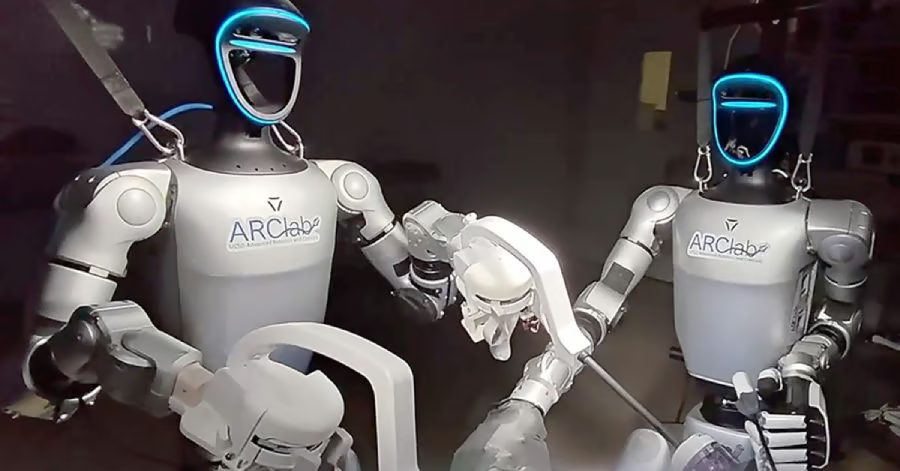
Researchers at the University of California San Diego (UCSD) completed two laparoscopic gallbladder removal procedures on live animal models using teleoperated humanoid robots, marking the first reported demonstration of humanoid robots completing this class of surgery in a preclinical setting.
The work explores whether general-purpose humanoid robots could eventually help extend surgeons' reach and ease pressure on healthcare systems facing workforce shortages. Despite the achievement, more development and testing will be needed before the technology reaches human clinical practice.
Another win for the medical and robotic industries
The project brought together researchers from the university’s engineering and surgery departments.
According to the team at UCSD, one procedure paired a teleoperated humanoid robot with a human surgeon assisting at the operating table during a gallbladder removal, while the second procedure paired two teleoperated humanoid robots throughout the operation.
The robots, nicknamed Surgie, each stood 5 feet tall and weighed 60 pounds. Researchers fitted each robot with custom adapters that allowed them to use standard surgical instruments. Their smaller footprint and mobility could make them easier to deploy in operating rooms than conventional robotic surgical systems, which can weigh about 1,800 pounds and often require specialized installations.
What this says about the future of medicine
Michael Yip, a professor in UCSD’s Department of Electrical and Computer Engineering and one of the study’s senior authors, said the research comes as healthcare systems face rising demand alongside a shortage of surgeons.
He noted that teleoperated, and eventually autonomous, humanoid robots could expand access to surgical expertise for patients who might otherwise struggle to receive timely care.
Beyond performing procedures, the researchers said humanoid robots could also support surgical teams by retrieving instruments and helping clean the operating room, reflecting the broader flexibility of general-purpose robotic platforms.
Limitations to be addressed
While the results mark an important milestone, several technical challenges remain before the approach can move closer to clinical use. The researchers identified latency during teleoperation and the need for repeated recalibration, both of which increased procedure time.
Although the team said controlling the robots felt intuitive and delivered precision comparable to existing robotic surgical systems, safety remains a key consideration.
As adopters push toward greater autonomy in surgical robotics, questions about reliability, fail-safe mechanisms, oversight, and accountability are likely to receive even greater scrutiny from regulators, clinicians, and patients.
The challenges highlighted in the study — and how effectively researchers address them — will likely shape the pace of progress for humanoid robots in this sector.
Related News: Singapore’s robot boom is creating a new challenge: the worker data needed to train AI. Learn why companies are racing to collect it—and the privacy concerns it raises.