






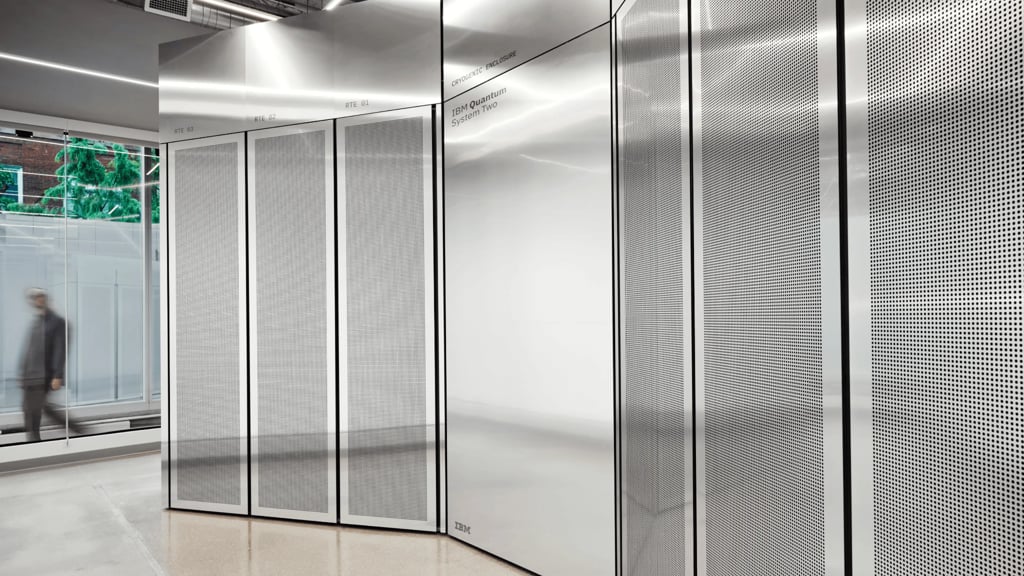
A window on a Chicago street now offers a view of an operating quantum computer.
On Nov. 6, IBM, the University of Chicago (UChicago), the State of Illinois, and the Illinois Quantum and Microelectronics Park (IQMP) unveiled an IBM Quantum System Two at UChicago’s Hyde Park Labs. It is IBM’s first quantum computer in Illinois, and the company calls it its most advanced system available.
The machine sits at street level behind floor-to-ceiling glass. Harley T. Johnson, CEO of IQMP, described it to IBM as likely the most publicly visible quantum computer in the world.
The stakes go past the view. The system anchors the National Quantum Algorithm Center (NQAC), which Illinois Governor JB Pritzker established in 2024 with IBM as a leading member.
What’s Behind the Glass
The system runs on IBM Quantum Nighthawk r2. eWeek has already covered its 19-second quantum sampling benchmark.
By IBM’s published specs, the chip brings:
- Qubits: 120 programmable qubits, linked by 218 tunable couplers in a square lattice.
- Reset hardware: 120 independent reset elements, for 458 physical quantum elements in total.
- Throughput: More than 100,000 circuits per second, which IBM says is 25 times its Heron fleet.
- Depth: IBM reports accurate observable estimation on circuits containing more than 7,500 gates, meeting a 2026 roadmap milestone.
Why Chicago Is Investing in Quantum Research
IBM and Illinois announced the plan in December 2024, with the state committing $25 million for equipment and site preparation. The computer’s permanent home is IQMP, a quantum campus still under construction on Chicago’s Southeast Side. UChicago hosts it until then.
“Today, it can deliver scientifically useful results to organizations across the state of Illinois and beyond,” said Arvind Krishna, chairman and CEO of IBM.
UChicago President Paul Alivisatos leaned into the setting: “I am delighted that this machine is being unveiled here in Hyde Park, where our neighbors and community will have a view into the future.”
Pritzker kept it practical. “I want the next generation of breakthroughs to happen in Illinois,” he said.
IBM is also expanding its partner-hosted deployments, including a System Two planned for Switzerland through an agreement involving Lockheed Martin.
What eWeek Found: Chicago’s Quantum Bet Needs Results Beyond the Hardware
Chicago now has an operating quantum computer supporting its algorithm research center. IBM’s next processor remains a future milestone: on Nov. 11, the company announced plans for Nighthawk r3, designed for 10,000 quantum operations across 520 programmable qubits. It plans to connect two r3 processors into a 1,040-qubit system in 2027.
That announcement does not displace Chicago’s machine as IBM’s most advanced available system. It separates capabilities researchers can use today from targets IBM still needs to deliver.
Capability | Chicago’s Nighthawk r2 | Planned Nighthawk r3 |
|---|---|---|
| Programmable qubits per processor | 120 | 520 |
| Circuit capability | IBM reports accurate observable estimation on circuits exceeding 7,500 gates | Designed for 10,000 quantum operations |
| Availability | Operating at Hyde Park Labs | Future processor; linked two-processor system planned for 2027 |
For businesses, the stronger reason to follow NQAC is the application research. IBM identifies projects involving Deloitte, AbbVie, and Northwestern University exploring molecular simulation for drug discovery. EPRI and the University of Illinois Urbana-Champaign are exploring quantum optimization for more efficient power grids. These are research efforts, with practical benefits still to establish.
The useful measures of progress extend beyond the processor specifications:
- Application results: Whether teams publish reproducible findings on chemistry, energy, or other industry problems.
- Performance comparisons: Whether those results improve on suitable classical methods when accuracy, runtime, and computing costs are considered.
- Access terms: How organizations qualify for computing time, what access costs, and how capacity is allocated. The announcements reviewed do not explain those details.
IBM says clients and partners have executed 34 billion circuits on Nighthawk r2 to date. That is a processor-wide usage figure, not a count for Chicago’s new installation, and it does not by itself establish a business advantage.
Separately, IBM’s advance to Stage C of DARPA’s Quantum Benchmarking Initiative puts its longer-term approach under independent technical scrutiny as it targets fault tolerance in 2029. Chicago’s immediate test is whether its research partnerships turn access to today’s hardware into useful, measurable results.
Subscribe to the Quantum State newsletter from eWeek to stay ahead of quantum computing and real-world applications shaping the next era of technology.