







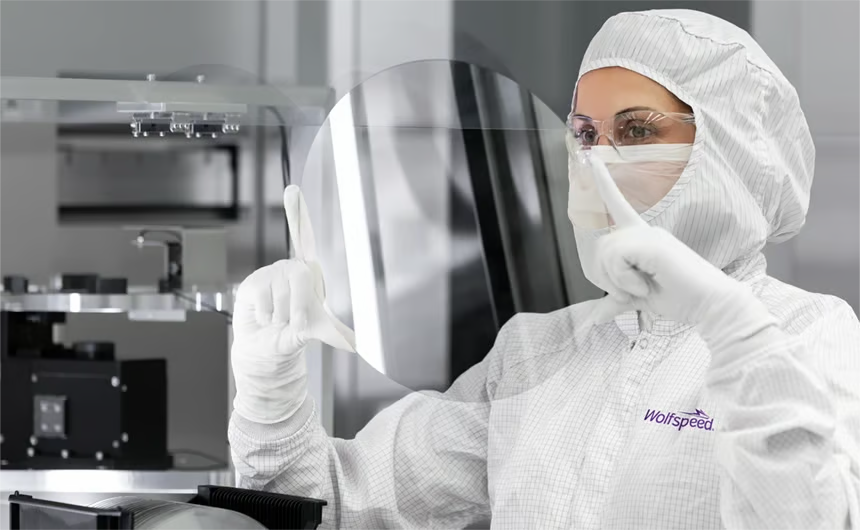
Wolfspeed has spent more than 35 years developing silicon carbide (SiC), a material best known in power semiconductors. Now it is selling a version clear enough to carry light.
On Oct. 29, 2026, Wolfspeed announced the commercial introduction of its transparent silicon carbide (TSiC) technology for augmented reality (AR), quantum computing, and advanced optics. The company said TSiC can “host quantum bits (qubits), preserve their quantum states and transmit quantum information through light—all within a single silicon carbide crystal.”
The launch gives developers exploring silicon carbide’s quantum applications access to optical-grade wafers. For Wolfspeed, which completed a Chapter 11 financial restructuring in September 2025, it also opens another potential market beyond power chips.
What Wolfspeed Is Selling
Wolfspeed’s product page lists TSiC substrates as commercially available in 150 mm and 200 mm diameters, with 300 mm wafers in sampling. The published targets focus on transparency and flatness. That manufacturing emphasis echoes recent U.S. quantum awards targeting hardware scaling and production bottlenecks.
| Specification | Wolfspeed Target |
|---|---|
| Commercial diameters | 150 mm and 200 mm; 300 mm sampling |
| Absorption coefficient (450–650 nm) | ≤ 0.05 cm⁻¹ |
| Thickness | 500 µm ± 20 µm |
| Total thickness variation | ≤ 1.5 µm, excluding the outer 3 mm |
| Optical roughness (Sq) | ≤ 1 nm, both sides |
These are published target specifications and may vary by wafer diameter. Wolfspeed advises customers to confirm specifications and evaluation requirements for individual part numbers.
Where TSiC Could Fit in Quantum Hardware
Wolfspeed says the crystal’s properties “are being explored across the quantum computing stack” in three roles:
- Qubit host: The crystal can serve as “a host for engineered spin-defect qubits,” according to the product page.
- Photonics: The same material is described as “a low-loss photonic platform” for routing quantum information as light.
- Packaging: Wolfspeed also lists TSiC as “a cryogenic packaging substrate” for hardware that runs at extremely low temperatures.
“Wolfspeed’s leadership in silicon carbide innovation extends well beyond traditional semiconductor applications,” said Katrin Feurle, Vice President, Beyond Power at Wolfspeed. The pitch lands as quantum companies pull manufacturing closer, with IonQ fabricating its Superion 256 chips at its SkyWater subsidiary.
What eWeek Found: Commercial Wafers Still Need Quantum Validation
Wolfspeed’s published absorption target covers visible light between 450 and 650 nanometers. That provides an optical benchmark, but it does not establish performance at every wavelength relevant to quantum devices. Neither the launch announcement nor the product page names a quantum customer or reports qubit coherence measurements for TSiC.
That distinction matters because some SiC defects studied for quantum applications operate in the infrared. University of Groningen research on vanadium defects, for example, examines optical transitions in telecom bands. Those findings concern a particular defect system, rather than a demonstration of Wolfspeed’s commercial wafers.
Our assessment is that the next evidence should match the proposed application. For a qubit host, useful results would include coherence and optical readout measurements. For photonics, developers would need losses at their operating wavelengths. Packaging applications would require validation under the intended cryogenic conditions.
For enterprise readers, wafer availability is a supply-chain development rather than proof of a working quantum component. Customer demonstrations, repeatable fabrication results, and application-specific measurements would provide stronger evidence that the material is moving toward deployment.
With Gartner forecasting $1.1 billion in quantum computing revenue in 2027, suppliers have an emerging market to pursue. That forecast provides context, however, rather than evidence of demand for TSiC itself.
Subscribe to the Quantum State newsletter from eWeek to stay ahead of quantum computing and real-world applications shaping the next era of technology.