






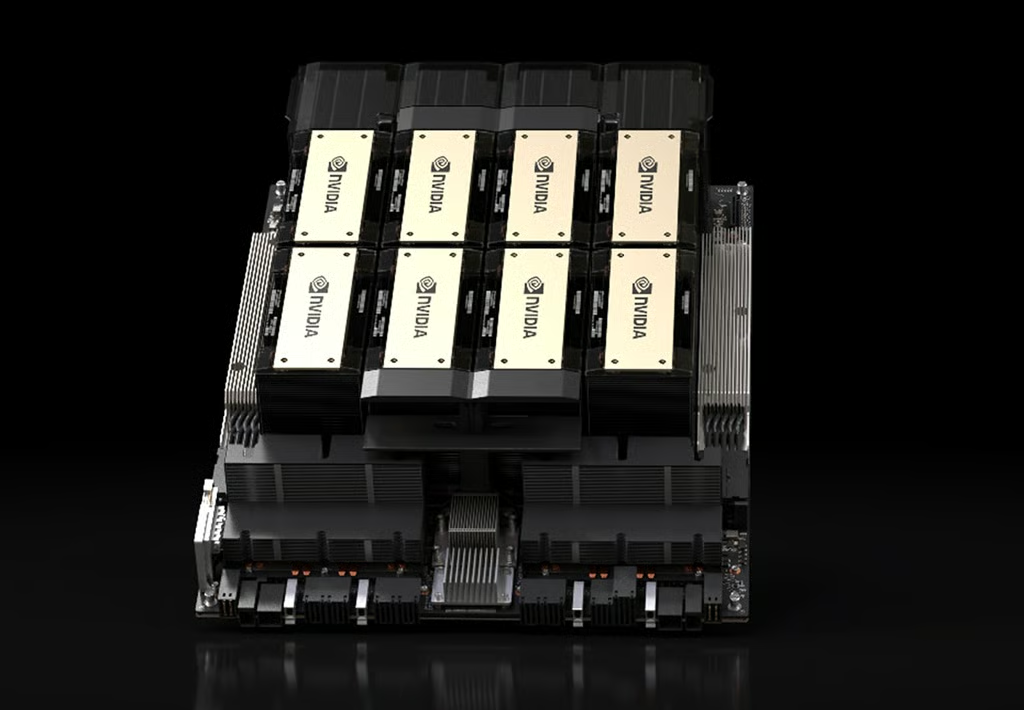


Latham & Watkins does not want every AI workload in the cloud. The law firm has spent about three years buying Nvidia GPU servers so it can run selected AI workloads on infrastructure it controls.
The servers are active in a third-party data center accessible only to Latham employees. Latham still uses commercial AI services such as Harvey, giving the firm a private deployment path for sensitive client data without replacing cloud AI altogether.
Latham operates multiple Nvidia H200 GPUs and is evaluating newer Blackwell and Vera Rubin systems, according to Bloomberg Law’s Sept. 11 report. The firm is also experimenting with fine-tuning Nvidia-developed open-weight models rather than developing a foundation model from scratch.
Why Latham bought its own Nvidia servers
Data control is the clearest reason. CIO Rene Mendoza told the Financial Times that some client information is sensitive enough that Latham does not want to place it with “any cloud vendor.” Running selected workloads on firm-controlled hardware keeps those workloads off a model provider’s infrastructure and gives Latham more control over integration with internal systems.
Open-weight models broaden that choice. Organizations can host and customize some models themselves instead of relying solely on proprietary APIs, expanding their enterprise model deployment options.
Cost also factors into the decision, although Latham says it is not the primary driver. The firm has cited token savings as one benefit of open-weight models but has not disclosed what it has spent on its GPU infrastructure.
Latham also has the staffing to support a more hands-on model. Bloomberg reports about 900 technology employees, including roughly 100 focused on AI.
The strategy remains hybrid rather than cloud-free. Latham still uses commercial AI tools while reserving its own infrastructure for workloads it wants to control more directly.
Kirkland & Ellis provides a useful comparison. The rival firm committed $500 million in May 2026 over three to four years to build its proprietary AI platform, another sign that the largest law firms are willing to invest heavily in greater control over their AI stacks.
What eWeek Found: Latham is building a hybrid AI stack, not replacing the cloud
Latham’s deployment is less a rejection of cloud AI than an effort to control where different workloads run. The firm operates multiple Nvidia H200 GPUs, is fine-tuning open-weight models on infrastructure it controls, and still uses commercial AI products such as Harvey, according to Bloomberg Law’s reporting. That combination points to a hybrid AI strategy in which data sensitivity, customization, and workload requirements determine whether a task stays on private infrastructure or goes to an outside provider.
Open-weight models make that architecture more practical because enterprises can run some models themselves instead of routing every inference request through a proprietary API. Recent Financial Times analysis has also raised the possibility that capable smaller and open models could reduce computing costs for routine workloads, putting more pressure on the assumption that every enterprise AI task belongs on hyperscale infrastructure.
Latham has not disclosed enough information to show that owning GPUs is cheaper. It has released no infrastructure cost, utilization, workload-volume, or comparative savings figures. Penn State Dickinson Law professor Daryl Lim told Bloomberg Law that the economics depend on keeping the servers occupied with valuable workloads; otherwise, outside providers retain an advantage by spreading infrastructure costs across many customers.
The enterprise implication is workload placement, not GPU ownership for its own sake. Organizations with sensitive or predictable AI workloads may have a stronger case for private compute, while bursty demand, frontier-model access, and workloads without stringent data-control requirements can still favor cloud services.
Want to learn more AI tips, tricks, and prompting techniques? eWeek readers get free 7-day access to The Neuron Academy, our practical learning platform designed to help professionals use AI more confidently at work. Browse all lessons →