







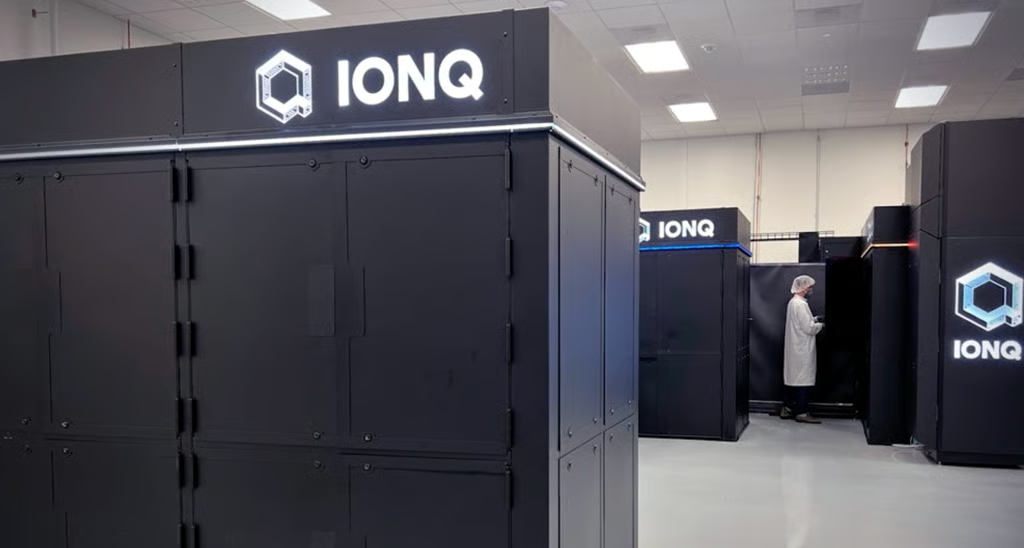
IonQ says it has taken a step quantum vendors have long struggled with: turning a trapped-ion system into something that can be manufactured more like semiconductor hardware.
The company unveiled Superion 256 on Sept. 8 after fabricating fully integrated 256-qubit quantum processing units at SkyWater and trapping ions in prototype systems now being assembled at multiple US facilities. Customer deliveries are planned for 2027.
Those milestones show real progress in fabrication and integration, but they do not yet establish how a complete Superion 256 system performs. IonQ has not published full-system fidelity, workload, power, or cooling results for the 256-qubit platform, leaving enterprise buyers with a product that is further along in manufacturing than in public validation.
What IonQ has demonstrated with Superion 256
IonQ's Superion 256 launch announcement says its Electronic Qubit Control, or EQC, architecture controls trapped-ion qubits with electronics integrated on the chip rather than with laser systems. The underlying qubit-control hardware is manufactured using standard semiconductor processes.
Working with SkyWater shortened IonQ's reported chip design cycle from nine months to two. The company also produced 12 times as many wafer lots over six months as under its previous foundry arrangement, while the Superion chip went through six tapeouts in the first half of 2026.
That marks a clear advance from May. In its May 6 earnings release, IonQ said it had received its first ion-trap chip samples and was moving from component testing toward integrated testing of the 256-qubit computer. By Sept. 8, it was trapping ions in Superion prototypes, but IonQ still had not disclosed how many of the 256 qubits had operated together or published full-system fidelity or workload results.
IonQ sold its first sixth-generation, chip-based 256-qubit system to the University of Cambridge in the first quarter of 2026. Deliveries are planned for 2027, and production systems are also slated for IonQ's cloud.
Quantum developers are confronting infrastructure constraints alongside qubit scaling. Diraq plans to install an eight-qubit silicon-spin system in an Equinix data center in October, while IBM has connected two modular cryogenic systems as part of its fault-tolerant roadmap. US awards of up to $300 million are also targeting fabrication, packaging, cooling, and control-system bottlenecks across quantum architectures.
What eWeek Found: Superion's headline benchmarks aren't full-system Superion benchmarks
IonQ's strongest recent technical results still do not show how a complete Superion 256 performs. Its reported 99.99% two-qubit gate fidelity in October 2025 used the EQC technology that underpins Superion, but IonQ's technical explanation describes randomized benchmarking on a qubit pair rather than across a 256-qubit Superion system.
IonQ's breakeven quantum error-correction result provides another useful baseline. The August 2026 qLDPC study used a 40-ion trapped-ion device, and IonQ identifies the experiment as running on a Tempo engineering test system — not Superion 256.
The data-center claims remain similarly unquantified. IonQ says Superion fits a standard server-rack footprint, integrates with typical data-center cooling, and draws less power than a rack of GPUs. Its Sept. 8 materials provide no wattage, operating-temperature, or cooling-capacity figures.
Superion-specific fidelity and workload benchmarks, detailed infrastructure requirements, and results from customer deployments are still needed to validate the finished platform. IonQ has demonstrated meaningful manufacturing and integration progress; full-system data-center validation remains outstanding.
Want to learn more AI tips, tricks, and prompting techniques? eWeek readers get free 7-day access to The Neuron Academy, our practical learning platform designed to help professionals use AI more confidently at work. Browse all lessons →