







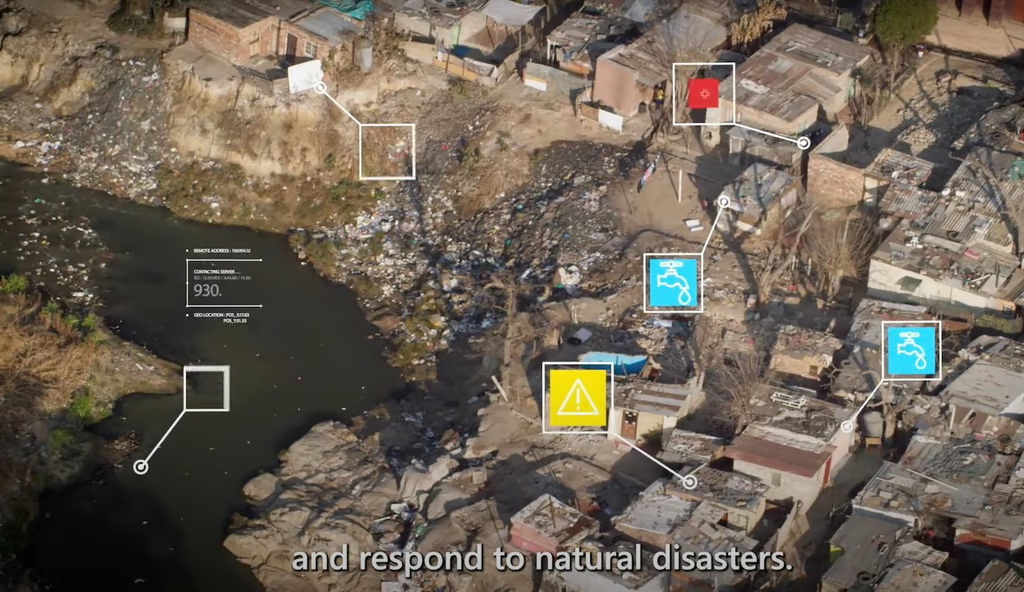
Artificial intelligence and satellites have been deployed to track extensive infrastructure damage caused by the 7.7-magnitude earthquake to help aid workers in Myanmar.
At midday on March 28, an earthquake hit Southeast Asia, collapsing buildings, dams, roads, and bridges. The disaster has already left more than 2,700 people dead or injured, and the death toll is expected to reach 10,000.
The worst-hit city is Mandalay, Myanmar’s second-most populous city, home to more than 1.7 million residents. Mandalay is close to the shallow epicenter, just 10 kilometers beneath the Earth’s surface, along the 1,400-kilometer Sagaing Fault.
More than 10,000 buildings were reportedly destroyed or severely damaged by Friday’s quake, which was the second strongest to hit Mandalay — an 8.0-magnitude earthquake was recorded in 1912.
Rescuers have been working around the clock, hoping to save more lives and retrieve casualties buried in rubble of collapsed structures. It’s a humanitarian crisis made worse by an ongoing civil war that continues to restrict the entry of aid workers into the most severely affected areas.
AI and satellite imagery offer critical support amid limited humanitarian access
How Microsoft’s AI for Good Lab is offering critical support to Myanmar
To support aid workers and rescue teams responding to the ravaged city, Microsoft’s AI for Good Lab deployed AI tools and satellites equipped with long-range cameras to capture images of the devastation.
The captured images were analyzed to assess the number of collapsed structures and the extent of the damage. This data aimed to help relief organizations strategically deploy personnel and resources to the hardest-hit areas. But the process was not without challenges.
One major challenge was the weather. Thick clouds hampered computer vision from capturing clear images of the city. “There’s no way to see through clouds with this technology,” Juan Lavista Ferres, Microsoft’s chief data scientist, said according to the Associated Press.
However, when the clouds cleared out, a satellite from Planet Labs started to capture images and send the pictures to the AI for Good Lab for data processing and analysis.
A team of data analysts stood by at Microsoft’s headquarters in Redmond, Washington, ready to tailor the visual data specifically for Mandalay, acknowledging that the geography and disaster conditions in Myanmar are unique.
“The Earth is too different, the natural disasters are too different and the imagery we get from satellites is just too different to work in every situation,” said Ferres.
Once the visual data was processed, the team shared the “critical information” with relief groups on the ground, such as the Red Cross, enabling them to have a clearer picture of the damage — including the number of buildings that were destroyed or partially damaged and where to focus the resources.
The data served as a “preliminary guide” for aid workers and still requires on-the-ground verification to ensure accuracy.