







A growing push in AI aims to move robots beyond repetitive factory work and into the messy, dynamic environments where people live and work.
Microsoft Research says that shift is now accelerating with the rise of vision-language-action systems designed to connect perception, reasoning, and movement in a single model.
With that ‘vision’ to ponder, the tech firm has announced Rho-alpha, its first robotics model derived from the company’s Phi series of vision-language models. The company says it is inviting organizations to evaluate the model through a Research Early Access Program, with plans to make Rho-alpha available via Microsoft Foundry at a later date.
“The emergence of vision-language-action (VLA) models for physical systems is enabling systems to perceive, reason, and act with increasing autonomy alongside humans in environments that are far less structured,” said Ashley Llorens, Corporate Vice President and Managing Director, Microsoft Research Accelerator.
The company is positioning this approach as a turning point for robotics, comparable to what large generative models have done for text and images. The central idea: combine language understanding with real-world sensing, so robots can handle new tasks with minimal reprogramming.
Forward the foundation
The announcement reflects a broader industry trend toward building “foundation model” robotics systems that can generalize across tasks, rather than relying on task-specific automation workflows that break down when conditions change.
Microsoft’s message is clear: physical AI is intended to be an adaptable foundation, not a one-off robot demo.
Bimanual manipulation and natural language control
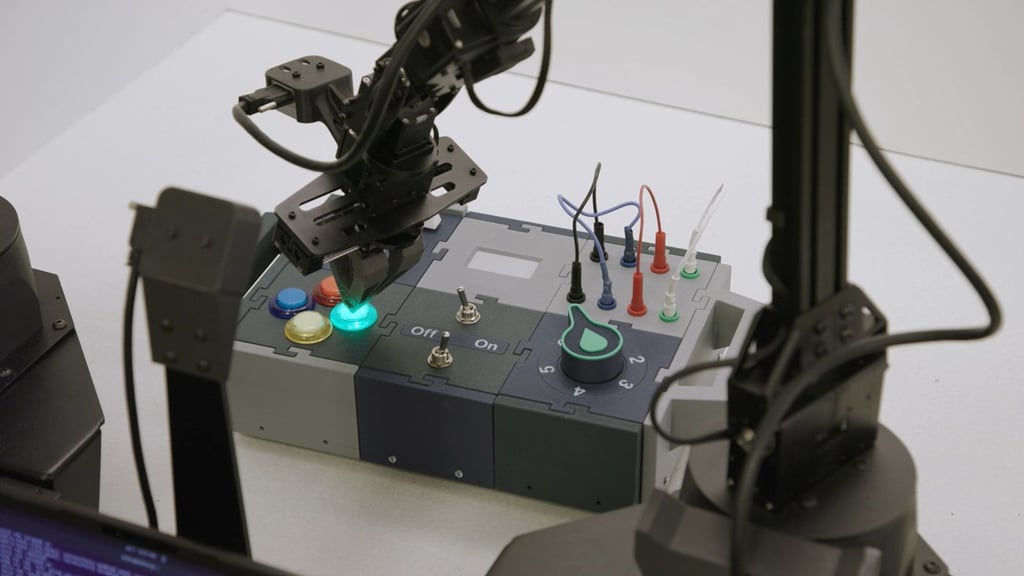
Rho-alpha is designed to translate natural language commands into control signals for robotic systems performing bimanual manipulation tasks. That focus on two-handed work is important because many real-world tasks—from tool use to packing and assembly—require coordinated motion and fine-grained precision.
Microsoft provided examples of prompts used to guide the system, including:
Prompt: “Push the green button with the right gripper.”
Prompt: “Pull out the red wire.”
Prompt: “Move the top slider to position 2.”
These are the kinds of instructions humans naturally give, but that traditional robots often struggle to execute without extensive programming, calibration, or specialized hardware design. If models like Rho-alpha can reliably bridge that gap, robots could become easier to deploy in settings where workflows change frequently.
Microsoft also highlighted a demonstration involving BusyBox, a physical interaction benchmark recently introduced by the company. In the footage, Rho-alpha interacts with the device at real-time speed while responding to spoken-style prompts, indicating the system’s potential for responsive, step-by-step task execution.
What makes Rho-alpha a ‘VLA+’ system
Microsoft describes Rho-alpha as a “VLA+ model,” meaning it expands beyond the typical vision and language inputs used in earlier VLA approaches.
For perception, Rho-alpha adds tactile sensing, with efforts underway to accommodate modalities such as force. This is a significant technical leap because touch-based feedback is often crucial for tasks like plug insertion, gripping unfamiliar objects, or manipulating items that shift during contact.
For learning, Microsoft says it is working toward enabling Rho-alpha to continually improve during deployment by learning from feedback provided by people. That capability could help reduce time spent on retraining models from scratch, while allowing robots to adjust to specific environments, preferences, or safety constraints over time.
This adaptability is central to Microsoft’s pitch. The company argues that “adaptability” itself should be treated as a hallmark of intelligence—an implication that robotics is moving away from rigid automation and toward systems that evolve in response to real-world conditions.
Training data scarcity remains a major obstacle
One of the hardest problems in robotics AI is data. Unlike language models, which can be trained on vast amounts of online text, robots need data grounded in physical experience. Collecting that experience through real-world demonstrations is time-consuming, expensive, and sometimes impossible.
Microsoft’s approach mixes physical demonstrations with simulation and large-scale web visual question answering data. That blended training strategy is meant to help the model learn general visual and language concepts while also developing physical skills that require grounded interaction.
The implication is that scalable robotics training may depend less on fleets of teleoperated robots, and more on simulation systems that can generate diverse training scenarios quickly—especially for rare events or dangerous tasks.
Nvidia Isaac Sim
Microsoft says simulation plays a key role in overcoming the limited availability of robotics data, particularly tactile feedback datasets. Its pipeline generates synthetic data through a multistage process based on reinforcement learning using the open Nvidia Isaac Sim framework. These simulated trajectories are then combined with commercial and openly available physical demonstration datasets.
This partnership dynamic underscores the growing role of cloud infrastructure in robotics development. Instead of training models solely on-device, organizations may increasingly rely on cloud-hosted simulation at scale, enabling faster iteration cycles and more rapid model updates.
Human correction remains part of the loop
Despite progress in perception and learning, Microsoft acknowledges that robots can still make mistakes that are difficult to recover from. The company says human operators can provide real-time assistance using teleoperation tools such as a 3D mouse, and Microsoft is working on tooling and model adaptation techniques that let Rho-alpha learn from corrective feedback.
Prompts shown for a tactile sensor-equipped dual-UR5e-arm setup included:
Prompt: “Pick up the power plug and insert it into the bottom socket of the square surge protector.”
Prompt: “Place the tray into the toolbox and close the toolbox.”
Prompt: “Take the tray out of the toolbox and put it on the table.”
In one example, Microsoft described the right arm struggling with plug insertion before receiving real-time human guidance. That detail highlights a key near-term reality: practical deployments may require shared autonomy, where humans intervene during edge cases while systems gradually improve.
A shift toward customizable physical AI platforms
Microsoft says it is working toward foundational technologies like Rho-alpha and associated tooling that would allow manufacturers, integrators, and end-users to train, deploy, and continuously adapt cloud-hosted physical AI using their own data for their own robots and scenarios.
If successful, that model could reshape the robotics ecosystem by lowering barriers to adoption. Rather than relying solely on highly specialized robotics engineering teams, more organizations could deploy adaptable systems tuned to their unique workflows.
While much of the AI sector focuses on replacing human labor, one new startup is centering its technology on people instead.