







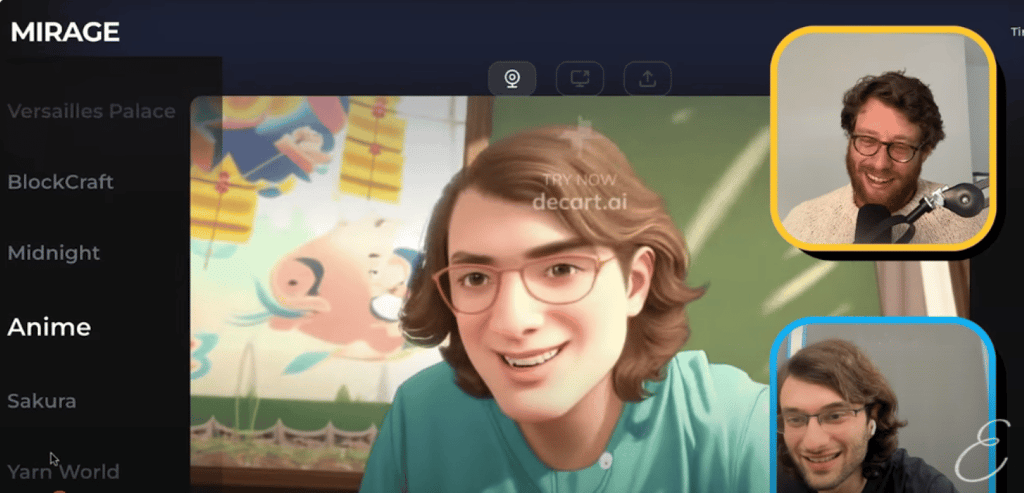
Remember when video filters just meant dog ears on Snapchat? That’s ancient history now.
Dean Leitersdorf was on Dan Shipper’s Every podcast and mid-sentence transformed into a wizard shooting candlelight from his hands, then turned a tissue box into a portal gun that actually fires when you pull the trigger.
This is Mirage, the first real-time video-to-video AI model from Decart. It transforms any video stream — your webcam, a game, whatever — with just 40 milliseconds of delay. The next version? 16 milliseconds.
Here’s the wild part
Unlike other AI video tools that generate entire clips at once, Mirage works frame-by-frame like an LLM predicting the next word; Dean calls it “next frame prediction.” Dean’s team spent six months solving the “error accumulation problem” —where models gradually degrade into static colors — by writing assembly code for GPUs.
Examples of what’s already happening with Mirage
- A new Minecraft mod that transforms the entire game on command.
- Casually turning GTA V into a winter wonderland in real-time.
- Launching its own consumer app (Delulu) for real-time selfie transformations.
You can try it out yourself right now by clicking here.
The bet on instant transformation of existing content
As we’ve written before, many players are focused on World Models at the moment. For example, Tencent dropped HunyuanWorld-Voyager, an open-source world model (GitHub) that generates camera-controlled 3D environments (paper). It’s currently #1 on Stanford’s WorldScore leaderboard and exports directly to 3D formats — no extra tools needed.
While Tencent and Google’s recently demonstrated Genie 3 focus on 3D reconstruction for VR and simulations, Decart is betting on instant transformation of existing content. However, Dean believes we need both approaches: deterministic code for the “bones” (like game physics, rules, etc.) and AI for the creative “muscles” (textures, visuals). As Dan points out in the episode, you could make a 3D game with simple logic and use Mirage as the “skin” to make it look like a legit AAA game (demos).
The bigger picture
Dean thinks AI will create entirely new entertainment categories beyond chatbots. His take? Every 12-year-old knows ChatGPT does their homework, but they have no idea what AI to use when they’re not doing homework.
Gaming is just the appetizer. Real-time transformation tech could reshape video calls, content creation, and how we perceive digital reality. In a way, we could be watching the birth of a new medium: one where the line between real and generated dissolves every 40 milliseconds. TBH, we wouldn’t be shocked if Meta tries to buy Decart to make “the metaverse” an actual thing.
Editor’s note: This content originally ran in our sister publication, The Neuron. To read more from The Neuron, sign up for its newsletter here.