







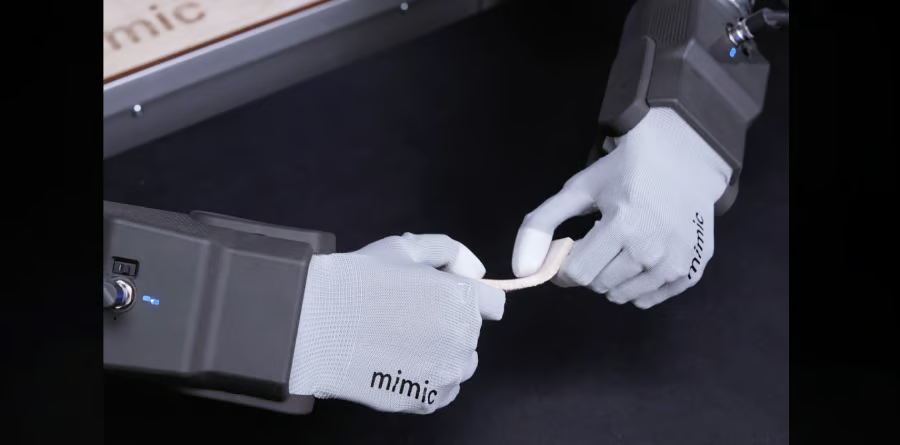
Building a robotic hand that moves like a human is only part of the challenge, Swiss startup Mimic Robotics says.
The company unveiled the Mimic Hand M1 and Mimic Wearable U1 as part of a vertically integrated robotics platform for general-purpose robotic manipulation. Rather than selling a robotic hand alone, Mimic argues that solving dexterity requires controlling every layer of the robotics stack—from hardware and data collection to AI models.
The company said its approach avoids what it calls the "cross-embodiment gap," where robots trained on videos of human hands must perform tasks using fundamentally different tools such as two-finger grippers.
The Mimic Hand M1 features 15 active degrees of freedom across 21 joints, including finger abduction and an opposable thumb. Instead of placing motors inside the hand, Mimic mounts actuators in the forearm and drives the fingers through tendons, a design inspired by human anatomy.
According to the company, the robotic hand can maintain a steady grip on payloads exceeding 25 kilograms (55 pounds) while detecting forces as small as 0.1 newtons, allowing it to sense objects weighing about 50 grams. Fingertip tactile sensors measure normal force, shear force and contact location, giving the system additional feedback beyond computer vision.
Mimic said the architecture was designed to improve force sensing, durability and long-term reliability for industrial environments, where robots must survive repeated impacts and continuous operation.
Wearable captures human demonstrations
The Mimic Wearable U1 is intended to reduce reliance on traditional robot teleoperation for collecting AI training data.
Instead of controlling a robot remotely, users wear the passive exoskeleton, which mechanically matches the movements of the M1 hand while reproducing its sensing setup, including tactile sensors and a wrist-mounted camera.
"The goal is really to collect robot data without needing the robot. Fundamentally, robot teleoperation just does not scale. That's why we have developed our wearable device," said Stephan-Daniel Gravert, CPO of Mimic Robotics.
The company also said it developed its own robotics middleware, called mimic-ipc, to reduce communication latency and improve synchronization between sensors and robot controls.
"Owning the entire stack is one of Mimic's core bets. We purposefully design every component of the system in-house to maximize robot AI model performance," said Elvis Nava, CTO of Mimic Robotics.
Why this could matter for industrial robots
Many factory tasks remain difficult to automate because they require careful handling, changing grip positions and adapting to unpredictable objects. Assembly work, electronics handling, packaging and sorting are examples where conventional automation often struggles.
A robotic hand that combines strength, touch sensing and human-like movement could expand the range of jobs robots can perform without requiring highly specialized machines for every task. Mimic’s approach also reflects a broader shift in robotics toward physical AI — systems that combine AI models with sensors and machines capable of interacting with the real world.
Mimic's strategy aligns with a broader industry shift toward "physical AI." Companies including NVIDIA, Figure AI, and Sanctuary AI are investing in AI models that can interact with and manipulate objects in the physical world.
The challenges ahead
Despite its capabilities, widespread adoption will depend on factors beyond the hand itself. Industrial customers will need reliable software, integration with existing factory systems, and proof that the hardware can operate continuously over long production cycles.
The company’s decision to prioritize a human-like hand also comes with tradeoffs. A five-finger robotic system is more complex than a simple gripper and requires more advanced control, maintenance, and training data.
Mimic Robotics is betting that solving dexterity requires more than a sophisticated robotic hand—it requires rethinking how robots are built, trained, and deployed. Whether that integrated approach succeeds will depend on proving it delivers greater productivity, lower operating costs, and reliable performance inside real factories, not just impressive demonstrations.
Other News: BrainCo is pushing human-machine interaction into new territory with an EEG-powered platform that translates brain signals into robotic actions in under 200 milliseconds—no implants required.