







The humanoid robotics race is starting to look less like a US-China contest.
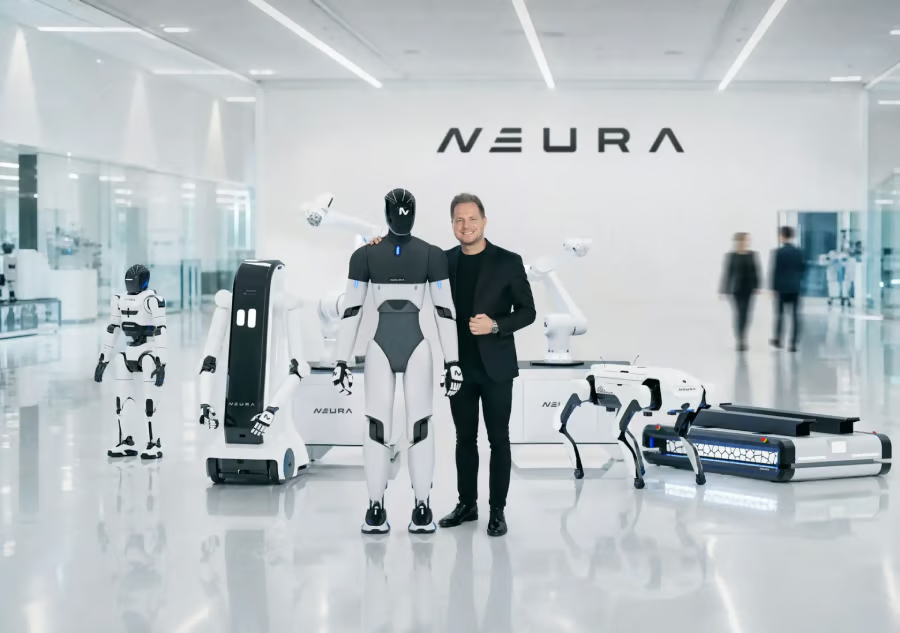
Europe’s hopes of becoming more competitive in robotics have received a major boost after German startup Neura Robotics raised $1.4 billion at a $7 billion valuation. It makes Neura one of the most well-funded robotics startups in the industry, with backing from Qualcomm, Amazon, Nvidia, and stablecoin issuer Tether.
The funding will go towards Neura increasing its production capacity to 6,000 humanoid robots this year, with ambitions to hit over 10,000 by 2027, according to the Financial Times report. By the end of the decade, it is targeting an annual production of over a million robotic arms and humanoid robots.
Qualcomm will likely use the investment to push its Snapdragon processor line, with its recent batch of X2 chips highlighted for their robotics capabilities.
Alongside this fast production timeline, Neura is also aiming to build “industrial AI applications” that can integrate physical AI and robotics. This would come in the form of the Neuraverse platform, which other robot manufacturers can use to train their own robots.
The goal would be to act as both a hardware manufacturer for industrial robots and a provider of software and services to other parties. Data on rudimentary tasks such as pressing a button, placing an item on a shelf, and walking around an obstacle are highly valued by robotic AI trainers, and Neura aims to provide specialist videos to speed up the training process.
The combination of hardware, software, and services could be the key reason why Neura has drawn so much attention from US tech giants. Mind Robotics received a similarly high valuation for its current output, due to its full-stack robotics system.
China leads the robotics race
China appears to be ahead in the early humanoid robotics race, with AgiBot, Unitree, and UBTech all shipping over 1,000 humanoid robots in 2025. Chinese startup Spirit AI’s embodied intelligence model topped Nvidia’s physical AI ranking, showing that China is not only ahead in volume but also in model sophistication.
China looks likely to extend its volume lead in 2026, with many US and European campuses buying humanoid robots from Chinese manufacturers. Some of the biggest names in the US and Europe have yet to reach commercial production, despite long-running promises from companies such as Tesla and Figure AI.
US robotics firms trying to keep pace
The United States may look to bind its companies together to fight China, similar to what it has done in AI by preventing Chinese companies from buying advanced hardware and restricting the sale of Chinese robots in the country. The Association for Advancing Automation has warned that losing the robotics race could, in turn, lead to losing the AI race as well.
Several major tech giants have entered the market in the last 12 months, either through acquisitions or by launching new divisions. Amazon acquired Fauna Robotics a few months after the startup revealed its humanoid robot, Sprout. Meta acquired the startup ARI, which focuses on building AI models for robots.
Also read: AGIBOT’s latest challenge tested humanoid robots in real-world settings, bringing together 526 research and enterprise teams from 27 countries.