






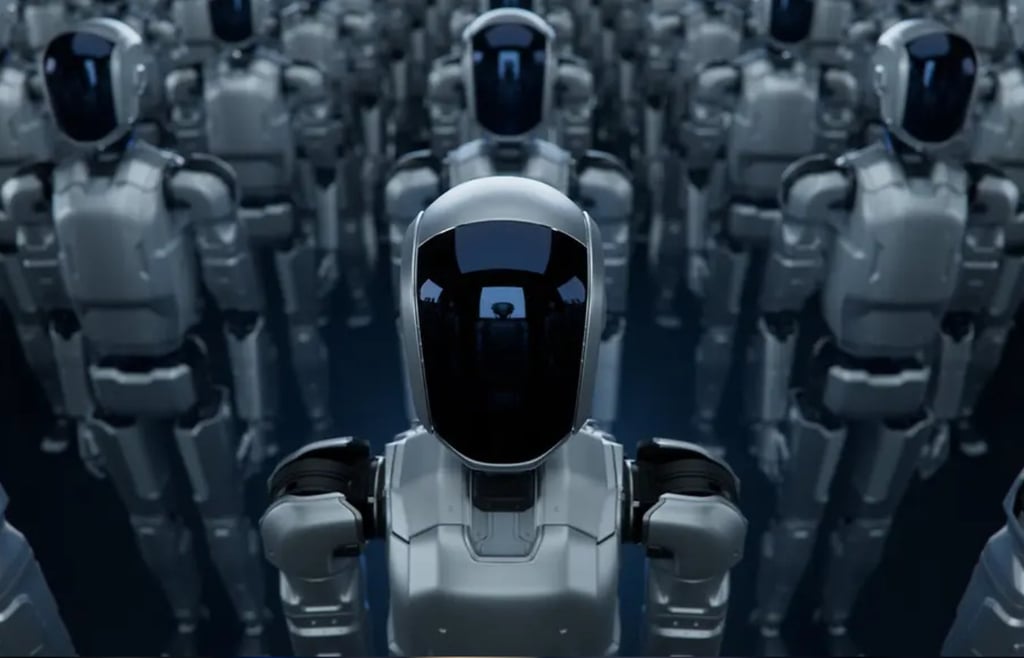


Meta’s next big AI platform may need legs.
Meta has acquired Assured Robot Intelligence (ARI), a startup focused on building artificial intelligence models for robots. The deal, which closed on Friday, was confirmed by the company, though financial terms were not disclosed.
ARI, a relatively small startup with around 20 employees, has been building AI models that allow robots, particularly humanoid ones, to perform physical tasks and operate in real-world settings. ARI’s co-founders, Xiaolong Wang and Lerrel Pinto, along with their team, will move into Meta’s Superintelligence Labs, the company’s advanced AI research division.
The group is expected to work closely with Meta Robotics Studio, an internal team focused on building both the hardware and software needed for humanoid robots. Meta said the incoming team will help strengthen its capabilities in robot control systems and self-learning models, especially for full-body humanoid movement.
In a post on X, Wang expressed his excitement about the move, stating the company’s mission from day one was to “achieve physical AGI.” Wang explained that for robots to be truly useful, they can’t just be remote-controlled puppets. “We believe this agent will be humanoid — and that scaling will come from learning directly from human experience, not teleoperation alone,” Wang wrote on X.
Why ARI matters to Meta
Meta is currently building its own internal Robotics Studio, and ARI is expected to provide frontier intelligence that enables robots to navigate messy human environments, such as kitchens and warehouses.
A Meta spokesperson said in a statement that the startup is “at the frontier of robotic intelligence designed to enable robots to understand, predict, and adapt to human behaviors in complex and dynamic environments.”
By bringing ARI into the fold, Meta hopes to solve the whole-body control problem, essentially teaching a robot how to balance, use its hands, and walk all at once while interacting with people.
The Android of robotics
This acquisition fits into a much larger, and very expensive, puzzle for Meta. The company recently raised its 2026 spending forecast to a range of $125 billion to $145 billion, according to The Wall Street Journal. Much of that money is being diverted from the Metaverse to physical AI.
Meta’s endgame doesn’t seem to be just building a single robot, but rather creating the operating system for the entire industry. Meta CTO Andrew Bosworth previously suggested the company wants to do for robots what Google’s Android did for smartphones.
The goal is to create software that other companies can license. This puts Meta in a direct arms race with Tesla’s Optimus project and Amazon, which recently snatched up Lerrel Pinto’s former company, Fauna Robotics, for its own humanoid efforts.
Meta has made it clear that its long-term goal goes beyond social media, aiming instead to build what CEO Mark Zuckerberg has described as “personal superintelligence.” Bringing ARI into the fold strengthens that vision, especially in the physical world, where AI systems must interact with people and environments in real time.
For a deeper look at the robots shaping this space, check out our breakdown of the top humanoid robot power rankings, featuring Tesla, Unitree, and other major players competing for real-world deployment.