






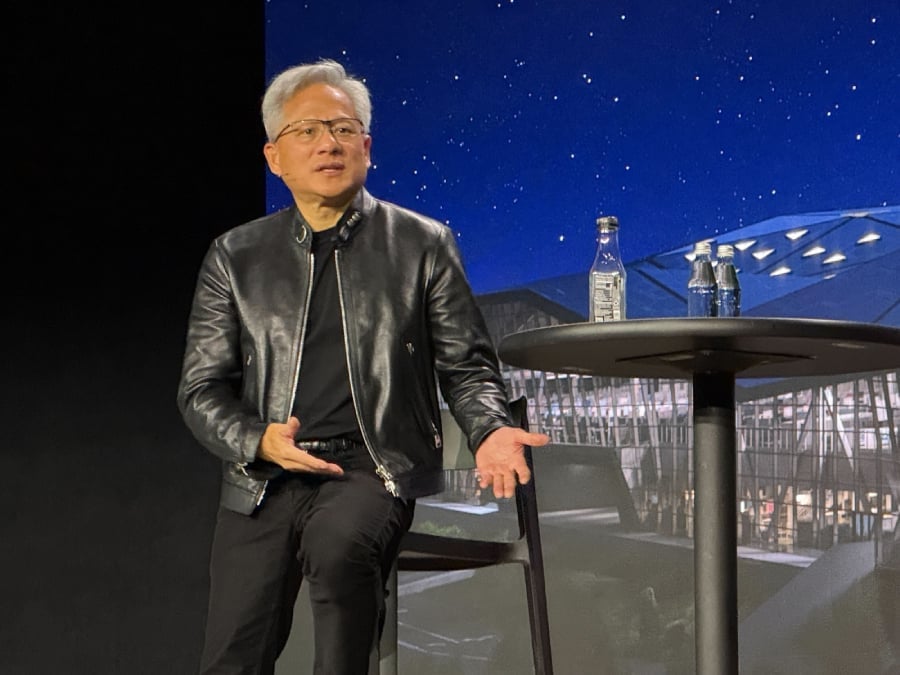


Nvidia CEO Jensen Huang just threw his considerable weight behind the fast-growing OpenClaw AI agent platform, declaring it a seismic shift in how humans will interact with artificial intelligence going forward.
Speaking with CNBC’s Jim Cramer on “Mad Money” from the sidelines of Nvidia’s GTC conference in California, Huang declared about OpenClaw:
“It is now the largest, most popular, the most successful open-sourced project in the history of humanity.” He added: “This is definitely the next ChatGPT.”
While the world has spent the last few years getting used to chatbots that can write essays or summarize emails, OpenClaw represents a fundamental shift. It is an “autonomous agent” platform, meaning it doesn’t just talk — it acts. Instead of a human guiding every step, these agents can make decisions and complete complex workflows with almost no supervision.
The appeal lies in its simplicity. According to Huang, users don’t need a computer science degree to get started.
“In one line of code, you can create for yourself your own agent,” he explained. “Then after that, just ask the agent to do whatever you want.”
The ‘architect’ in every pocket
To illustrate the power of these agents, Huang used the example of home renovation. An OpenClaw agent could be tasked with designing a kitchen, and rather than just giving advice, it would go out and learn the necessary tools to produce a finished product.
“They’ll go off and learn how to design a kitchen. It will come back with design and reflect on that,” Huang explained.
The Nvidia chief believes this will bridge the gap between manual labor and high-level design. He told Cramer, “Every carpenter can now be an architect. Every plumber will become an architect. We are going to elevate the capabilities of everyone.”
The ‘AI Tigers’ are hungry
The OpenClaw phenomenon has taken root particularly deep in China, where homegrown AI companies dubbed the “AI tigers” are racing to integrate the technology into their offerings.
The market response on Wednesday was telling. MiniMax surged more than 22% in Hong Kong trading. Knowledge Atlas Technology, better known as Zhipu, climbed roughly 14%. Both companies have been aggressively rolling out agentic AI tools built on OpenClaw’s foundation.
Zhipu recently unveiled GLM-5, an open-source large language model designed with enhanced coding abilities and extended support for agent-based tasks. The company claims its performance approaches Anthropic’s Claude Opus 4.5 on coding benchmarks and surpasses Google’s Gemini 3 Pro in certain tests, though CNBC notes these claims haven’t been independently verified.
SenseTime, which has pivoted hard from its earlier focus on facial recognition surveillance to broader AI software platforms, gained over 2% after integrating one of its AI assistants with OpenClaw. Meanwhile, Shanghai-listed cloud computing firm UCloud Technology jumped 13%.
The excitement wasn’t limited to software. Asian hardware giants also rallied after Huang projected that purchase orders for Nvidia’s Blackwell and Vera Rubin platforms could hit $1 trillion by 2027. SK Hynix gained nearly 9%, while Samsung Electronics rose over 7%.
Nvidia’s Play: NemoClaw
Not one to let a paradigm shift pass him by, Nvidia moved quickly to build around OpenClaw’s momentum. The company announced NemoClaw on Monday, an enterprise-grade version that layers Nvidia’s software stack and security tools onto the open-source platform.
The move addresses a growing concern: what happens when AI systems gain the ability to act independently? Security, privacy, and control become existential questions rather than technical footnotes.
With NemoClaw, Nvidia is building guardrails, including privacy protections, oversight mechanisms, and enterprise-grade security designed to make autonomous AI agents safe to deploy at scale.
Also read: See how Nvidia is putting agentic AI into action with its new OpenShell toolkit built for enterprise use.