







Enigma, a physical AI startup, has emerged from stealth with a $71 million seed round as it works on a new approach to making robots easier for people to use.
The round was led by Index Ventures and Ribbit Capital, with participation from Conviction Partners and executives and researchers from companies including OpenAI, Anthropic, DeepMind, xAI, Cognition, and Wiz, according to the company.
Enigma said it will use the funding to expand its research and engineering teams, increase computing capacity, and grow real-world deployments.
The startup’s core idea is that better robots will not come only from stronger AI models or improved hardware. The company believes the way humans interact with machines could be just as important.
“Once in a generation, a technology shift reshapes not just software, but the structure of entire industries,” said Jonathan Jacobi, co-founder and CEO of Enigma.
“We believe AI's next chapter is moving beyond chatbots and screens into systems that can understand, adapt to, and operate in the physical world. We're building the intelligence layer for robotics through breakthrough AI models and novel human-robot interfaces. Our goal is to make intelligent robots as natural to work with as computers and smartphones are today.”
Turning robot control into a public experiment
As part of its launch, Enigma is opening what it calls the world’s first public interactive AI robotics experience at robots.online.
The company said 100 AI-powered robots will be available for people to control online in real time. Users will be able to direct robots as they perform physical tasks, allowing Enigma to study how people naturally communicate with machines.
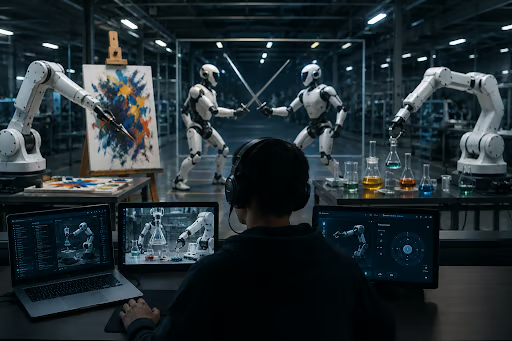
The robots, located in facilities in Israel and California, can complete activities such as drawing with a paintbrush, fighting with swords and performing simple chemistry demonstrations by moving and mixing liquids.
Rather than asking users to learn complicated robotic commands, Enigma is testing different ways humans might communicate with machines, including text, voice, video demonstrations and direct screen interactions.
“We’re going to learn a lot about what is the right way to interact with robots,” Jacobi told TechCrunch. “Do we want to just talk to them over text or audio? Do we want to show them an example as a video? Or maybe do we want to tap, drag, and drop?”
Enigma was founded less than a year ago by Jacobi and Gal Niv, who met through Israel’s Unit 8200 after competing in hacking competitions as teenagers. Jacobi became Microsoft’s youngest-ever employee at 17 and later worked with Niv on cybersecurity and large-scale systems before moving into robotics.
The pair entered the field without traditional robotics backgrounds, betting that an outsider perspective could help rethink how people use machines.
Shardul Shah, partner at Index Ventures, said the founders’ different backgrounds were part of the appeal.
“Someone who’s an insider may start with the capability of teleoperation or dexterity, but Enigma is starting from a very different place: ‘What’s the ultimate experience?’” Shah said, according to TechCrunch.
The challenge ahead
Enigma’s biggest asset may also be its biggest uncertainty. The company is betting that large-scale public interaction data will reveal a breakthrough way for humans to communicate with robots.
That could give Enigma valuable insight into robot interfaces and training methods. However, the company has not yet revealed a specific commercial product, and its business model remains largely experimental.
The robotics industry has repeatedly shown that moving from impressive demonstrations to reliable real-world use is difficult. Enigma’s approach could help solve the usability problem, but it still needs to prove that better interfaces can translate into robots people and businesses will actually adopt.
Also read: Unitree’s new embodied AI model combines speech, vision, navigation, reasoning, and physical manipulation to help humanoids handle household and care tasks.