







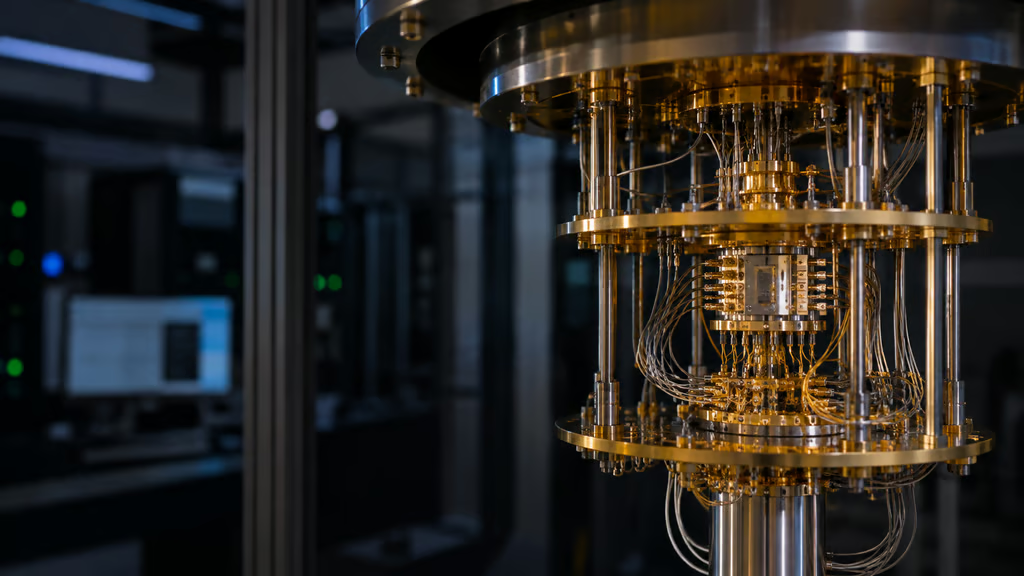
Quantinuum says its Helios quantum computer now loses protected quantum information at a rate of about five errors per million error-correction rounds.
The result marks progress toward more reliable quantum computing, but the figure measures logical memory performance rather than overall computing accuracy.
On Oct. 19, Quantinuum reported a logical fidelity of 99.9995% on Helios, its 98-qubit trapped-ion commercial computer, using a color code within its error-correction architecture.
The company says the error rate is 10x lower than its own September record and 100x lower than the best published result from other hardware types, which it identifies as Google Quantum AI's superconducting system.
Quantinuum ties the result to Apollo, the universal fault-tolerant computer it plans to deliver by 2029. That timeline lands as federal programs push for fault-tolerant machines, including a Department of Energy (DOE) competition with up to $215 million in planned funding.
What the color code experiment showed
Key findings, according to Quantinuum and independent analyses of its preprint:
- Exponential suppression: Quantinuum reports a record factor-of-12 reduction in remaining logical errors for each increase in code distance.
- Logical gates: At code distance 5, a two-qubit logical gate showed an error of about 7 in 100,000.
- Hardware limit: The team did not run the distance-7 gate experiment because it needed more qubits than Helios has.
- Same machine, two codes: The September Helix record and the October color code result both ran on the same Helios hardware.
Robin Blume-Kohout, co-director of Sandia National Laboratories' Quantum Performance Lab, who was not involved in the study, said the paper shows "a logical qubit nearly 100x better than its component physical qubits."
The distinction matters because preserving quantum information and performing calculations on it are different challenges. A low logical memory error rate does not automatically mean a quantum computer can execute long, complex calculations with the same reliability.
Lower errors cost more qubits
In quantum error correction, code distance describes how much protection a logical qubit has against certain physical errors. Higher distances can make stored quantum information more reliable, but they generally require more physical qubits to maintain that protection.
The Quantum Computing Report analysis identifies the following results across the tested code distances:
| Measure | Distance 3 | Distance 5 | Distance 7 |
|---|---|---|---|
| Logical error per round | 5.5 × 10⁻⁴ | 3.8 × 10⁻⁵ | 5 × 10⁻⁶ (99.9995% fidelity) |
| Physical qubits per logical qubit (data plus measurement) | 13 | 37 | 73 |
Qubit overhead sets how large a fault-tolerant machine must be, so it matters as much as raw error rates, a problem IBM also targeted in its recent study on reducing error-correction overhead.
What eWeek Found: The qubit count behind the fidelity
Quantinuum's 99.9995% fidelity record highlights a central challenge in fault-tolerant quantum computing: improving reliability requires additional physical qubits.
The company's announcement compares Helix's 10 physical qubits per logical qubit with a figure of up to 37 for its color-code approach. Separately, the Quantum Computing Report analysis identifies 73 physical qubits for the distance-7 memory configuration associated with the headline fidelity result.
The figures require careful interpretation because they describe different reported configurations or comparisons. The available explanations do not establish that the difference comes solely from including or excluding measurement qubits.
That distinction matters when evaluating quantum computing architectures. Organizations comparing vendors should examine which code distances, qubit resources, and logical operations each reported performance figure represents. A headline fidelity record alone does not establish the hardware requirements of a complete fault-tolerant system.
The same caution applies to comparisons with other quantum computing milestones. Google's recent magic-state cultivation result on Willow measured errors in preparing a resource used for quantum calculations, rather than preserving stored logical information. The two results therefore measure different capabilities and are not directly comparable as overall performance benchmarks.
Blume-Kohout argued the overhead is still manageable at scale: “A scaled-up version of this system could reach the reliability required for useful fault-tolerant computation at a feasible size—less than a million physical qubits—which improves the outlook for practical quantum computing.”
That assessment remains a projection. Although Helios demonstrated low logical memory error rates at distance 7, extending those results to larger systems and more complex logical operations will require additional experimental evidence.
Quantinuum's result strengthens its case for scaling toward fault-tolerant quantum computing, but the next challenge is demonstrating that low error rates can be maintained during increasingly complex calculations. A logical gate experiment at distance 7 or beyond would provide another important test of progress toward its 2029 Apollo target.
Other news: Telefónica and IQM Quantum Computers are bringing the first quantum computer to the Community of Madrid, with plans to install a five-qubit IQM Spark system at the Universidad Politécnica de Madrid by the end of 2026.