







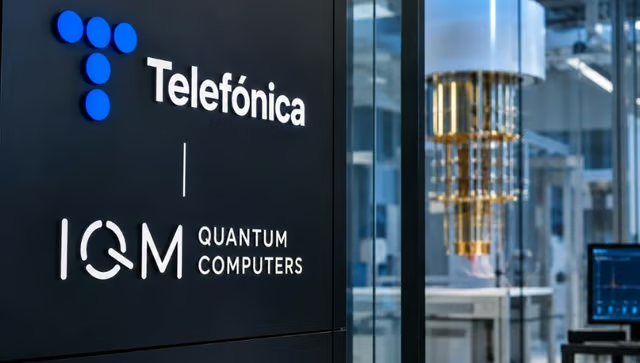
Madrid is getting its first quantum computer, and a telecom operator is delivering it.
Telefónica and IQM Quantum Computers announced Oct. 23 that they plan to install a five-qubit IQM Spark system at the Universidad Politécnica de Madrid (UPM) before the end of 2026. The machine is intended to give researchers, universities, hospitals, and startups access to physical quantum hardware for experimentation and training.
The project follows two other quantum systems ordered for Spain's Galician Supercomputing Center (CESGA). It also points to Telefónica's growing role in quantum infrastructure, extending beyond secure communications into the delivery of computing systems.
What the Madrid System Is
The IQM Spark is a 5-qubit superconducting system. Key details from the announcement:
- Design: The release describes it as “an all-in-one solution specifically designed for research, education and early-stage development.”
- Use: Developing and testing quantum algorithms on real hardware and building the expertise needed to explore future use cases.
- Not disclosed: The price, the contract terms, and the funding arrangement.
It is a training and testing machine, not one built to outperform classical computers.
Jan Goetz, CEO and co-founder of IQM Quantum Computers, described it as regional infrastructure: “By investing in its own quantum computer, the Community of Madrid is creating an infrastructure that will enable its researchers, students and industries to grow their capabilities over the long term.”
Other European deployments are also tied to local access, such as the IBM Quantum System Two planned for Switzerland's national supercomputing center in Lugano.
Telefónica Sells Quantum Compute and Quantum-Safe Networks
The Madrid deal adds to a quantum portfolio Telefónica has built over the past year:
| Date | Project | Details |
| Dec. 2025 | CESGA purchase agreement with IQM | 54-qubit IQM Radiance and 5-qubit IQM Spark, scheduled for delivery by June 2026 |
| Dec. 2025 (reported) | Madrid hospital link | Quantum key distribution link between two Madrid hospitals with Vithas, LuxQuanta, and QoolNet |
| Jan. 2026 | Data center interconnection | Service protected with post-quantum cryptography |
| Mar. 2026 | Quantum Telco strategy at MWC | Quantum-safe communications, quantum ecosystems, applied quantum computing, and a cryptographic hub |
| Oct. 2026 | UPM, Madrid | 5-qubit IQM Spark due before the end of 2026 |
Borja Ochoa, non-executive chairman of Telefónica España and CEO of B2B, said, “Telefónica is the first operator in Spain to offer communications between data centers protected by the new post-quantum cryptography standards.”
That service, launched in January, follows recommendations from the U.S. National Institute of Standards and Technology (NIST) and Germany's Federal Office for Information Security (BSI), the agency that helped set Germany's post-quantum migration deadlines.
What eWeek Found: Five Qubits Is the Point
A 5-qubit machine can be simulated easily on an ordinary computer, so its value is not computing power. It is hands-on time with physical hardware, including noise, calibration, and running code on a real device, which simulators and remote cloud queues do not fully replace.
The more telling detail is who is delivering it. Quantum installations are often announced by hardware makers, national labs, or supercomputing centers. Here, a carrier is acting as the integrator, the same role it already plays for data center links and quantum key distribution (QKD).
For Telefónica, the opportunity extends beyond supplying a single research machine. Delivering quantum systems could help the operator build technical expertise, strengthen relationships with research institutions, and position itself for future enterprise demand.
The commercial opportunity remains uncertain, however, particularly while small quantum computers are primarily used for experimentation rather than production workloads.
Infrastructure providers are moving the same way, as with ORCA's PT-3 running beside NVIDIA GPUs in a Digital Realty lab in London.
The next test is delivery. The Madrid system is due by year-end, and the announcement gave no update on the two CESGA systems that were scheduled for delivery by June 2026.
Confirmation that the systems are running, along with evidence of sustained use by researchers and institutions, would offer a clearer measure of their practical value.
For Telefónica, the longer-term question is whether these early deployments can establish a meaningful role in Europe's quantum computing ecosystem beyond supplying research hardware.
Other news: Germany is urging organizations to begin preparing for post-quantum cryptography by the end of 2026, with high-risk systems targeted for migration by 2030 and a broader transition by 2035.