







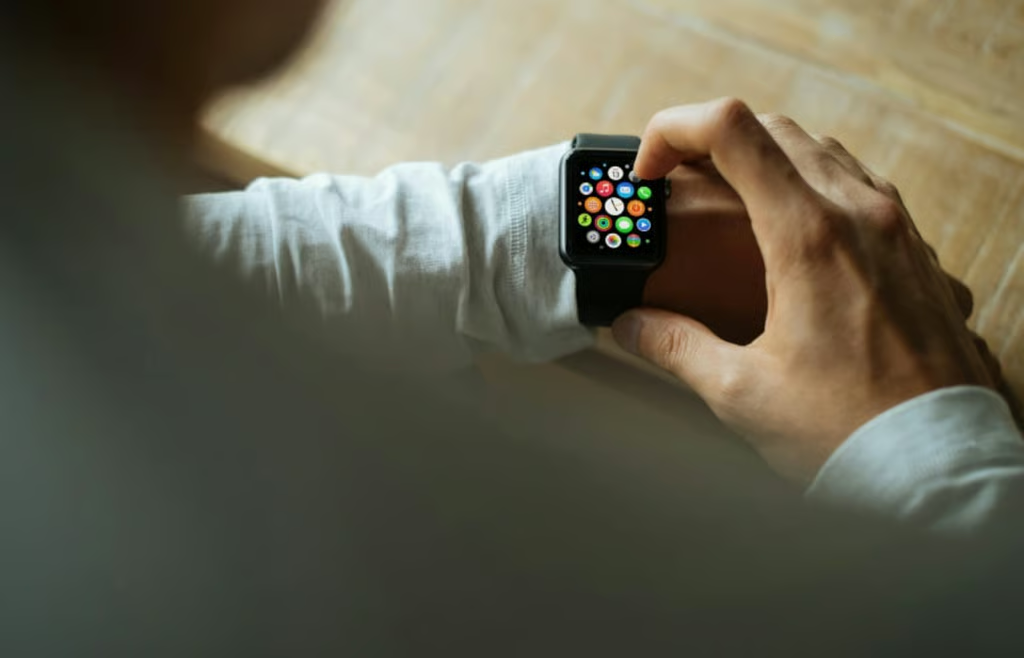
A smartwatch that tracks blood sugar without needles is still a 2026 tech dream. But thanks to AI, it is now closer than you think.
The story underneath it has changed: the most consequential advances in glucose tracking are no longer happening in sensor labs alone. They're happening in software, where AI is turning a flood of glucose data into something closer to a personal metabolic advisor.
For IT leaders, healthcare enterprise managers, and digital health developers, the immediate future isn’t about a watch that measures blood sugar. It’s about building an intelligent data ecosystem that can securely aggregate, translate, and act on metabolic telemetry.
- The wrist still isn't a lab
- Apple's decade-long project just changed hands
- Samsung is building the AI layer instead of waiting on the sensor
- The real product shipping today: AI-coached, prescription-free CGMs
- The market expansion: Demographics are shifting
- Where AI could matter more than better hardware
- Architecture of the modern wearable glucose stack
- What IT and health-tech buyers should actually track
- The bottom line
The wrist still isn't a lab
In February 2024, the FDA issued a safety communication telling consumers not to trust any smartwatch or smart ring that claims to measure blood glucose without piercing the skin. The agency reports that it had identified dozens of companies marketing such devices under multiple brand names and warned that inaccurate readings could lead someone to take the wrong dose of insulin or other medication.
Some of the consequences of using the said devices range from confusion to coma. That warning remains in force today, and no smartwatch or ring has since won an FDA clearance to measure glucose noninvasively on its own.
Crucially, the warning carves out an exception: watch apps that simply display data from an FDA-authorized continuous glucose monitor, or CGM. That distinction is the hinge the entire industry is now built around.
Apple's decade-long project just changed hands
Apple's noninvasive glucose sensor, reportedly conceived during the Steve Jobs era, is still in development more than 15 years later. What changed this spring is who's running it.
Bloomberg's Mark Gurman reported in May that Apple shifted oversight of the project from platform architecture chief Tim Millet to Zongjian Chen, the engineering leader who also oversees Apple's Advanced Technologies Group and modem hardware. Gurman described the handoff as a signal that Apple believes the science may finally be far enough along to move toward a shippable product, though no timeline has been given.
Elsewhere in the noninvasive space, a CES 2026 showcase device called the PreEvnt Isaac took a different approach entirely. It detects acetone in the breath, a biomarker associated with rising glucose, rather than sensing through the skin. It's not exactly a watch but a pendant-style device that is still under clinical trials. This device illustrates how many parallel paths toward noninvasive detection are still being tested.
Samsung is building the AI layer instead of waiting on the sensor
Samsung has taken a more incremental route. Current Galaxy Watch models can't measure glucose directly, but the company has spent years laying analytical groundwork around it.
The Galaxy Watch8 series introduced an Antioxidant Index, which uses light-based spectroscopy on a fingertip to estimate carotenoid levels tied to fruit and vegetable intake, plus an AGEs Index that runs overnight to track a marker linked to how quickly the body accumulates age-related metabolic byproducts. Samsung has described the underlying sensor work as an eight-year R&D effort that included clinical validation against blood carotenoid levels and Raman spectroscopy.
Samsung executives also confirmed active research into an optical, noninvasive glucose sensor, though no launch date was provided. In the meantime, Galaxy Watch serves as a display and alert surface for compatible CGMs from Dexcom and others, layered with Samsung's own metabolic health metrics.
The real product shipping today: AI-coached, prescription-free CGMs
The most mature part of this ecosystem isn't a watch at all. It's the emergence of over-the-counter continuous glucose monitors, sold without a prescription and paired with AI-driven coaching apps.
Marketed to adults looking for metabolic insights rather than diabetes management, Dexcom's Stelo and Abbott’s Lingo debuted in 2024 as the first FDA-cleared, over-the-counter CGMs for non-insulin users.
Both run roughly $85 to $99 per month, are HSA/FSA-eligible, and connect to smartwatches, including the Apple Watch and, in Stelo's case, the Oura Ring. Dexcom has been expanding Stelo's AI features this year, including an expanded nutrition database and photo-based meal logging.
The goal is to make the software layer, not just the sensor, the reason customers stay subscribed. Abbott's Lingo, meanwhile, takes a heavier-handed coaching approach, converting glucose spikes into a single daily "Lingo Count" score designed for people who've never tracked glucose before.
The sensor is increasingly a commodity, and the AI coaching layer built on top of it is where companies are trying to differentiate and retain subscribers.
The market expansion: Demographics are shifting
The target audience for glucose tracking has officially broken out of its traditional silo. No longer limited strictly to adults managing Type 1 or Type 2 diabetes, metabolic tracking is moving directly into mainstream pediatric care and preventative corporate wellness.
Last month, the regulatory landscape expanded when the FDA cleared the first over-the-counter continuous glucose monitor for children and teenagers ages 2 to 18, according to Healthline. This rollout of non-prescription options, like the Dexcom Stelo ecosystem, for a younger demographic means that schools, pediatric networks, and family-focused health platforms must now adapt to a steady influx of real-time interstitial fluid data streaming directly to kids' smartwatches.
Where AI could matter more than better hardware
A CGM generates roughly 288 readings a day. That's far more data than any person can meaningfully interpret on their own, which is exactly the kind of pattern-recognition problem AI is suited for. Academic research has moved well past simple trend lines.
A team publishing on arXiv introduced GluFormer, a generative foundation model trained on more than 10 million CGM readings from over 10,000 adults, most of whom were without diabetes. It is designed to learn glycemic patterns and translate them into broader predictions about metabolic health.
A separate 2024 paper described CGM-LSM as a transformer-based model trained on 1.6 million glucose records that cut one-hour forecasting error by nearly half compared with prior approaches. More recent clinical research tested whether AI-driven low-glucose prediction, built on models like XGBoost, can flag dangerous drops up to 30 minutes before they happen using real-world trial data.
That's the practical payoff: not a smarter sensor, but a system that can warn someone that their glucose is trending toward a problem before it becomes one. A system that can help explain that spike to a specific meal, a bad night's sleep, or a missed workout.
Architecture of the modern wearable glucose stack
For technical teams evaluating or deploying digital health initiatives, the standard product architecture no longer relies on a single hardware vendor. It is built as a modular, three-tier ecosystem:
| Layer | Component | Function | Enterprise consideration |
| Telemetry layer | Subcutaneous biosensor (e.g., Dexcom, Abbott) | Measures interstitial fluid glucose levels; typically replaced every 10–14 days. | Must hold explicit FDA clearance or CE mark; high recurring cost footprint. |
| Edge interface | Mainstream smartwatch (Apple, Samsung, Garmin) | Syncs via direct Bluetooth or smartphone bridge to display trends and haptic alerts. | Battery performance under constant data syncing; OS-level data security protocols. |
| Intelligence layer | AI-driven analytics platform | Processes sensor telemetry alongside sleep, activity, and heart metrics to generate insights. | Data privacy compliance (HIPAA/GDPR); transparency of algorithmic coaching. |
What IT and health-tech buyers should actually track
For organizations evaluating digital health investments, wellness benefits, or remote monitoring programs, the sensor announcements are the least useful signal. The more relevant questions are about the software stack building up around CGM data:
- Data portability and standards: Whether glucose data from Dexcom, Abbott, Apple Health, and Samsung Health can flow into a common record without proprietary lock-in.
- Model validation, not just model existence: Foundation models trained on massive CGM datasets are promising, but researchers building week-ahead forecasting tools have cautioned that external validation is still required before these tools are ready for clinical use, and that some accuracy gains come at a steep computational cost relative to simpler models.
- Regulatory boundaries: The FDA's line between "displaying CGM data" and "measuring glucose" isn't going away, and any product or partnership that blurs it invites the kind of scrutiny the agency has already shown it's willing to apply.
- Privacy architecture: Glucose is now sitting alongside sleep, heart rate, and nutrition data inside consumer health platforms. That aggregation is exactly what makes the AI coaching useful, and exactly what makes it a bigger target.
The bottom line
No smartwatch is going to read your blood sugar through your skin in 2026. But that's no longer the most interesting part.
The interesting part is that the industry has stopped waiting for that breakthrough and started building an entire AI-driven interpretation layer around the CGMs that already exist. Apple's and Samsung's sensor bets may take years more to pay off. The software race is already underway.
Also read: As AI becomes more deeply embedded in health care, lawmakers are also pushing to strengthen protections around sensitive medical data shared with AI platforms.