







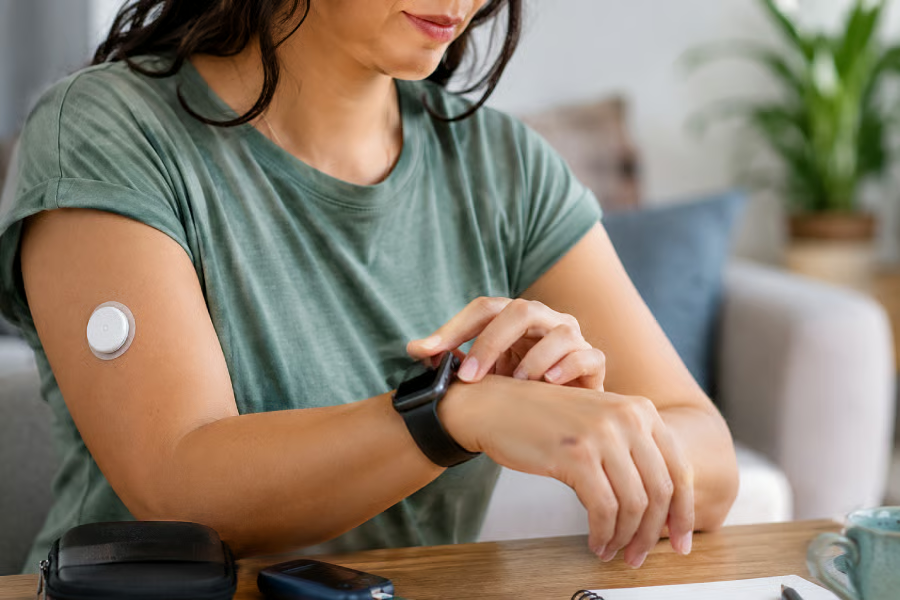
Smartwatches are getting better at spotting health patterns. Blood sugar could be one of the next big tests.
For now, the caveat matters: smartwatches cannot measure blood glucose on their own in an FDA-authorized, noninvasive way. The FDA has warned consumers not to rely on smartwatches or smart rings that claim to measure blood sugar without skin penetration, because inaccurate readings could lead to dangerous treatment decisions.
That warning does not apply to smartwatch apps connected to approved continuous glucose monitoring systems, or CGMs, that measure glucose directly. According to the FDA, these apps are different from wearables that claim to estimate blood glucose on their own.
That distinction is where the story gets interesting. The smartwatch may not replace a glucose monitor anytime soon, but AI could help wearables become better companions to approved CGMs, food logs, sleep data, workout records, and heart-rate trends.
Smartwatches may get better at explaining glucose patterns
Some CGM users can already view glucose readings on compatible wearables. Dexcom, for example, brought direct Apple Watch connectivity to its G7 CGM system in 2024, allowing users to see readings from the approved sensor without relying on an iPhone as the middleman.
That makes Apple Watch an important bridge between approved medical sensors and everyday health tracking. Apple already positions the watch around heart health, activity, sleep, and safety features, while CGM makers supply the glucose data. AI could eventually help connect those streams into more useful explanations, such as whether sleep, exercise, or meal timing appears linked to a user’s glucose patterns.
The key point for consumers is simple: Apple Watch can help surface glucose data from compatible CGMs, but it is not an FDA-authorized noninvasive blood glucose monitor on its own.
The next step is not just showing the number. It is explaining what the number means.
AI systems could help link glucose spikes and dips to sleep, exercise, stress, meal timing, and prior patterns. Instead of simply showing that blood sugar rose after lunch, a future health assistant might point out that the spike was higher than usual after poor sleep or a late workout.
That kind of pattern recognition is already part of the broader CGM value proposition. Dexcom says its Clarity software helps users and clinicians review glucose trends, patterns, and statistics over time. Abbott’s FreeStyle Libre systems similarly emphasize glucose trends and real-time data through connected apps.
AI could help predict highs and lows earlier
Researchers are already testing AI models that use CGM data to forecast near-future glucose changes. A 2024 arXiv preprint proposed a large sensor model trained on 1.6 million glucose records from patients with diabetes to improve short-term glucose prediction.
That does not mean the technology is ready to guide treatment decisions from a smartwatch. But it does show where the field may be heading.
Other research is moving in the same direction. A 2024 paper on glucose forecasting described an AI-powered system that combines glucose data with behavioral and physiological signals, including diet, medication, physical activity, sleep, and stress. A newer 2026 preprint proposed a CGM foundation model trained on more than 109,000 hours of glucose recordings.
For smartwatch users, the long-term promise is more useful alerts. Instead of warning only when glucose is already high or low, an AI-powered system could eventually detect that a user is trending toward a problem and suggest action earlier.
That distinction matters. A prediction gives users time to respond. A late alert may only confirm what is already happening.
Wearables could personalize health advice
AI may also help turn glucose tracking into more personalized lifestyle guidance.
A smartwatch already collects activity, heart rate, and sleep data. A CGM captures how the body responds to meals and daily routines. Combined, those signals could help AI identify patterns that generic wellness advice misses.
For example, the same food may affect two people differently. A workout that stabilizes one person’s glucose may not have the same effect for another. Research on wearable sensors and prediabetes detection has explored how CGM data and smartwatch motion data could be used together to classify metabolic risk, though the study was a proof-of-concept with a small group of participants.
Consumer glucose tracking is also expanding beyond traditional diabetes care. The FDA cleared Dexcom Stelo as an over-the-counter glucose biosensor for adults who do not use insulin, and Abbott has introduced Lingo as a consumer biosensor aimed at people interested in metabolic insights.
That could make smartwatch health coaching feel less like a step counter and more like a daily metabolic assistant.
Smartwatches still need medical guardrails
The risk is that consumer health tech often moves faster than medical validation.
Blood sugar data is not the same as a sleep score or an activity ring. People with diabetes may use glucose readings to make decisions about food, insulin, medication, or urgent care. The FDA specifically warns that inaccurate glucose measurements can lead people to take the wrong dose of insulin or other glucose-lowering medication, which can quickly become dangerous.
That means AI explanations and predictions need to be accurate, clearly labeled, and clinically validated before they become central to treatment decisions. Even approved CGMs have limits. The FDA’s recall and safety communications database shows why glucose devices need ongoing monitoring after they reach the market.
The FDA’s smartwatch warning is a reminder that convenience cannot replace approved glucose sensors. Watches may help display, organize, and interpret glucose data, but they should not be treated as standalone glucose monitors unless regulators authorize them for that purpose.
The near future is smarter tracking, not magic sensors
The most realistic near-term future is not a smartwatch that reads blood sugar through the wrist. It is a smartwatch that works with approved glucose sensors and uses AI to make the data easier to understand.
That could still be a major upgrade.
For users, the value may come from better predictions, clearer explanations, and more personalized coaching. For tech companies, glucose tracking could become part of a larger race to build AI health assistants that connect the dots across sleep, fitness, nutrition, and chronic disease management.
The smartwatch may not replace the glucose monitor soon. But with AI, it could become a much better translator for what the glucose data is trying to say.
Want to know which smartwatches can actually display glucose data today? Check out our guide to the best blood sugar tracking smartwatches, including Apple Watch, Samsung Galaxy Watch, Garmin, and Oura Ring, and what each one can (and can't) do.