







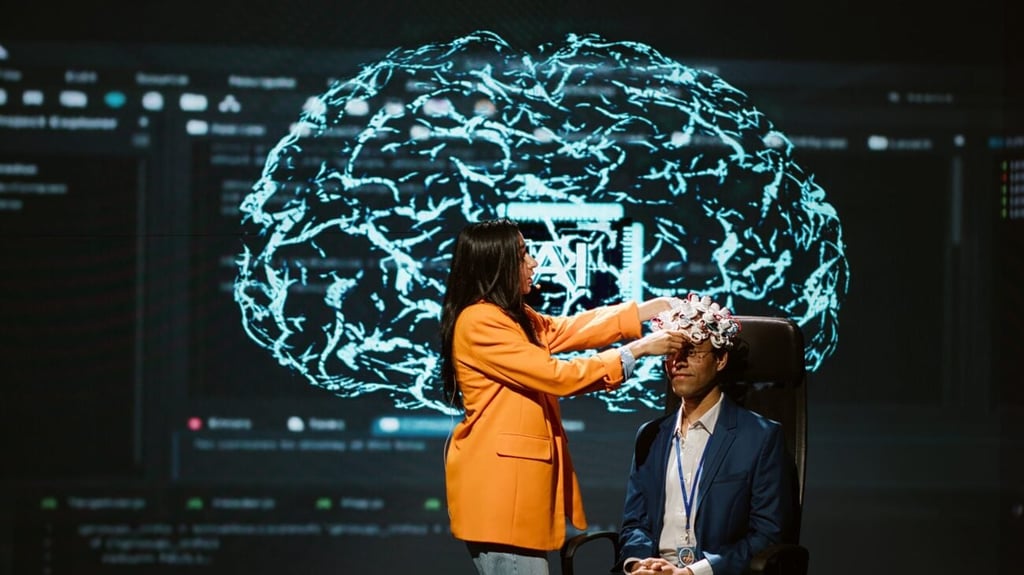
Synchron, a brain-computer interface company that recently showcased its technology at NVIDIA’s GTC conference, claims its interface can help people with paralysis and other severe physical disabilities to control hands-free technology and better interact with the world. Data collected from the real-life cases will help train “cognitive AI” designed for both medical applications and broader, general-purpose use.
Apple Vision Pro serves as an interface between brain implant and smart home
At GTC, Synchron demonstrated a seamless integration of several emerging technologies: an Apple Vision Pro, NVIDIA’s Holoscan multimodal AI sensor processing platform, and Sentrode — Synchron’s proprietary interface that connects human thoughts to the physical environment.
The system works by transferring neural signals from a stent-like brain implant to the AssistiveTouch features of the Vision Pro headset. Importantly, this implant is minimally invasive, requiring no skull surgery as it reaches the brain via the jugular vein.
“We are building a brain foundation model using generative pre-training techniques that learn directly from neural data — abstracting human cognition at its source – to create features that improve our user’s lives,” said Synchron CEO and founder Tom Hoxley in a press release. “This is possible because of our ability to scale large datasets, by making BCI as common as a stent insertion.”
During the demonstration, a user named Rodney adjusted the temperature, lights, and music in his home using the system.
In a separate development in September, Synchron announced that six study participants who had short-term use of the brain implant experienced no serious side effects related to the brain or blood vessels. These individuals — each living with arm paralysis — successfully interacted with digital interfaces through the BCI.
Chiral: A roadmap from digital interfaces to AI based on the human brain
Chiral is the long-term vision for Synchron’s technology — a future brain-computer interface system that combines real-time neural processing with advanced AI. To realize this, the company is aiming for three key milestones, in collaboration, with NVIDIA:
- Real-time neural decoding of motor functions, letting users control digital environments directly through their brain implants with minimal latency.
- Adding awareness of the real world, using NVIDIA Cosmos to map out the environment and understand realistic physics.
- The development of an AI model based on anonymized user data. This will be Chiral, a “self-improving, general-purpose” model for both medical and general use.
Synchron refers to this evolving model as “cognitive AI.” The end goal is to move “beyond intent recognition, laying the foundation for real-time intention-to-action” and to have a “full-scale foundation model of the brain.” Anyone who participates in the current Synchron brain-computer interface could be training its successor. Synchron calls this the next stage past generative AI. Still, the company acknowledges that this vision remains speculative — for now.
Meanwhile, “By combining its breakthrough BCI technology with NVIDIA AI and Omniverse, Synchron is helping to deliver new possibilities for individuals with disabilities, enabling greater independence, communication, and connection with the world,” said David Niewolny, senior director of business development at NVIDIA.