







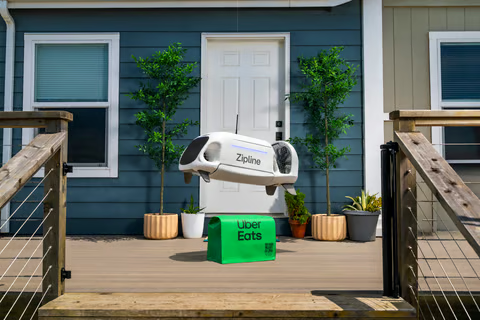
Uber wants drone delivery operating at a scale rarely seen today: 1 million orders a day. The ride-hailing and delivery company partnered with autonomous-drone operator Zipline on Aug. 17 with a goal of reaching that volume by the end of 2029.
Uber Eats plans to start Zipline deliveries in Dallas and Houston before the end of 2026, then expand into dozens of US cities. Uber is also making an undisclosed strategic investment in Zipline, tying the drone rollout to its broader push toward autonomous transportation.
The target represents a steep jump from Zipline’s current scale. Uber says Zipline has completed more than 2.7 million deliveries in total and currently makes one delivery somewhere in the world about every 20 seconds. The 2029 goal calls for nearly that cumulative volume every three days.
Inside Uber and Zipline’s drone delivery plan
Uber will put Zipline delivery inside the Eats marketplace, while Zipline operates the autonomous aircraft. Axios reported that Dallas and Houston will launch first, allowing the partnership to begin in markets where Zipline already operates.
Zipline’s Platform 2 system is designed for home delivery, with an 8-pound payload and a 10-mile service radius. The main aircraft stays overhead while a smaller delivery unit descends on a tether to place the order at its destination.
Uber says eligible orders could arrive in five to 10 minutes, although that remains a company projection because the Uber Eats service has not launched. The companies have not disclosed customer pricing or a city-by-city expansion schedule.
Uber is pursuing a similar model in autonomous ride-hailing. On Aug. 14, Uber and Pony.ai outlined plans for more than 2,000 robotaxis across additional European cities, with Pony.ai supplying the vehicles and autonomous-driving software while Uber supplies riders.
Regulation and economics remain the big tests
Drone delivery has already shown that technical capability does not guarantee workable economics. Reuters reported in July 2026 that Dexa and Kroger suspended an eight-month Ohio grocery-delivery pilot after visual-observer requirements made expansion too labor-intensive to be profitable.
The FAA introduced its proposed framework for beyond visual line of sight, or BVLOS, operations in August 2025. The Part 108 proposal would create a more standardized approval process for package delivery and other commercial drone operations and remained unfinished as of Aug. 18, 2026.
Zipline has already flown commercially without visual observers under FAA approval, so BVLOS itself is not the unresolved technical hurdle. The harder test is scaling regulatory approvals, aircraft capacity and delivery economics fast enough to support Uber’s target.
Infrastructure is another scaling issue. Singapore is testing how delivery and service robots operate in a mixed-use district, while a broader wave of embodied AI systems is moving into real-world deployments that depend on reliable physical infrastructure beyond the AI models themselves.
Uber’s 2029 figure remains a target, not a forecast. Expansion beyond Dallas and Houston, broader BVLOS approvals and evidence that drones can compete economically with couriers will determine how realistic 1 million deliveries a day becomes.
Read more: The effects of autonomous delivery may eventually extend to the workforce as well: JD.com is preparing delivery workers for robotic logistics as automation moves deeper into last-mile operations.