






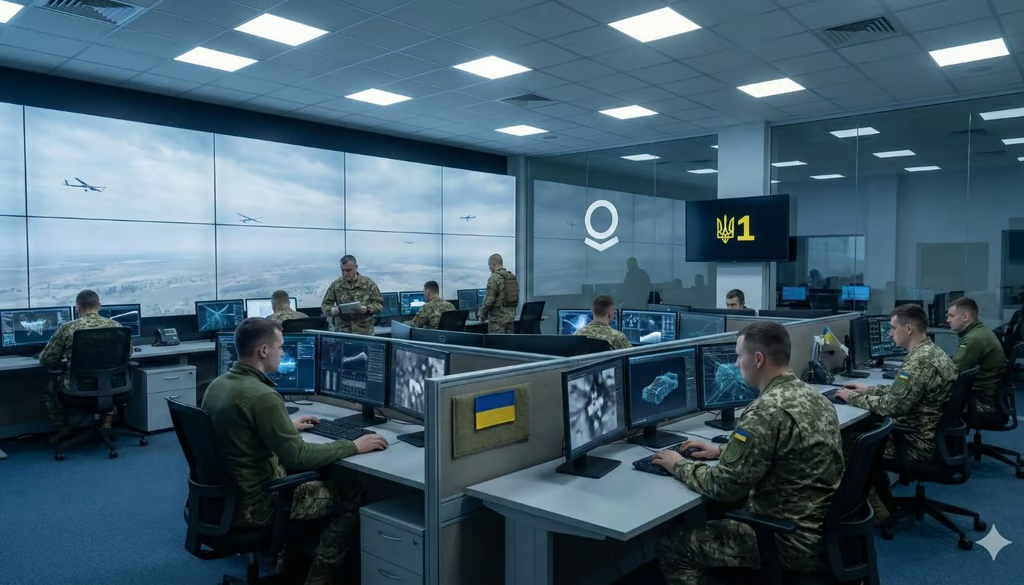


Ukraine is partnering with Palantir to turn battlefield data into AI systems designed to counter drone attacks, launching a secure new platform aimed at accelerating autonomous air defense.
The initiative places AI at the center of Ukraine’s effort to keep pace with increasingly large-scale aerial threats.
In a LinkedIn post, Ukraine’s Minister of Digital Transformation Mykhailo Fedorov said the project will give Ukrainian defense developers access to a secure AI environment built on real combat data.
Palantir’s role moves closer to the front line
The effort introduces Brave1 Dataroom, a secure digital environment set up to support the testing and training of military AI systems using operational data. The initiative involves Ukraine’s Ministry of Defense, the Armed Forces, and military research institutions, with access limited to approved Ukrainian defense developers.
Palantir is supplying the software infrastructure that underpins the Dataroom, providing a protected environment for working with sensitive data and running AI training workloads.
Fedorov described it as a step toward strengthening air defense capabilities through AI. The initiative builds on Palantir’s existing cooperation with Ukrainian government agencies, formalizing its role inside a new defense-focused AI platform.
How Brave1 Dataroom is structured
The Dataroom is set up as a secure digital workspace for developing, testing, and validating military AI systems without exposing sensitive data to unauthorized users. Access is restricted to Ukrainian defense-tech companies that pass security and compliance checks, reflecting the classified nature of the material used inside the platform.
The environment is populated with real operational data collected by Ukraine’s armed forces, including visual and thermal imagery of aerial threats such as Shahed-type drones. Rather than relying on simulations or synthetic datasets, developers can work with records drawn directly from battlefield conditions, providing a more realistic basis for training and evaluation.
Within the Dataroom, organizations can train and validate AI models across multiple stages of the counter-drone process, from detecting and classifying airborne objects to tracking and interception. Officials have said the platform is intended to support iterative development using real data, positioning it as shared infrastructure for military AI work rather than a single weapons program.
Volume as the real challenge
Ukrainian officials have consistently framed autonomy as a response to volume, not a pursuit of more advanced weaponry. Interceptor drones are already in use, but the sheer number of incoming targets is testing the limits of systems that rely heavily on human operators.
According to Defense News, Ukrainian military leaders estimate that Russia can produce more than 400 Shahed-type drones per day, with plans to scale production toward 1,000. That pace, officials have warned, is forcing a shift toward systems that can detect, track, and engage targets with less direct human input, simply to keep up.
The Dataroom serves as supporting infrastructure rather than a standalone solution. By giving Ukrainian developers a place to train and test AI models securely, the platform is intended to accelerate the shift toward greater autonomy that officials say is needed to handle sustained, large-scale drone attacks.
A foundation, not a one-off effort
Officials have said the current focus on counter-UAV autonomy is only the first use of Brave1 Dataroom, with additional military applications planned as development continues.
Access is expected to remain restricted to vetted Ukrainian developers, consistent with the government’s focus on security and domestic capability building as the platform evolves beyond its initial role.
The US Department of Defense is moving forward with Grok as part of its AI stack, despite ongoing backlash tied to the chatbot’s image generation.